


By Vanessa Mascia Turri
Naples became one of Europe’s most ambitious experiments in democratic water governance after Italy’s 2011 referendum against water privatisation. Yet bringing water back into public hands did not necessarily redistribute power over how water itself would be governed.
In 2011, after the Italian referendum against water privatisation, Naples became one of the most ambitious experiments in remunicipalised water governance in Europe. The city transformed its water utility into ABC Napoli (Acqua Bene Comune Napoli), a publicly owned entity presented not simply as a return to public management, but as an attempt to implement the “democracy of the commons” theorised by the Italian Forum of Water Movements.
Within this perspective, water was understood not only as a public service, but as a common good whose governance should involve the direct participation of citizens and social movements.
Over the following decade, Naples became a testing ground for a broader political question that has emerged across many remunicipalisation struggles: what happens when the language and practices of the commons enter public institutions? The Neapolitan experience shows that bringing water back into public hands does not automatically democratise its governance. Instead, participation became continuously negotiated and reshaped through political conflict, financial pressures and struggles over who should control public resources.
From water struggles to the democracy of the commons
Since the early 2000s, struggles against water privatisation have connected local mobilisations to broader debates around the commons. Struggles against water privatisation in Europe have often gone beyond opposition to market reforms and increasingly connected demands for public ownership with broader claims around the commons and direct democracy, as explored throughout the Reimagining, remembering and reclaiming water series. In many countries, water movements have challenged not only privatisation, but also the idea that essential services should be governed through technocratic and top-down forms of management, increasingly linking water struggles to broader claims around the commons and direct democracy, as discussed in Transforming capitalism? The role of the commons and direct democracy in struggles against water privatisation in Europe.
In Italy, these debates converged in the Italian Forum of Water Movements, one of the broadest water movements in Europe. As broader discussions around the commons in Italy have shown, these debates extended well beyond water itself and raised wider questions about collective resources, democracy and institutional change. Under the slogan “si scrive acqua, si legge democrazia” (“it is written water, it is read democracy”), the movement argued that remunicipalisation should involve not only public ownership, but also direct civic participation in water governance.
Naples became the most ambitious attempt to translate this political vision into institutional practice.
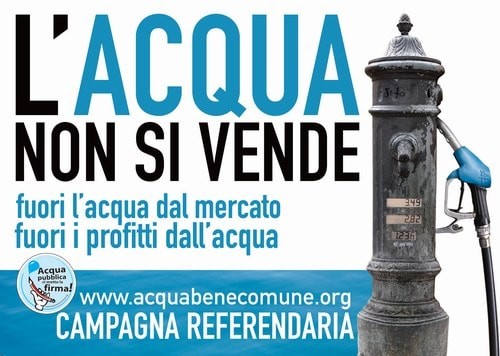
Poster from the 2011 Italian referendum campaign against water privatization reading “Water is not for sale.” Image courtesy of the Forum Italiano dei Movimenti per l’Acqua.
Naples became the most ambitious attempt to translate this political vision into institutional practice.
Yet public and academic debates on remunicipalisation have often focused on privatisation conflicts and legal transitions, paying far less attention to what happens afterwards. How are participatory mechanisms actually organised inside remunicipalised utilities? How much power are institutions willing to share with social movements and citizens once remunicipalisation has taken place?
My article From theory to practice: evaluating civic participation in Naples’ remunicipalised water service examines these questions through the case of ABC Napoli, reconstructing how participation was progressively organised, contested and reshaped during the decade following remunicipalisation.
Participation and the limits of the commons
At the moment of remunicipalisation, Naples faced deteriorated infrastructures, chronic underinvestment and a massive municipal public debt. For many activists of the Neapolitan water movement, remunicipalisation was therefore not only about public ownership, but also about transforming the priorities of water governance through ecological restoration, infrastructural investment and more equitable access to water.
Over the following decade, ABC Napoli experimented with different forms of civic participation. Initially, the municipal government opened the board of directors to representatives linked to the Italian Forum of Water Movements and to environmental associations. Yet local activists who had led the mobilisation against privatisation were largely excluded from these arrangements, generating immediate tensions over who had the legitimacy to participate in the governance of the utility.
The most ambitious participatory experiment emerged with the creation of the Civic Council, a public assembly open to citizens, activists and ABC workers. Meetings were held directly inside the company and addressed issues such as tariffs, infrastructure maintenance, hiring policies and investment priorities. Delegates from the assemblies also participated in discussions with the board of directors, creating one of the most advanced attempts in Europe to institutionalise direct civic participation inside a remunicipalised water utility.
However, participation became far more conflictual once these assemblies started intervening in concrete political and economic questions. Members of the Civic Council promoted long-term infrastructural investments and the recruitment of specialised personnel while defending the financial stability of the utility. According to several interviewees, these priorities increasingly clashed with those of the municipal government, which was more focused on short-term employment policies and the management of public-sector jobs within a broader context marked by debt, unemployment and political pressures surrounding public employment.
These tensions ultimately led to the removal of the board of directors and to the progressive weakening of participatory governance. In the following years, participation increasingly shifted towards weak consultative mechanisms with limited influence over decision-making processes. Many activists gradually distanced themselves from the experiment, while severe financial constraints continued to limit investments in infrastructures and ecological renewal.
Rather than evolving towards deeper forms of democratic governance, the Neapolitan experience progressively revealed the difficulties of institutionalising the “democracy of the commons” within existing municipal structures and political priorities.
Remunicipalisation without democratisation?
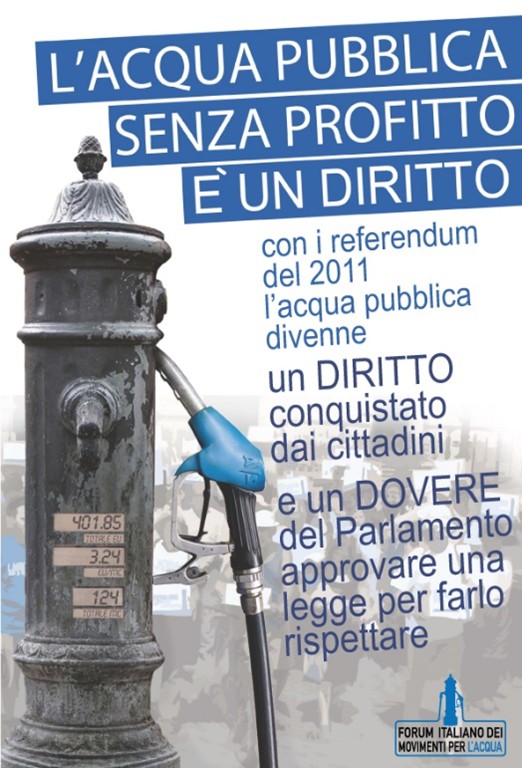
Poster from the Italian public water movement following the 2011 referendum campaign, emphasising water as a public right rather than a source of profit. Image courtesy of the Forum Italiano dei Movimenti per l’Acqua.
The experience of ABC Napoli complicates many celebratory narratives surrounding remunicipalisation. Bringing water back into public hands did not automatically redistribute power inside public governance. On the contrary, the Neapolitan case shows how quickly the language of the commons can become absorbed into existing institutional structures once participation starts challenging concrete political and economic interests.
The weakening of participatory governance inside ABC Napoli did not result from a lack of civic mobilisation or technical expertise. Quite the opposite: activists involved in the water movement developed increasingly detailed proposals on tariffs, infrastructures and long-term investments, becoming capable of intervening directly in the governance of the utility. Participation became problematic precisely when it stopped being symbolic and started questioning how public resources, infrastructures and employment should be managed.
In Naples, these tensions unfolded within a broader context marked by public debt, deteriorated infrastructures, unemployment and long-standing systems of political mediation surrounding public-sector employment. Under these conditions, the “democracy of the commons” increasingly collided with the political and administrative logics shaping municipal governance.
More broadly, the Neapolitan experience suggests that remunicipalisation alone cannot democratise essential services without a real willingness from public institutions to share decision-making power. Commons become politically difficult when they move beyond participation as consultation and start demanding participation as co-governance.
Rather than offering a linear model of democratic transformation, Naples reveals the unresolved tensions that emerge when social movements attempt to institutionalise the commons inside existing state structures. The question, then, is not simply whether remunicipalisation is possible, but whether public institutions are truly willing to democratise the power through which public resources are governed.
—
Featured image: Protest sign reading “Public water, public management. Clear?” during a demonstration of the Italian water movement. Photo courtesy of the Forum Italiano dei Movimenti per l’Acqua (acquabenecomune.org).