
by Francesco Lauria
“Listening to the Sound of Change”: A Conversation with LOTTA and Aluisi Tosolini on politics, activism and the legacy of Genoa 2001.
One conversation, three generations of activists
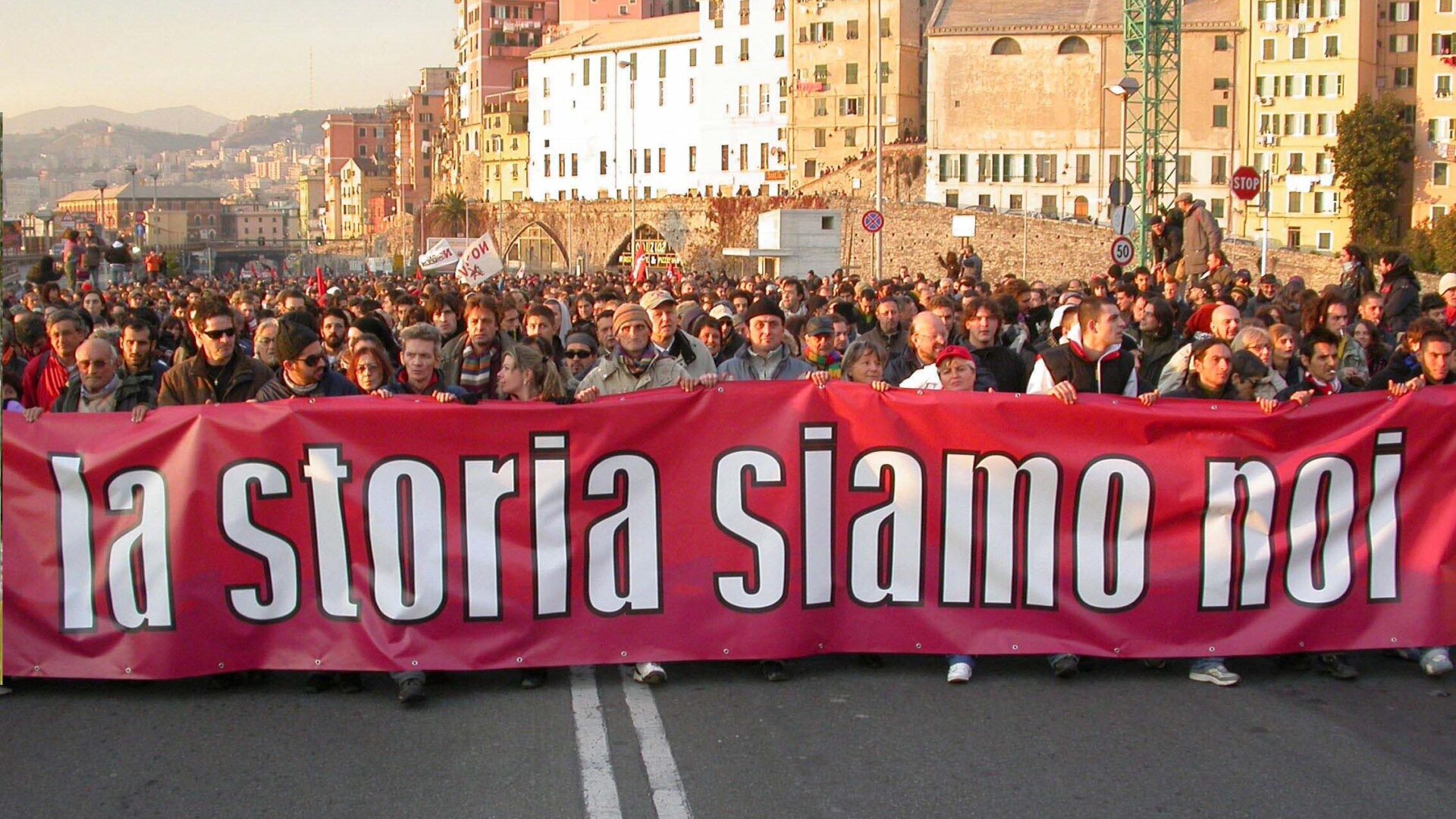
Twenty-five years after the G8 Summit in Genoa, the founder of Slow Food, Carlo Petrini, wrote in a posthumously published article, quoting political scientist and activist Susan George, that the vast majority of those who took to the streets in Genoa represented:
“the first mass movement in history that demanded nothing for itself; it sought only justice for the whole world.”
Yet beyond the rhetoric of anniversaries and the nostalgia of those who were there, what remains today of that extraordinary mass movement, so brutally crushed by those in power? What does Genoa mean to those who lived through those days? And what does it represent for those who are now committed to fighting climate change and stubbornly working to build a fairer world—people who, in 2001, had not even been born?
To explore these questions, we spoke with LOTTA, born in 2002, a young vegan and queer artist and activist, and Aluisi Tosolini, born in 1959, philosopher of education and National Coordinator of the Schools for Peace network.
The conversation is edited and conducted by Francesco Lauria, born in 1979, activist journalist and eyewitness to the events of the 2001 G8 Summit in Genoa.
Three generations. One conversation.
Biographies in a world on fire: LOTTA
Lauria: “I realised that perhaps making music no longer made sense in a world on fire… Then I came to understand that music itself could become the sound of change.”
LOTTA, who are you? And how did you find yourself, just a few months ago, in Santa Marta, Colombia, taking part in the Fossil Fuel Treaty Summit?
LOTTA: I spent seven years of my life immersed in classical music, first at music high school and then at the conservatoire. I was captivated by its grandeur, its beauty, and by everything performing it gave me.
The double bass—my principal instrument—also allowed me to travel as far as China. I was sixteen years old, and ever since then a common thread has run through my life: the desire to keep travelling, singing, and carrying with me—and within me—the beauty of classical music.
Before choosing the name LOTTA, I had actually wanted to call myself Traviata. My ambition was to help preserve this extraordinary cultural heritage, because classical music is unlike a painting hanging in a museum: the moment people stop performing it, it simply ceases to exist.
I moved from the province of Parma to Milan, and something inside me broke.
In Parma I had been one of only a handful of young double bass players. At the Milan Conservatoire I suddenly found myself surrounded by many equally talented musicians, where competition was far more intense—at times, downright ruthless.
There was one particular moment when a place became available in an orchestra. I caught myself hoping that one of my closest friends would make a mistake—that her bow would slip, that she would play out of tune—because, like everyone else, I desperately wanted that opportunity.
I left the conservatoire that day and, on my way home, found myself thinking:
“If this is who I am at twenty, who will I become by the time I’m forty?”
I could no longer find any real meaning in the path I was following.
I spent my days rehearsing crumpled scores in ensemble sessions where every break seemed to be devoted to spotting someone else’s mistakes.
That was the moment I realised it was no longer my world—no longer the place where I belonged.
I joined a Legambiente community garden in Milan, where one day I noticed a poster about Fridays for Future.
A few years later, at one of the most difficult moments in my life, Fridays for Future organised a demonstration outside La Scala Opera House—the very place that symbolised everything I had dreamed of becoming.
That was my first experience of joining a protest. I found myself surrounded by young people with megaphones, raising their voices and demanding justice: justice for a fairer future—or rather, for a present free from war and committed to a genuine ecological transition.
I began educating myself, and what I discovered was overwhelming.
By 2022, the climate crisis had entered my life completely. There was no longer room for anything else. I wanted to give up music. I wanted to leave everything behind, because music itself had become a distraction from the planetary upheaval humanity was unleashing.
What sense did it make to spend eight hours a day practising the double bass while the world was burning?
So I travelled to Strasbourg to join a mobilisation calling on the European Union not to classify gas and nuclear energy as sustainable investments under the EU Taxonomy.
Outside the European Parliament, I took part in my first act of civil disobedience.
Activism was already part of my family’s history. My father had been involved in the Autonomia Operaia movement during the 1970s.
That day we were shouting our demands outside the Parliament. I was part of a group of kayakers on the River Rhine. Our role was to act as a diversion, slowing down the police so that the rest of the demonstration could continue.
Within moments, two police boats arrived and intercepted us. As they escorted us away, the only thing that came into my mind was to sing. And then something happened that changed my life. The police officer steering the boat began whistling Bella Ciao along with me.
It may sound unbelievable, but in that moment I felt something profoundly human, despite the very radical views I held about the police. For those few minutes, we were no longer an activist and a police officer. We were simply two human beings singing together on a river on a beautiful day.
In the end, they let us go.
Perhaps it wasn’t only because of the music, but something had shifted. Something different had emerged. I returned to the demonstration singing and dancing outside the European Parliament, convinced that if people had been warning about climate and ecological collapse since the 1970s, yet emissions were still rising and governments, corporations and societies had still failed to change course, then perhaps what needed to change was not only politics, but also the way we communicate.
Art—and music above all—could become the breakthrough capable of lowering people’s defences and allowing them truly to hear the message.
I wrote a performance entitled Detonation, in which I tell the story of how a classical double bassist became a climate activist outside the European Parliament.
I began performing it in public squares across Europe—in Paris, Berlin, Prague and Vienna—overcoming my fears and carrying nothing but my double bass, an amplifier and my voice.
When I returned to Italy, organisations including Fridays for Future, Extinction Rebellion, Ultima Generazione, Greenpeace and Legambiente began inviting me to perform and supporting my work.
What had started as a personal passion gradually became my profession.
Had that moment in Strasbourg never happened—had I not begun singing that day—I would almost certainly have abandoned music altogether.
I would have abandoned the person I was and everything that made me happy in order to become someone else. I owe an enormous amount to that single moment.
In these times of eco-anxiety, fear, and political and economic collapse, music gives me hope. It is the raft I cling to as I try to navigate the catastrophe we are already living through.
I come from Emilia-Romagna, a region where climate collapse is no longer an abstract concept but something we experience first-hand: devastating floods on one side, relentless heatwaves on the other.
Without music, everything would be infinitely harder.
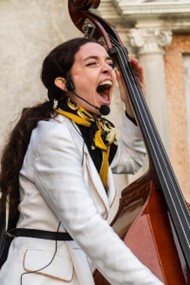
LOTTA’s concert in Venice (source: Mirandola.net)
Biographies in a world on fire: Aluisi Tosolini
Lauria: From Strasbourg, let’s move to Tricesimo, in the province of Udine, and briefly retrace the journey of Aluisi Tosolini—a nationally recognised expert on intercultural education, adult learning and religious dialogue.
You were also the headteacher of LOTTA’s school, so your paths crossed long before today’s conversation.
For those readers who may not know you, tell us about your own story.
Tosolini: In this conversation I suppose I speak as a grandfather—simply as an older man. Whether that also makes me a wiser one is another matter.
Looking back at my own journey, there are only a few key moments that truly shaped me.
The first takes me back to Padua, to the years of Autonomia Operaia, which LOTTA mentioned when speaking about her father.
The soundtrack of those days was Area and their song Gioia e Rivoluzione.
It was 1976–77. I was studying in Venice and, for health reasons, I often travelled to Padua.
Like many young people of my generation, I was fascinated by that political and cultural ferment.
During that period I bought a small book that I still treasure today: Dominio e sabotaggio (Domination and Sabotage) by Toni Negri.
It was a text on the Marxist method of social transformation, written during one of the most dramatic, polarised and violent periods in the history of the Italian Republic.
The following year, again because of my studies, I moved to the province of Como. There I experienced one of the defining moments of modern Italian history: the kidnapping and murder of Aldo Moro.
Those were also the years marked by the neo-fascist massacres. I vividly remember the bombing of Bologna railway station, and before that the Italicus Express, Piazza della Loggia, and Peteano. That was the atmosphere in which my political and personal consciousness took shape.
I arrived in Parma towards the end of 1978, having begun my studies at the city’s Faculty of Theology. Shortly afterwards I became involved with the magazine Missione Oggi, under the guidance of Father Eugenio Melandri, whose work there eventually led him to serve as a Member of the European Parliament for Democrazia Proletaria between 1989 and 1994.
So my journey began before I was twenty, with Toni Negri. I witnessed the years of the Red Brigades from the sidelines, before eventually embracing the path of non-violence.
The first book I co-authored, together with the late Gianni Calligaris and published by EMI (Edizioni Missionarie Italiane), was entitled Boycott South Africa: Italian Banks and Beyond.
It reflected our commitment to the international campaign urging a boycott of the banks and companies that continued to operate in South Africa, thereby helping to sustain the apartheid regime. Those events may seem distant today, yet they profoundly shaped my life.
I then began my career as a teacher until, in 2001—almost simultaneously with the events of the Genoa G8 and shortly after the sudden and devastating death of my father—I became a headteacher.
As headteacher in Fornovo, near Parma, one of the first initiatives that brought our school to national attention was the campaign organised by the primary school in Riccò against the war in Iraq.
Many people were scandalised. They believed that schools—especially primary schools—should have nothing to do with such issues. I have never accepted that view.
Even before then I had served on the Ministry of Education’s first national commission on intercultural education, a field to which I have dedicated much of my professional life.
Throughout my years as a school leader, I tried to build educational communities capable of giving practical expression to Article 3 of the Italian Constitution—removing the obstacles that prevent people from achieving full equality and participation.
That was also the spirit in which, during my career, I encountered the very young Carlotta, whom everyone now knows as LOTTA.
Today, having recently retired, I continue that commitment as a philosopher of education and trainer with the social cooperative Casco Learning.
Extinction Rebellion – and Beyond
Lauria: LOTTA, today you are part of Extinction Rebellion. Wherever you travel, you often tell us that there is always a network of fellow activists waiting to welcome you.
How is this global movement organised? Who are you collectively? And who do you work alongside?
LOTTA: Extinction Rebellion is home. Wherever I travel in the world, I know that I will find a community ready to support me.
When I arrived in Brazil for COP30, for example, I met activists from Extinction Rebellion Venezuela. We looked at each other for barely a second, yet we already understood why we were there and what we were fighting for together. We immediately recognised ourselves as part of the same global movement.
That means I can travel almost anywhere in the world and still feel at home—because I know I will meet people who do not look at me with suspicion, but who understand the work I am doing where I come from, just as I understand theirs.
Extinction Rebellion emerged shortly after Fridays for Future, towards the end of 2018, during the wave of global climate mobilisation inspired by Greta Thunberg.
What was needed at that moment was a shared organisational structure—a common voice capable of bringing people together.
From there, the movement spread across almost every continent. Today we also have groups throughout Africa and Oceania. The scale that XR has achieved is genuinely extraordinary. One of the reasons may sound simple, but it is fundamental: every local group is autonomous.
There are ten shared principles that everyone agrees to uphold, ensuring a common vision while preserving a deeply horizontal structure. There is no leader—and there never will be—to whom anyone must ask permission before taking action. I have never placed much faith in labels or banners.
I am part of Extinction Rebellion, but I also work alongside Fridays for Future, Greenpeace, and many other organisations. What matters most to me is feeling part of a broad, intersectional global mobilisation.
The struggle for climate justice is inseparable from the fight against neocolonialism, against capitalism, from the transfeminist movement, and from the struggle for animal rights.
For me, Extinction Rebellion has been a remarkable school of democracy.
Just look at how we organise ourselves in Italy: how responsibilities circulate, how power is exercised within the movement, and how no one ever holds the same mandate for more than six months.
Another essential aspect is the sharing of knowledge. Since 2019 we have built an online collaborative database where activists collectively develop strategies, exchange experiences and create alternatives outside the mainstream narratives dominated by multinational corporations.
Let me give you an example. If XR Rome is organising a mobilisation around a particular issue, it can immediately draw on the collective intelligence stored in those databases. Activists can see how a similar action unfolded in Boston, learn from the experience of XR London, ask for advice, and adapt successful ideas to their own context.
That shared knowledge is one of our greatest strengths. Our movement is built upon solid foundations. Among our core principles are regenerative culture, consensus-based decision-making, and active listening.
During the winter months we focus on education and training. Spring is devoted to planning actions and campaigns. By the end of April, mobilisation begins. Summer, however, is different.
It is a time to take care of ourselves, to practise regenerative culture, to listen to one another and reflect on how we are feeling, and on the direction we want our movement to take.
Then training begins again—including legal workshops, so that everyone understands their rights when taking part in acts of civil disobedience. We try to move in rhythm with nature. For us, listening and caring are just as important as taking action.
We also study nonviolent communication, because when you are engaged in direct action you need to know how to prevent situations from escalating.
Whenever we take action, each of us is paired with a buddy—someone whose sole responsibility is to look after us throughout the demonstration. If at any moment you need support, reassurance or simply someone to listen, you know that person will be there.
Different movements adopt different methods, and I believe that is absolutely right. There is no single path to change.
Extinction Rebellion is also a movement deeply rooted in art. Every action is conceived almost like a performance, designed to engage people rather than simply confront them.
I think of the Red Rebels, silently processing through the streets as a global symbol of all those who have lost their lives because of climate collapse, of forests destroyed, and of ecosystems brought to ruin.
Or I think of The Big One in London, when we brought a giant pink boat into the city centre and occupied the streets for days with music, dancing and marches. Scientists came into the squares to speak directly with hundreds of people gathered around them.
There is something immensely powerful about transforming scientific data into art—allowing it to reach people in a way that is immediate, emotional and impossible to ignore.
“I apologise for telling you about the G8 in Genoa…”
Lauria: In his recent book I Apologise for Speaking to You About the G8 in Genoa, Lorenzo Guadagnucci writes:
“A quarter of a century after the events of July 2001, we find ourselves living in a world that is, in many respects, even worse than the one we hoped to change: more unjust, more insecure, and gripped by an existential crisis so profound that even the very idea of the future is under threat. It is literally a world on fire—because of an overheating climate that has spun out of control, and because war has once again become the principal means through which international disputes are addressed, without resolving them and, in fact, making them worse. All of this is taking place amid a moral, civic and political decline with few precedents in modern history—or at least in the history of the Western world.”
What memories—or perhaps what idea—do each of you have of the days of Genoa 2001?
If, back then, we believed that another world was both possible and necessary, only to be met with a wave of national and international repression that sought—partly successfully—to crush the movement, where do we stand today?
Looking back twenty-five years later, what similarities and differences do you see between that moment and the world we inhabit now? Especially considering that, LOTTA, you had not yet been born.
Tosolini: Let me answer through music. I don’t know what LOTTA thinks of Marracash, but there is one song of his that I find extraordinarily powerful: Gli sbandati hanno perso— The Outcasts Have Lost.
In many ways, it has become the anthem of my generation. That does not mean internalising defeat. It means recognising, soberly and realistically, that the world we imagined—and demanded—in Genoa has indeed come into being, but in reverse.
Earlier, LOTTA spoke about colonialism and decolonisation. Today we are living through a process of recolonisation that is unfolding with extraordinary brutality.
What some commentators have called the Borgian logic has returned: the belief that if you possess enough power, you are entitled to do whatever you want, unconstrained by laws, rules or the rights of others.
Power can take many forms. It may lie in military force. It may lie in wealth. Today it also lies in what has been called computational power—the capacity to dominate through artificial intelligence, algorithms and digital infrastructures.
If you have enough money—if you are someone like Peter Thiel—you can shape political outcomes, help determine who becomes Vice-President of the United States, impose your worldview on others, and ultimately colonise not only territories but people’s minds and everyday lives.
That is the reality I see today. Like Marracash, I acknowledge that the outcasts have lost. Yet I also remain convinced that, whether or not another world still seems possible, it is unquestionably necessary.
The world we are building resembles a Tyrannosaurus rex: a civilisation moving inexorably towards extinction. LOTTA has already described this very clearly from the perspective of the climate crisis.
But climate collapse is only part of the picture. There is another issue that has shaped my own commitment to non-violence throughout my life: war.
Even today, twenty-five years after Genoa, I continue to coordinate the Italian Schools for Peace network. And yet war—any war—has once again become thinkable. More than that, it has become normalised. There is scarcely any genuine public debate about it.
The assumption now seems to be that a colonising power has every right to wage war in pursuit of its interests. If you refuse to comply, you are simply shot. The real question, then, is this: How do we resist that logic? How do we change the way we see the world?
That, I believe, is one of the defining political challenges of our time.
LOTTA: I wasn’t yet born when the events of Genoa took place. And yet, within today’s movements, Genoa is constantly present.
It is a warning. A shared memory. A point of reference that continues to shape the way many of us think and act.
Within my own activist community, people of every generation are represented. I don’t believe change can—or should—be carried forward by young people alone. Not only have we inherited a broken world, but we now seem to be expected to repair it by ourselves.
That is neither fair nor possible. We need alliances across generations.
I’d like to draw a comparison with a much more recent event—not because it can in any way be equated with the killing of Carlo Giuliani or the violence at the Diaz School, but because, as both a woman and an activist, it evokes the same dark sense of intimidation.
I’m referring to what happened recently in Bologna and Brescia, where several Extinction Rebellion activists were taken to police headquarters. Some of the young women were ordered to strip completely naked and remain unclothed in front of a police officer.
It was a blatant act of intimidation. These procedures are normally reserved for situations in which there are serious grounds to believe that someone is concealing drugs or weapons.
Then there is Italy’s new Security Decree, with its provision for preventive detention. People who have committed no offence can now be stopped simply because the authorities believe they might take part in a protest.
We are reaching levels of authoritarianism where dissent itself is becoming increasingly intolerable. And if we look beyond our own national context, the situation is, in many places, even more alarming.
When I travelled to Brazil for COP30, I met an Indigenous woman leader from the Acara Valley, in the Amazon region. She had been kidnapped and held captive in Rio de Janeiro for two months.
The message could not have been clearer:
“If you continue fighting the multinational corporation that is destroying your land—if you continue opposing the aluminium project that has stolen Indigenous territories and devastated the rivers your community depends upon—you will be killed.”
As pollution contaminates the rivers, Indigenous communities lose the ability to survive from their own lands. They are forced into dependence on the very capitalist industries and supermarket systems that have destroyed their way of life.
We are witnessing not only the destruction of ecosystems, but also the destruction of Indigenous cultures, as they are pushed towards a Western model imposed through violence and exploitation.
At the same time, we tolerate the persecution and imprisonment of those who defend their people’s rights. I met this extraordinary woman, who continues her struggle despite the fact that she cannot leave her territory without an armed escort.
When she shook my hand, she said something I will never forget: “We are fighting the same battle.” Those words have stayed with me ever since.
Human beings are social creatures. Yet the individualism dominating our societies today is slowly destroying us.
That Indigenous leader gave me all the strength I need to continue every struggle, every act of resistance, for the next sixty years of my life. Personally, I need nothing more than that.
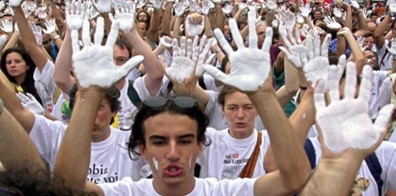
Genoa, July 2001, Nonviolent demonstration (source: Francesco Lauria)
“Society does not Exist”?
Lauria: In 1987—the same year the G7 Summit was held in Venice, where it was peacefully challenged by Democrazia Proletaria under the leadership of Mario Capanna—British Prime Minister Margaret Thatcher famously declared:
“There is no such thing as society. There are individual men and women…”
What should our collective political priorities be today? What do climate justice and social justice mean to you?
Returning to the discussions in Santa Marta, how should we organise a just transition, beginning with work itself? And what role is the large-scale development of artificial intelligence likely to play—from an ecological perspective as well?
LOTTA: The ecological transition has the potential to create an enormous number of jobs. But for that to happen, the transition has to be genuine.
It means investing in people’s skills, supporting workers through change rather than abandoning them, and recognising that the transformation ahead is unavoidable. The climate crisis is also a water crisis, an energy crisis, an economic crisis and, ultimately, a democratic crisis.
One of the most inspiring examples I know is the former GKN factory collective in Florence.
Instead of accepting the closure of their factory, the workers proposed occupying and transforming it—shifting production away from the automotive industry towards solar panels and cargo bikes. It is an extraordinary project, conceived from the ground up and supported through popular shareholding.
Across Europe people speak about it far more than we do in Italy. It is exactly the kind of initiative that politics should have embraced. Instead, our political institutions often stand by—whether passively or actively—as industrial production is redirected towards military purposes.
Another crucial challenge is energy security. Recent events have shown just how vulnerable our economies remain, with global energy supplies capable of being disrupted by only a few kilometers of sea in the Strait of Hormuz.
If we genuinely want resilience, we must invest seriously in renewable energy—above all in solar and wind power. I’m not an engineer or an energy expert. I’m a musician. My role is to collect stories and tell them.
But the scientists are clear: this transition is both technically possible and urgently necessary.
Tosolini: When we speak about artificial intelligence—the great frontier of our age—I would begin with three books. The first might seem, at first glance, unrelated, yet it is fundamental.
It is In the Abyss: From Zionism to Genocide – Israel’s Moral Collapse, by Omer Bartov.
It is an extremely difficult book, but one that helps us understand how artificial intelligence is increasingly being used as an instrument of war—capable of determining, within seconds, who lives and who dies. As a military technology, artificial intelligence has radically transformed the very nature of warfare.
The second book is The Ethics of Artificial Intelligence in Defence, by Mariarosaria Taddeo, one of the world’s leading scholars in this field.
She reflects on the traditional concept of the just war through the lens of artificial intelligence and modern deterrence. Once again, we find ourselves confronting what I would call the new logic of domination: computational power.
Only a few days ago I wrote a review of Paolo Benanti’s latest book, The New Logic of Domination: Computational Power, Democracy and the Human Condition.
Benanti begins with a short but extraordinarily important text by Gilles Deleuze, Postscript on the Societies of Control. That essay—which also includes a dialogue between Deleuze and Toni Negri—puts forward a striking argument: machines are never merely tools.
They are the material expression of the way power is organised within a society. Every historical model of society produces its own characteristic technologies. There were simple mechanical machines. Then came machines powered by energy. Today we live under the rule of computational machines.
Control is no longer exercised primarily through imprisonment, discipline or explicit command. Instead, it operates through algorithms, data, prediction and continuous modulation. Whoever controls computational power increasingly controls reality itself.
Today there are even serious discussions about the possibility of altering people’s memories through advances in cognitive science—changing the data from which memories are reconstructed and, in doing so, reshaping the past itself.
One day, something similar could even happen with the collective memory of Genoa. There are those who speak today of algocracy, others of algor-ethics.
Personally, I believe that some of the most interesting reflections on these issues have come not only through academic debate but also from Pope Leo XIV, particularly in his encyclical Magnifica Humanitas. At the heart of his message lies a simple but fundamental principle: humanity must remain at the centre of artificial intelligence.
Just think of the contrast between China and the United States. Europe finds itself caught between two competing models. In China, artificial intelligence has become socially accepted as an instrument of pervasive state control. Virtually every aspect of people’s lives—and, increasingly, even their aspirations—is subject to surveillance.
In the United States, by contrast, the prevailing assumption is that artificial intelligence should remain almost entirely free from regulation. Any form of regulation is seen as an obstacle to innovation and economic growth, except where military security is concerned.
Within education, however, we are beginning to discuss something different: what would it mean to develop a genuinely human-centred artificial intelligence? Are these merely comforting words? Or is this precisely where the real political challenge lies?
I believe it is. The challenge before us is not simply to draft laws that say yes or no to artificial intelligence. It is to build democratic pathways that make computational resources genuinely accessible to everyone. These technologies must serve human beings—not the other way round.
They must be decolonised. And they must be democratised.
Resisting Repression, Educating for Peace
Lauria: LOTTA, does that make you an “eco-vandal” deserving five years in prison? How can art capture the attention of people who prefer to look away?
And you, Aluisi—did you end up educating a troublemaker? As a teacher and headteacher, what does educating for peace mean in a time of war?
LOTTA: One of the most meaningful moments for me took place in Venice, during the ACLI National Conference on the Ecological Transition. That was where you and I first met, Francesco.
Ironically, the previous two times I had been in Venice I had spent hours inside a police station. The first occasion was almost surreal. The police didn’t just detain me. They detained my double bass as well. We had been demonstrating on the Rialto Bridge to draw attention to the failures of COP28.
The second time was during the heavily securitised celebrations surrounding Jeff Bezos’s wedding. On that occasion, all it took was holding up a placard in St Mark’s Square for ten seconds before we were seized, dragged away and locked inside a room at the police headquarters.
Returning to Venice under completely different circumstances—inside the magnificent Scuola Grande di San Rocco, surrounded by Tintoretto’s extraordinary paintings—felt almost symbolic. It was wonderful to move from repression to dialogue.
The real issue is this: if I perform as a busker with my hat on the ground without the required permit to occupy public space, at worst I am asked to move elsewhere.
But the moment I unfold a banner carrying a political message, everything changes. That is when repression begins.
The Minister Matteo Salvini, together with Venice’s then mayor Luigi Brugnaro, even called for climate activists like us to face prison sentences of up to five years. Yet despite all of this, expressing dissent through music—and through art more broadly—remains profoundly important.
To connect more deeply with people and encourage genuine listening, I try to work across different musical styles. When I visit schools, I often use rap and pop music.
When I perform in public squares, I tend to move towards folk music and the great tradition of the Italian singer-songwriters. I want to speak to every generation.
The same was true of my performance, Detonation, which I have taken into theatres as well as onto the streets. I deliberately begin with songs that are familiar and accessible, drawing people in before gradually introducing the political message at the heart of the performance.
Tosolini: Carlotta’s—LOTTA’s—personal journey, having known her first as a very young student, perfectly illustrates what a school can achieve when it genuinely opens people’s minds.
There are many aspects of her thinking that resonate with my own. At the same time, however, the very same principle should apply to those who have arrived at completely different conclusions.
What matters is the willingness to engage seriously with one’s ideas, to study, to question, and to understand that standing by one’s convictions may also involve paying a personal price.
A school should help people reject indifference. To me, education is never about indoctrination. It is about creating the conditions in which young people can grow into citizens capable of assuming responsibility for themselves and for others.
That, in itself, is already an education for peace.
Is Another World still Possible?
Lauria: Another world is possible. The slogan that appeared on banners, posters, church walls and flags during the Genoa G8 was never merely a slogan. It expressed a much broader political vision.
Again drawing on Lorenzo Guadagnucci’s reflections, let me mention just a few of the issues that animated that movement—many of which have since been pushed to the margins of institutional politics: neoliberalism and social movements; degrowth and alternative models of development; financial capitalism and fair trade; torture and police violence.
And then debt cancellation, access to medicines—something whose importance became tragically clear during the Covid pandemic—small-scale farming, participatory democracy, and the role of what were then still new media in activism and social mobilisation.
Looking beyond nostalgia, what do you believe remains today of that vast and diverse movement?
Tosolini: Every one of those issues remains strikingly relevant. Some may have changed name over the years, but none has lost its importance. If there is one genuinely new challenge that has emerged since then, it is artificial intelligence.
Among all the themes you have mentioned, however, the one I would emphasise is participatory democracy. Indeed, I would go further. Today the issue is simply democracy itself.
LOTTA: I believe that two of the most urgent issues today are neocolonialism and growing inequality. Neocolonialism is everywhere, and it is a responsibility that concerns us directly. I think, for example, of Eni’s activities across the African continent, in countries such as Mozambique and the Republic of the Congo.
There, the extraction of gas and oil has not brought development. Instead, it has fuelled instability and deepened social conflict.
In Mozambique, in the province of Cabo Delgado, the race to exploit natural gas has devastated local economies traditionally based on fishing and agriculture. It has intensified a bloody civil conflict and led to the militarisation of entire territories in order to protect extraction sites, while local communities remain excluded from any share of the wealth being generated.
In the Republic of the Congo, pollution and decades of gas flaring continue to poison both the air and the land. Even where Eni presents itself as a champion of the ecological transition—as in Kenya, through the cultivation of castor oil for biofuels—local communities warn of land grabbing and growing threats to food security in regions that are already highly vulnerable.
It is a deeply disturbing paradox.
We continue to finance and protect an economic system that destabilises the countries from which migration originates, devastates ecosystems and prevents local economies from developing independently, making them increasingly dependent on multinational corporations.
And then we complain about migrants and refugees arriving on our shores. Eni is perhaps the clearest example of this contradiction. It is a company that is around one-third owned by the Italian State—and therefore indirectly financed by all of us through our taxes.
Historically, it is also one of the fifty-seven entities responsible for the overwhelming majority of global carbon emissions. Despite extensive advertising campaigns promoting its commitment to the ecological transition, the proportion of its investments genuinely devoted to renewable energy and green technologies remains extremely limited—well below twenty per cent of its overall budget.
The core of its business continues to depend on fossil fuels. We cannot point the finger at the world’s biggest polluters unless we are first prepared to examine what we ourselves continue to finance at home.
Feminism, Emotional Education and Patriarchy
Lauria: We have spoken about fossil fuels, but we could just as easily have been talking about weapons or meat. LOTTA, how has your activism changed you at a personal level? What role does feminism play in your life? What does it mean, for you, to describe yourself as vegan and queer?
And, Aluisi, what role can education play in fostering emotional intelligence in a world that remains deeply patriarchal and authoritarian?
LOTTA: The interconnectedness of inequalities inevitably mirrors the interconnectedness of discrimination. That is why today we cannot speak only about solidarity between generations; we must also speak about solidarity between genders. How do we build alliances that do not erase our differences, but instead learn to live with them?
My activism did not begin on the front line against the biggest polluters. It began alone in my bedroom, watching documentaries that revealed the direction humanity was taking.
Learning about the planetary boundaries, understanding what we are doing to the oceans, the atmosphere and biodiversity, witnessing the collapse of ecosystems and the mass extinction of countless species—all this forced me to look at the world differently.
After all, we were destroying the greatest common good we possess: our planet. At first, I searched for someone to blame. The racist. The climate denier. The Zionist.
Then I gradually realised that the root of all the struggles I was encountering was always the same. Violence. Oppression. The stronger imposing their will upon the weaker through the power they accumulate.
I do not believe power is, in itself, the problem. The problem begins when power ceases to be shared and becomes concentrated in the hands of a few. That is the moment when it starts to corrupt both people and relationships.
Within Extinction Rebellion, in our own small way, we try to do the opposite. We share knowledge. We distribute responsibilities. We prevent power from accumulating in the hands of a few individuals.
That is what allows us to grow together and imagine a different way of living in the world.
For this reason, I do not see the transfeminist movement, the struggle for LGBTQIA+ rights, antispeciesism and climate justice as separate causes. They all spring from the same root.
Once I fully understood what we inflict upon animals every single day, I came to see it as one of the greatest forms of systemic violence that humanity has succeeded in normalising.
We should never forget that around eighty per cent of all mammals now living on Earth exist because they are bred for human exploitation.
Every year we kill tens of billions of animals for meat, while at the same time remaining incapable of guaranteeing food for every human being.
When I came to understand this, I became vegan. But my journey did not end there.
I began asking myself what all these different forms of oppression had in common. The more I reflected, the clearer it became that the underlying assumption was always the same:
the belief that one life is worth less than another, and that those who possess greater power have the right to decide the fate of those who possess less.
There is a short story I often tell. Imagine a caterpillar. Most people have no difficulty feeling empathy for it. Now imagine a cow. For many, that empathy suddenly becomes much more conditional.
Yet both are living beings, both are capable of suffering, and both are part of the same web of life of which we ourselves are a part.
Antispeciesism is not about comparing human beings with animals. It is about questioning the assumption that automatically give us the right to dominate every other form of life.
That same logic has accompanied colonialism, patriarchy, racism and every system of domination throughout history. What changes is only the group that is considered less worthy of protection.
The underlying mechanism remains exactly the same. This is why I believe emotional education is so important.
If we fail to educate ourselves to recognise the suffering of others, we will always find new reasons to justify violence.
Today I live in the hills above Salsomaggiore Terme, sharing my home with rescued animals. That place has become my refuge. It is where I write, compose music and try to imagine different ways of inhabiting the world.
Living alongside animals has taught me far more than many books ever could. It has taught me patience. It has taught me silence. Above all, it has taught me that relationships need not be based on domination. They can be built on trust.
I believe this is also the deepest meaning of climate justice. It is not simply about reducing emissions. It is about learning to live differently—with one another and with every living being that shares this planet with us.
Tosolini: Listening to LOTTA, I find myself returning to a word that has accompanied me throughout my life: education. Education is not the transmission of information. Nor is it the imposition of values.
Education is first and foremost the creation of relationships that enable another person to flourish. This is why I have always believed that schools should be places where democracy is practised every day—not merely taught.
Democracy is not learned from textbooks. It is learned by experiencing participation, dialogue, shared responsibility and mutual trust. The same applies to emotional education.
For far too long, our educational systems have concentrated almost exclusively on cognitive development while neglecting the emotional dimension of human life. Yet emotions shape the way we relate to others. They shape our capacity for empathy. They influence our political choices. They determine whether we respond to fear with violence or with dialogue.
Patriarchy has also produced a model of masculinity that imprisons men themselves. Generations of boys have been taught that vulnerability is weakness, that tears should be hidden, and that asking for help is somehow shameful. This has caused immense suffering—not only for women, but for men as well.
Educating for peace therefore also means educating people to recognise their own fragility. Only those who accept their own vulnerability are truly capable of caring for others. Without this emotional dimension, democracy itself becomes fragile.
Because democracy ultimately depends upon relationships built on trust. And trust cannot exist where fear becomes the dominant language.
Our Dreams: Care and Sharing
Lauria: Finally, what are your dreams of freedom and emancipation today? And what dream would you like to share with others and with our readers?
Tosolini: I acknowledge the significant age differences: someone who is 67 obviously has a different perspective than someone who is 24.
The dream, for me, is to continue being a philosopher, and philosophers, by definition, should be, as Gilles Deleuze stated, creative people and creators. Philosophers must, in fact, know how to use thought to challenge dominant narratives.
My inspirational poet has always been Pierpaolo Pasolini, joined by Pierluigi Cappello. In a stunning text, Pasolini thus concludes a journey through a sort of poetic interview.
“My God, then what do you have going for you?…” “Me? – [a stammering, nefarious sound, I haven’t taken the optalidon, my voice is shaking like that of a sick boy] – Me? A desperate vitality.”
I believe that keeping one’s desperate vitality alive is the answer. In another poem, Pasolini states: a society destined to perish is bound to perish, an individual never. I dream of always keeping my desperate vitality alive, with all the strength of what David Maria Turoldo called: “desperate hope.”
LOTTA: At the beginning of my activism, back in 2022, I had a very simple goal. I thought that if we managed to stop the climate crisis, one day I would return to playing in an orchestra—to playing Puccini.
Then my horizons broadened. I began to understand how deeply all these struggles are interconnected: climate justice, colonialism, the liberation of Palestine, animal rights, and transfeminism. Today I don’t know whether I will ever return to playing Puccini. What I do know is that I continue to imagine a world without cages—a world where human and animal liberation move forward together, grounded in mutual respect and education.
I also dream of a State that genuinely cares for people, that protects those who strive to build the common good, and that makes me feel welcomed rather than branding me an “eco-vandal” simply because I claim the right to breathe.
I hope to be alive when we finally begin to redistribute the power and wealth that are now concentrated in the hands of so few. I dream of a society that recognises limits to individual accumulation and finally chooses to place care at its very centre.
Perhaps, in the end, this is the hyperstition I continue to nurture: not waiting for that world to arrive, but trying to live a small part of it every single day.
Tosolini: LOTTA has repeatedly—and rightly—emphasised the concept of care. In closing, I would like to mention one final book: The Philosophy of Care by Luigina Mortari, a work that traces this idea back to Plato and Heidegger.
What does care really mean? First of all, it means providing nourishment—ensuring that people have what is essential to live.
Secondly, care means committing oneself to enabling everyone to express and fulfil their aspirations.
Thirdly, care means healing: giving priority to those who are most vulnerable, especially in times of illness and suffering.
In other words, care means preserving and protecting life; allowing human existence to flourish through education; and healing the wounds of our shared condition through compassion and support.
These are the three dimensions of care that I believe in. They are, above all, relational dimensions, because care is always a relationship between human beings.
Violence destroys care because it destroys relationship. Yet none of us exists except through relationships. No one is born outside a network of shared reciprocity.
Interestingly, computational power aims for precisely the opposite: to strip away the in from the Latin individuum and turn us into mere dividuals— nothing more than numbers, soulless automatons.
Further Reading
LOTTA: http://lottaforchange.it
TOSOLINI: http://cascolearning.it/magazine/author/aluisi-tosolini/
LAURIA: http://fiesolebarbiana.blogspot.com
This interview is republished, translated and with permission, from Le Parole e Le Cose.