
By Mohamed Amine Saidani, Meriem Farah Hamamouche and Emanuele Fantini
In Algeria, access to deep natural resources has reshaped young oasis dwellers’ relationship with agricultural work while simultaneously generating new opportunities and new forms of precarity and exploitation for sub-Saharan migrants.
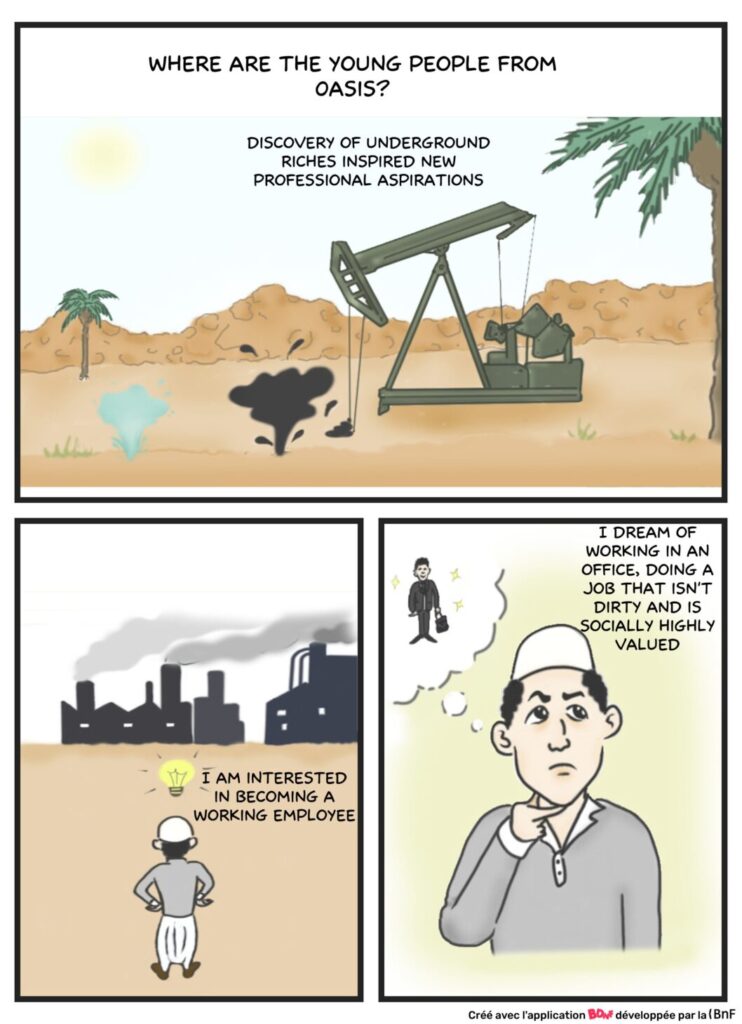
The discovery of underground resources (oil, gas and groundwater) in the Algerian Sahara and their exploitation through the development of the petrochemical industry fostered salaried employment. As a result, as argued by Otmane & Kouzmine (2013), local agricultural labour shifted towards economic sectors that were better paid, less physically demanding and more socially valued.
Political decisions and agricultural development programmes, combined with easier access to deep groundwater and private investments, transformed the Saharan landscape. Different forms of agriculture now coexist: ancient oasis, new oasis extensions and large-scale agricultural development. Yet these changes also intensified the shortage of local agricultural labour.
The blog traces the historical and political drivers of labour scarcity in the M’Zab Valley, located in the Ghardaïa region, and examines how this shortage has created opportunities for undocumented migrants from sub-Saharan migrants, while also reconfiguring local power relations and generating new forms of labour precarity and exploitation.
The M’Zab Valley
The M’Zab Valley is located in the wilaya of Ghardaïa in southern Algeria, about 600 kilometres south of the capital, Algiers. Like most oases in North Africa, the M’Zab Valley is characterised by the coexistence of two agricultural landscapes (see fig.1): the old palm groves, established in the eleventh century, where traditional date palm trees are cultivated, and the new agricultural extensions, established in the 1980s, located on the periphery of the old palm groves. These extensions are characterised by diversified farming systems, mainly oriented towards the intensified cultivation of commercial date palms and horticultural crops.
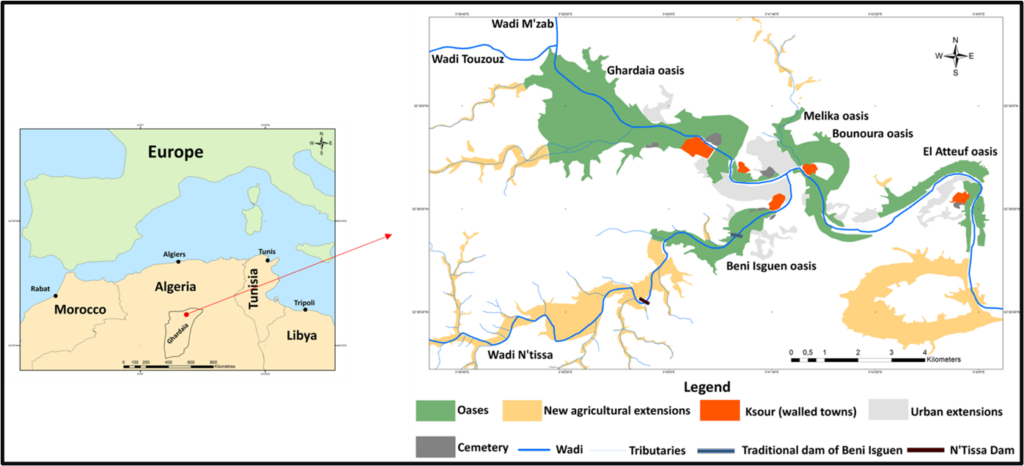
Figure 1: Map of the M’zab valley and their oases. Source: Meriem Farah Hamamouche.
The M’Zab Valley faces several processes of degradation, mainly due to rapid urbanisation and the degradation of natural resources, in particular the depletion and pollution of water tables. This raises concerns about the sustainability of palm cultivation and the oasis system itself. The region is also confronted with the withdrawal of young people from agriculture, resulting in a shortage of local agricultural labour.
The research presented in this blog post is based on semi-structured interviews we (Saidani and Hamamouche, two of the three authors of this blogpiece) conducted between September 2024 and January 2025 in the oasis of Beni Isguen, one of five oases in the M’zab Valley in the Ghardaïa region. We have strong connections to the Ghardaïa region, having conducted research over the past eight years on various topics. These include community governance of water resources, the water-energy-food nexus and local development. Cross-cutting issues such as migration, youth and gender have also been investigated. In addition to our research publications, we have supported young men and women to promote the transfer of ancestral skills and knowledge.
For this blogpiece, we carried out interviews with a dozen farmers and elders, and a dozen migrants, mainly of Malian nationality, who work as agricultural labourers. The blogpiece also draws on material from a local workshop in which farmers and elders worked together to trace the history of labour force in the Ghardaïa region.
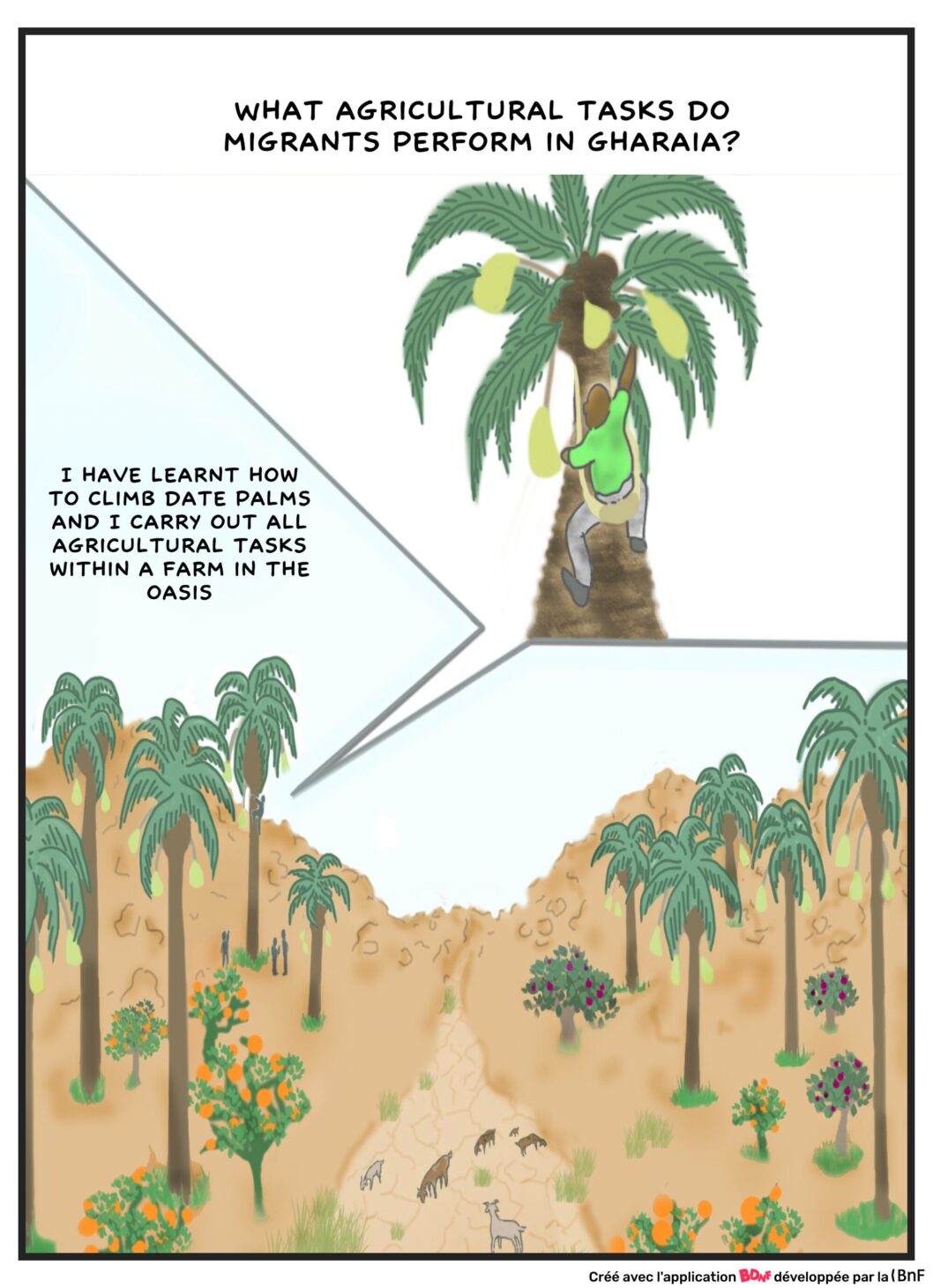
In addition, we worked with an illustrator to bring the interviewees’ stories to life. As migration is a politically sensitive topic, the illustrations allowed us to tell the stories without putting the migrant workers or their employers at risk, as the process was entirely anonymized.
Access to groundwater and new land as an opportunity for re-articulating power dynamics: ‘M’elKhedamL’Moula’chi’ from peasant to landowner
Agricultural labourers have always had a low social status. In the Algerian Sahara, agricultural and hydraulic tasks were traditionally carried out by the ‘Khammès’ (sharecroppers by the fifth) or ‘Harratine’ (men of colour: formerly enslaved). This social discrimination was addressed in the 1970s by former president Boumediene through the Agrarian Revolution. This aimed to “eliminate all forms of exploitation of the labour of others by restoring direct labour relations in agriculture, based on the principle that the land belongs to those who work it” (Charter of the Agrarian Revolution and Ordinance 71-73 of 8 November 1971 on the Agrarian Revolution, Journal officiel de la République algérienne no. 30 November 1971).
The emancipation of the former Khammès and Harratine, as well as the expropriation of large landowners and date palm owners in favour of their former agricultural workers, significantly transformed social structures and power relations within oasis societies.
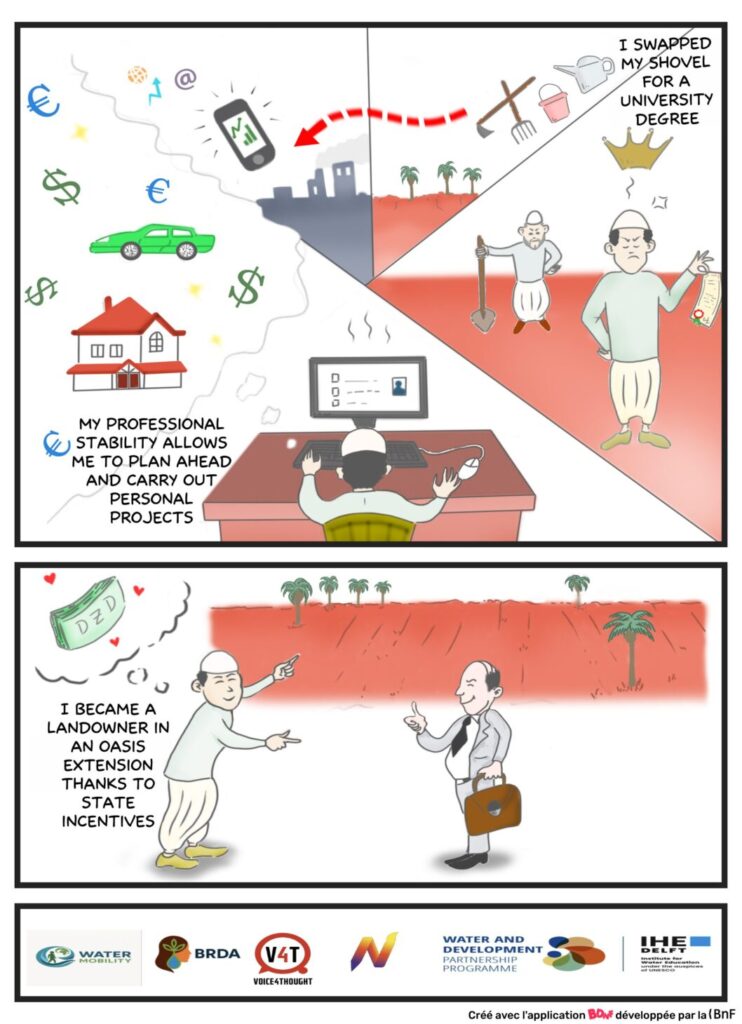
Encouraged by the 1983 law on access to agricultural land, former Khammès and Harratine and their descendants, engaged in so-called ‘modern’ Saharan agriculture based on deep groundwater exploitation. They appropriated land and developed agriculture outside the ancient oases, drawing on their knowledge and expertise in farming, well-digging and irrigation.
According to a former Khammès from the M’zab valley in Ghardaïa:
“We have gone from ‘M’elKhedamL’Moula’chl’ (from peasant to landowner): access to agricultural land is seen as social revenge for the past, an opportunity for economic and social climbing thanks to the creation of a heritage based mainly on date palms… This speculation is a symbol of prestige, nobility, and a secure future through retirement benefits, but above all of social success”.
Young people from other social groups, including descendants of former nobles and landowners, followed a similar path. For many, becoming a landowner was both an economic and social ambition. In the oasis of Beni Isguen, descendants of dispossessed nobles acquired land under the APFA law.
The suppression of the Khammès and Harratine statutes, combined with young oasis inhabitants’ desire to appropriate new land, led to a severe depletion of the agricultural workforce in ancient oases, a deterioration of community irrigation systems, and a profound devaluation of agricultural labour.
According to a skilled date palm worker in the M’zab Valley, a local family refused to give him their daughter’s hand in marriage in the 1980s because of his work as an agricultural labourer:
“In their eyes, being an agricultural labourer was synonymous with lack of ambition, failure, instability, no future and low social status… They would have preferred me to get a land plot outside the oasis, or to work in the administration or in the oil industry”.
Tensions over agricultural labour have further increased with the introduction of new development programmes, such as the National Agricultural Development Plan (PNDA), land concessions schemes and the Algerian Youth Support Programme (ANSEJ). These policies aimed to modernise Saharan agriculture through deep groundwater exploitation and to create jobs. Instead, they have had the opposite effect, pushing oasis youth away from agricultural work. According to a farmer working on an agricultural extension:
“Since the 2000s, young people no longer want to be farm workers. They want to be entrepreneurs and landowners… Some even set up fictitious projects in order to obtain subsidised agricultural equipment, which they then sell to buy cars and other non-essential goods”.
Agricultural labour remains physically demanding and socially devalued. It is widely associated with low status. Today, most young people aspire to salaried jobs in administration or industry or seek to migrate to larger cities or abroad.
Sub-Saharan migrants as available and cheap labour
Labour shortages have pushed farmers and investors to recruit migrants from Sub-Saharan countries, and mostly from Mali, often informally, for work rejected by young Algerians. The slogan ‘Maranichmalien’ (I am not a Malian) is commonly used by young Algerians to refuse all physical and back-breaking agricultural work. It reflects the gap between the state-led agricultural development in the Sahara -mainly based on the exploitation of deep groundwater- and Algerian youth aspirations for non-agricultural livelihoods. Some young people describe undocumented migrants as “Harratines of the 21st century”, pointing to the persistence of racialised and hierarchical divisions of labour. A farmer in the oasis describes the situation as follows:
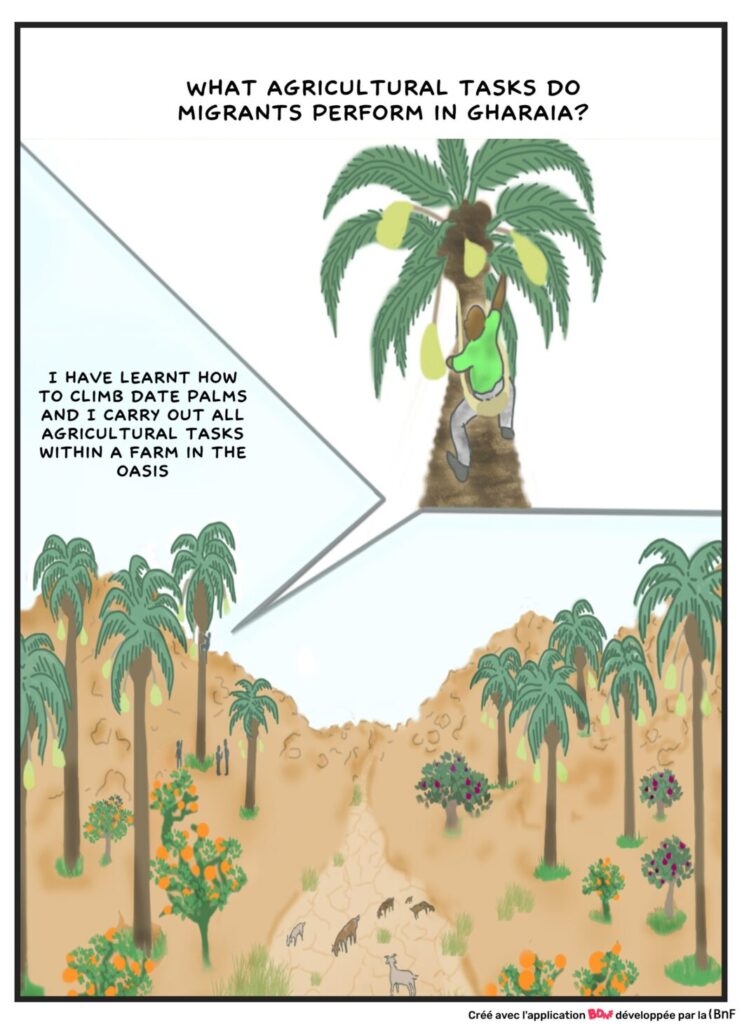
“Young Malians are hard workers, unlike our young people. They learn quickly and work amazing hours, sometimes working for two farmers in one day to earn a living… They’ve even learned to climb date palms. They do all the farm work without complaining and are loyal to their employers. Before they leave Ghardaïa, either for Europe or to return home, they make sure that a member of their family comes to take their place”
Why migrate from Mali to Algeria?
Drought, political and economic instability and armed conflict in the sub-Saharan region, since the 2000s, intensified after 2011, have increased migration toward Algeria. Young migrants leave their home countries to settle temporarily in Algeria and work to support their families back home, but also to accumulate the financial resources needed to carry out their future projects. In Ghardaïa, most foreign agricultural workers are Malian.
Migration mainly involves the most socially and economically disadvantaged groups, particularly in the Niger River basin, in areas such as Gao and Timbuktu, where low levels of education and income prevail. Falling river levels and repeated droughts have reduced agricultural yields and deepened poverty.
Therefore, migration becomes a family strategy, supported through financial contributions and transnational networks, who help to make decisions and fund the journey, to arrange contacts with journey facilitators and future employers in Ghardaïa.
Why Ghardaïa?
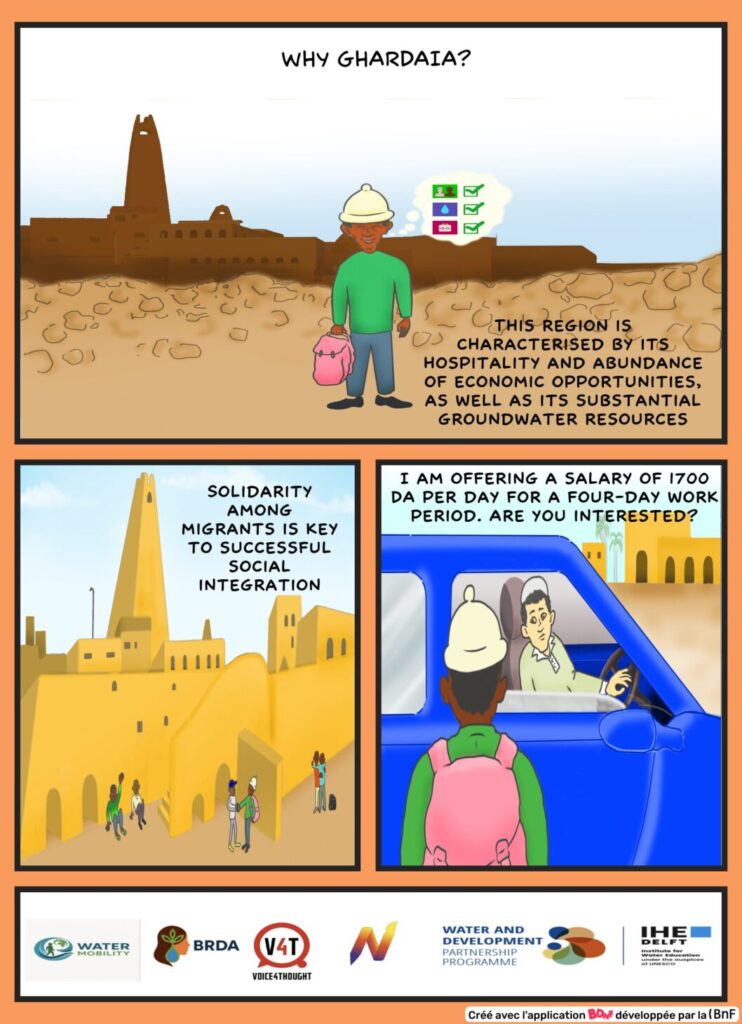
The decision to settle in the Ghardaïa region rather than in another Saharan region is explained by three main reasons. The first relates to family ties. As mentioned by a Malian migrant:
“My older brother has lived in Ghardaïa since 2014…he has taken in all the young men from the family and from our home village who have wanted to try the migration adventure…we need a stable local person before we leave…because it’s this person who takes care of us once we’re there until we find a job…he also puts us in touch with employers”.
Second, the decision to migrate to Ghardaia is also motivated by the high demand for labour. In the words of a Malian migrant:
“I came to Ghardaia for the work and the better pay… During my journey I first stopped in Bordj Baji Moukhtar, a region on the border with Mali, where I worked for 1000 da/day, then I went to Adrar where I worked for 1200 da/day… here in Ghardaïa we are paid 1700 da for 7 hours of work, or 35,000 da/month.”
The third reason given by the migrants is the hospitality and solidarity of the local community in the Ghardaia, as well as the support they receive from the farmers. Over the years, this win-win dynamic, based on mutual needs and interests, has created bonds of trust and mutual support between employers and migrant workers. In the words of a Malian migrant:
“In an irregular situation, I avoid leaving the farm to avoid any controls and therefore any deportation to the border by the security services… So, my employer makes sure that I have everything I need on his farm… He gives me a roof over my head, a television, pays for my shopping and sends money to my family in Mali”.
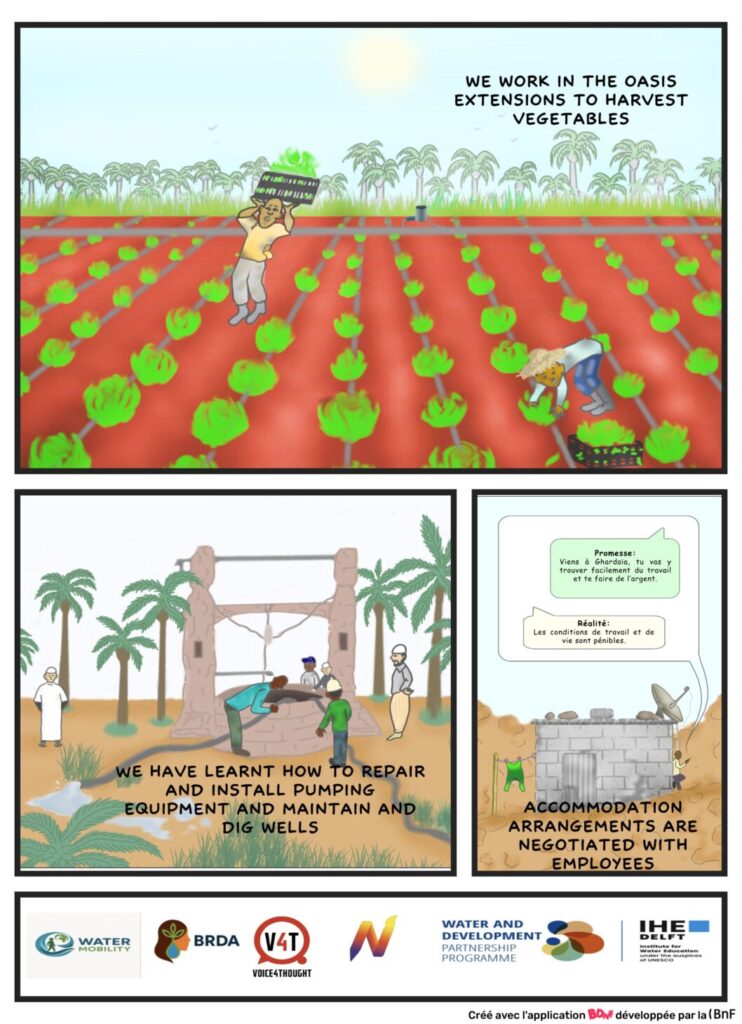 Different forms of employment: trust, precarity and the making of an invisible workforce
While the working relation between employers and migrant workers is often framed as one of solidarity and mutual aid, it also often reproduces unequal power relations within migrant communities themselves. Long-established migrants increasingly act as intermediaries and guarantors for employers, gaining privileged access to better housing, higher wages, supervisory roles and lighter tasks. In exchange, they recruit younger or newly arrived migrants who take on the most physically demanding and precarious work.
This intermediary role creates a layered hierarchy of dependency: farmers rely on trusted senior migrants; senior migrants depend on their status as brokers; and younger migrants remain at the bottom of the labour chain, exposed to exploitation, wage deductions and informal debt arrangements. Community-based recruitment thus operates simultaneously as a protective mechanism and as a channel through which exploitation is displaced downward, from landowners to intermediaries and finally onto the youngest and most vulnerable workers.
Besides, forms of migrant employment vary according to agricultural models and the role farming plays in household livelihoods. Small oasis gardens oriented toward family consumption rely mainly on occasional daily labour, while diversified oasis systems and new agricultural extensions require more stable and permanent workers. Wages and contracts are negotiated informally, and employment ranges from short-term daily work to monthly arrangements, sometimes supplemented with housing, food, and other benefits to retain workers during critical agricultural periods. Permanent and seasonal employment is organised through trust-based arrangements embedded in long-standing social ties, offering a degree of security to both farmers/employers and workers. By contrast, daily labour recruited at gathering points is far more exposed to fraud, non-payment and threats of denunciation. Migrants respond through defensive strategies such as demanding partial payment in advance or accepting work only through known contacts.
On top of all of this, the undocumented status of agricultural workers means that they do not contribute to social security and therefore have no access to benefits such as health insurance or pensions. This makes the profession highly vulnerable to life’s uncertainties.
Conclusions
In the Saharan regions, deep groundwater is now considered a resource that can be accessed through drilling and motorised pumping. However, this exploitation is not neutral; it stems from political decisions, development ideologies, and state visions of agricultural modernisation which view the Sahara as an “El Dorado” for achieving the country’s food self-sufficiency. Unlocking access to land and groundwater has redefined power relations between traditional oasis stakeholders and reconfigured territorial water governance, while encouraging intensive agricultural development on the oases’ periphery.
These political, technical, social and environmental changes have contributed to the disengagement of young people in oases from agricultural work, paving the way for a new type of agricultural worker: sub-Saharan migrants, who have become an indispensable yet invisible labour force sustaining both traditional oases and new agricultural extensions.
From this perspective, access to deep groundwater emerges as a deeply political issue situated at the intersection of environmental transformation, social inequality and migration. It has reconfigured not only land use and agricultural production, but also labour regimes and social hierarchies. The resulting system links national development policies to local labour shortages and to transnational migration routes, producing a mix of opportunities, dependency and exploitation that runs from state visions of modernisation to the everyday working conditions of young Malian migrants in the oases of southern Algeria.
—
This blogpost has been written within the framework of the project “Water Mobility” supported by IHE Delft Water and Development Partnership Program, which is funded by the Dutch Ministry of Foreign Affairs.