
On 12 July 2026, Indigenous leader and human rights defender Pranab Doley was arbitrarily arrested along with four other Indigenous community leaders – Amit Nag, Brijit Kutum, Rajib Pegu and Bhaskar Saikia. These arrests are part of the continued targeting of Adivasi resisting the dispossession of Indigenous lands in the Kaziranga region (Assam, India) for destructive greenwashing projects like tiger conservation, tourism and luxury resorts.
On July 18th, the Community Network Against Protected Areas (CNAPA) released the following statement.
UPDATE:
The case of Pranab Doley was heard on July 27th, and the court granted him bail on July 29th. Then, on July 30th, a day later, the Assam Government invoked the National Security Act (NSA) against him, even though during the court case the judge repeatedly warned the Investigating Officers not to bring up fresh charges after the orders were pronounced.
On August 2nd, CNAPA has released an updated statement on this case.
Undisciplined Environments stands in solidarity and comradeship with Pranab Doley, the CNAPA, and Indigenous resistances against green colonialism.
To endorse, use this form or email the CNAPA at [email protected]
List of signatories (in progress) below.
Statement Condemning Baseless NSA Charges on Human Rights Defender Pranab Doley and Criminalisation of Indigenous Resistance in Kaziranga
by the Community Network Against Protected Areas (CNAPA)
02 August 2026
The Community Network Against Protected Areas (CNAPA), while welcoming the bail orders for the release of Indigenous leader and human rights defender Pranab Doley, Convenor of the Greater Kaziranga Land and Human Rights Protection Committee (GKLHRPC) and founding member, CNAPA, along with four other Indigenous community leaders – Amit Nag, Brijit Kutum, Rajib Pegu and Bhaskar Saikia of GKLHRPC, strongly condemns and opposes the baseless and illegal slapping of charges under National Security Act (NSA), 1980 on Pranab Doley. We are relieved that Amit Nag, Brijit Kutum, Rajib Pegu and Bhaskar Saikia have been released from Golaghat jail in Assam and have reunited with their comrades, communities and families. Pranab continues to be incarcerated in Golaghat jail due to the fresh NSA charges slapped against him on 30th July, 2026, a day after his bail in the primary case in which he and the other four leaders of GKLHRPC were arrested on 12th and 14th July 2026.
CNAPA continues calling out the continued targeting of Adivasi/Indigenous/Tribal community leaders and political activists resisting the dispossession of Indigenous lands in the Kaziranga region for destructive greenwashing projects like tiger conservation and tourism.
Of Bail Orders and Bail Rejections
While Pranab, Amit, Brijit, Rajib and Bhaskar have got bail in FIR no 108/2026 of Bokakhat Police Station, the anticipatory bail applications of women leaders Geeta Gowala, Mrinali Gowala and Srimoti Kishan were rejected by the District Sessions Judge, Golaghat, Assam. CNAPA is concerned about the rejection of the anticipatory bail of the women leaders, which makes them vulnerable to continuous harassment and threats of arrest at any time. In fact, our worries have doubled with the recent news that the Adivasi women from Inlay Pathar do not even have a ‘safe space’ to protect themselves. They are being visited by senior police officers in the dead of the night with threats, even when they are sitting in front of the police station throughout the day demanding recognition of their ancestral land back, which was illegally grabbed from them without their consent by the Assam Tourism Development Corporation for the construction of luxury Hyatt hotels through its Indian partner Juniper Hotels.
We reiterate that no one should face the trauma that the women leaders are being subjected to relentlessly, and anticipatory bail is a right of the women leaders of Inlay Pathar and Hatikuli facing false and fabricated criminal cases against them.
Assam and the Statecraft of Arm-twisting
CNAPA expresses its shock and anger at the way in which the Assam Government under Himanta Biswa Sharma has subverted justice by serving fresh NSA charges on Pranab Doley even as his bail release papers were being prepared on 29th July 2026. It may be noted that the Assam Government issued a communication for grounds of detention on 30th July 2026 under Section 8 (1) of the NSA, 1980. The notice was then served to Pranab’s father at their ancestral home on 31st July 2026, stating that he is being detained under Section 3 (2) of the NSA, 1980. The sequence of events reveal the deliberate attempt of the Assam Government to wait for his bail to be given in the primary case he was arrested in and then use NSA, almost as an afterthought, to further detain him and thereby demoralise him and Indigenous/Tribal/Adivasi peoples and other marginalized sections of Greater Kaziranga who have been fighting against state-led violence on their lands and bodies through fake encounters, custodial murders, forced disappearances apart from forced evictions and land grabbing in the name of tourism, tiger, elephant and rhino conservation.
This post-bail invoking of the NSA on Pranab Doley clearly points to the fact that the Assam Government subverted the order of a sessions court. During the hearing and even later, the judge repeatedly warned the Investigating Officers of the case to submit the full case diary and not come up with fresh charges after orders were pronounced. While granting bail on 29th July, Additional Sessions Judge N.M. Abdullah Ahmed stated that, “the present dispute arises from deep concern over environmental degradation and its impact on the socio-cultural fabric of the local tea-tribe community.” The bail order further stated, “where environmental conservation intersects with indigenous life, the ordinary machinery of criminal law cannot be used to suppress local concerns. Genuine public peace is achieved not by silencing the affected people, but by listening to them.” It also stated, “it is also necessary to mention here that, in cases involving marginalised groups such as tea-tribe communities, structural inequality prevents the local community from negotiating on equal terms with corporate or state entities. In such a situation, treating an activist or community leader as an ‘external disruptive element’ does not lead to any productive outcome.”
But a reading of the NSA order detaining Pranab Doley under the NSA reveals something totally contradictory to what the Sessions Judge stated. It is clear the Assam Government seems to believe that this preventive detention is in the interest of maintaining the security of the state and public order. And to substantiate this claim, the Commissioner of Home and Political Department, Assam, has made references to Pranab Doley’s international travels which were for making representations on behalf of the people of Kaziranga against the violence and injustices they were facing at different United Nations conventions like the Convention on Biological Diversity (CBD) and treaty body meetings of the UN Special Rapporteur on Business and Human Rights Group. In fact, regarding Pranab Doley’s foreign travels, the Sessions Judge had noted that, as an environmental activist, Pranab Doley has travelled to many foreign countries and may have received money for travel and other expenses in that process, and that investigating officers can carry out a “document-based investigation” “without requiring the judicial custody of the accused.” Yet Pranab Doley is in jail under a baseless and fabricated NSA order of detention.
The Assam Government seems to have mastered the statecraft of arm-twisting voices of dissent through false and fabricated criminal cases and prolonged illegal incarceration. It must be emphasised that this has been a pattern with the Assam Police, and they had earlier done the same with farmer leader Akhil Gogoi and now have repeated it with Pranab Doley.
Making a Mockery of National Security
It is pertinent to raise questions around whose interest ‘national security’ has been invoked. The BJP-led Government has been fencing off forests in the name of fortress conservation and selling off Indigenous/Adivasi lands to international luxury hotel groups in the name of tourism and GDP growth, continuing colonial traditions. Here are Pranab Doley and his comrades of Greater Kaziranga who have been questioning the growing structural inequalities, resisting dispossession and demanding recognition of forest and land rights for communities for decades. It is time that across India, people understand the fundamental basis of these Indigenous/Adivasi communities’ struggles and question who is making a mockery of ‘national security’! It is in this context that we want to remind everyone of Bishnu Prasad Rabha’s famous revolutionary verse “Raijye ache duiti patha, Ekti kalo, ekti sadathe, Raijyer jodi mongol chao, Duiti pathar boli dao” [there are two sacrificial goats in the state/one black, the other white;/if you want the best for people/then sacrifice both].
CNAPA therefore calls upon the Government of Assam to:
- Immediately release Pranab Doley and drop arbitrary and baseless NSA charges on him.
Withdraw all fabricated criminal charges filed against peaceful protesters and human rights defenders in Kaziranga. - Ensure an independent and impartial inquiry into the allegations of unlawful detention, procedural violations, and the reported use of excessive force during the protests.
- Suspend all construction and land acquisition activities of the Hyatt Luxury Hotels project at Inlay Pathar and Hatikuli.
- Recognise and respect land rights and revenue claims of the affected communities through transparent and lawful processes.
- Immediately stop exclusionary and militarised models of fortress conservation and ensure a democratic, rights-based approach that recognises Adivasi/Tribal/Indigenous peoples and local communities as custodians of biodiverse habitats.
CNAPA, a national coalition of indigenous peoples and forest-dwelling communities, Gram Sabha/Village Council federations, activists, journalists and academics from across India, stands unconditionally with the people of Inlay Pathar and Hatikuli. It condemns the Home and Political Department of the Assam Government, Kaziranga’s Forest Department and Bokakhat Police and Assam’s paramilitary troops’ attempts to intimidate, forcefully evict and illegally acquire lands for luxury Hyatt Hotels in Kaziranga.
Statement Condemning the Arrest of Human Rights Defender Pranab Doley and the Criminalisation of Indigenous Resistance in Kaziranga
by the Community Network Against Protected Areas (CNAPA)
18 July 2026
The Community Network Against Protected Areas (CNAPA) strongly condemns the arbitrary arrest of Indigenous leader and human rights defender Pranab Doley, Convenor of the Greater Kaziranga Land and Human Rights Protection Committee (GKLHRPC) and founding member, CNAPA, along with four other Indigenous community leaders – Amit Nag, Brijit Kutum, Rajib Pegu and Bhaskar Saikia of GKLHRPC and calls out the continued targeting of Adivasi Indigenous community leaders and political activists resisting the dispossession of Indigenous lands in the Kaziranga region for destructive greenwashing projects like tiger conservation, tourism and luxury resorts, etc.
Pranab Doley was detained arbitrarily by Assam Police on 12 July 2026 in Guwahati without being furnished an arrest memo at the time of his detention. Pranab’s grounds of arrest were communicated at 3 am in the morning of 13th July 2026, many hours after he had been taken into custody. His residence was reportedly searched without a warrant, and electronic devices and several other items were seized several times. Pranab, Amit and Brijit continue to be in police custody till Monday (20th July 2026), while Rajib and Bhaskar are in judicial custody after their surrender before the Sub Divisional Judicial Magistrate Bokakhat on 14th July 2026. Besides this, several activists associated with the movement against the land acquisition for luxury resort – including Geeta Gowala, Mrinali Gowala, Srimoti Kishan etc – face criminal prosecution under serious offences and have been subjected to police atrocities. These illegal detentions, arrests and intimidations raise grave concerns regarding how Indigenous people are being criminalised for raising their voice against land grab as well as the violation of due process of law and the fundamental constitutional rights of citizens as guaranteed in law.
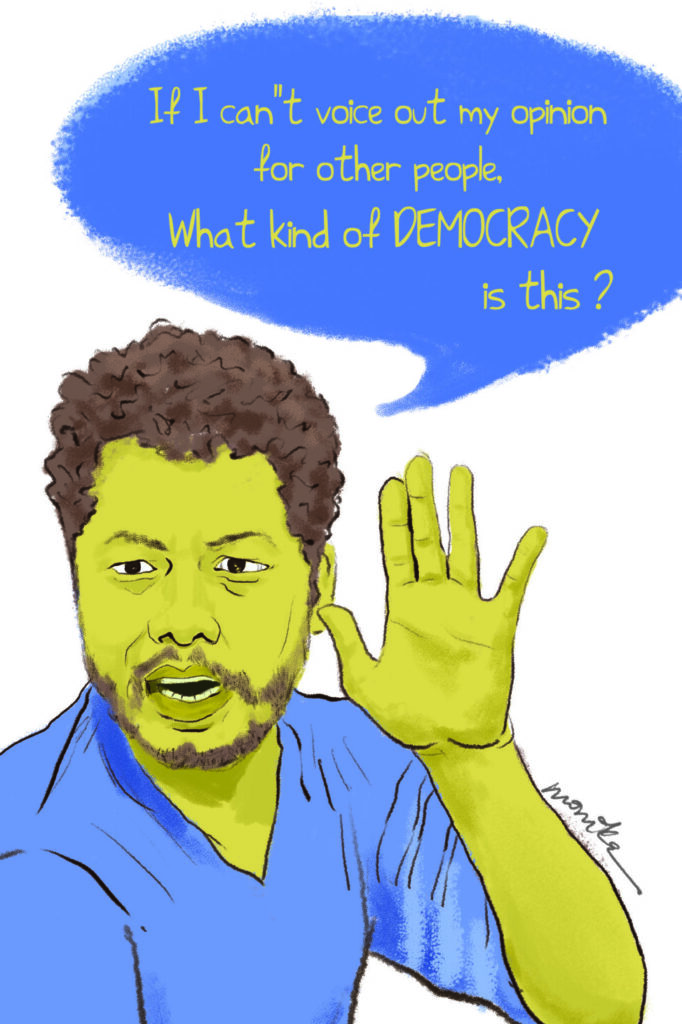
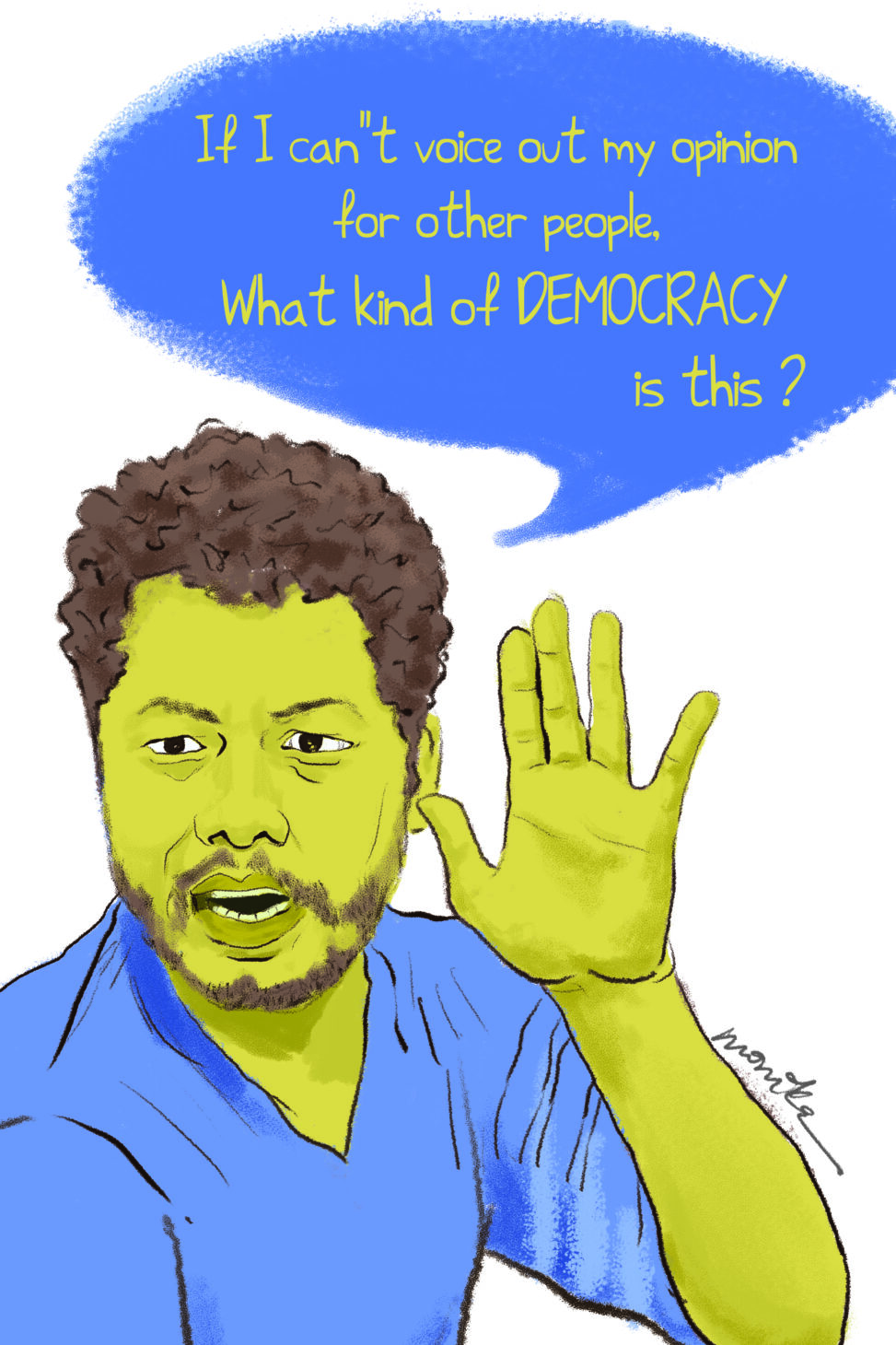
While being arbitrarily arrested, Indigenous leader Pranab Doley said: “If I can’t voice out my opinion for other people, what kind of democracy is this?” Illustration by: Monika from @defiance_in_art
These arrests cannot be viewed in isolation. They are part of a larger pattern of criminalising democratic dissent by communities opposing the acquisition of Adivasi Indigenous agricultural and grazing lands at Inlay Pathar and Hatikhuli, adjoining Kaziranga National Park, for a proposed luxury tourism project by Hyatt International and its Indian partner Juniper Hotels. The affected families have consistently stated that they have cultivated these lands for generations, possess long-standing revenue records, and were neither meaningfully consulted nor provided Free, Prior and Informed Consent (FPIC) before their lands were fenced off and construction activities commenced. The people of Inlay Pathar and Hatikuli, along with leaders like Pranab Doley, have repeatedly engaged in dialogue with Kaziranga officials and the Golaghat District Administration for over four years, but instead of recognising their rights and addressing the issue, they were chased, beaten and abused on every occasion and were called illegal encroachers.
The communities whose agricultural and homestead lands are being stolen for the construction of the Hyatt Luxury resort belong to the Tea Tribe and Adivasi communities whose ancestors were brought to Assam under colonial systems of indentured labour. Despite generations of labour that contributed significantly to Assam’s economy and landscape, Tea Tribes and Adivasi communities continue to experience historical marginalisation and insecure land tenure. The current struggle is therefore not merely about land, but a larger resistance for dignity, livelihood, identity, the constitutional promise of equality and justice and the historical injustice meted out against these communities.
The protests that emerged in June 2026 were fundamentally about defending these rights. The Assam government’s response to the people’s peaceful mobilisation against the resort was the slapping of arbitrary criminal charges with a clear intention to harass leaders as well as stifle people’s voices. The arbitrary allegations include trespassing, carrying of weapons, outraging modesty of women police personnel among several others, which has created a chilling effect on democratic protests. This further sends a disturbing message that the police enjoy unquestioning impunity and that communities asserting their constitutional rights shall be treated as nothing but criminals.
Arbitrary arrests and violent repression of Indigenous leaders expose the broader link between the fortress model of conservation and extractive development that CNAPA has been consistently questioning.
Across India, many protected areas continue to be governed through a colonial “fortress-conservation” approach that views local and Adivasi Indigenous communities as obstacles to conservation rather than custodians of forests and biodiverse habitats. The Kaziranga region has, for decades, witnessed intensive militarised conservation, including arbitrary shoot-at-sight orders. Such an approach has repeatedly generated allegations of excessive use of force, arbitrary detention, fake encounters, intimidation, restrictions on traditional access to land and forests, leading to shrinking democratic space for communities living in and around so-called protected areas. Conservation cannot become a justification for land grab, criminalising Indigenous leaders, weakening constitutional protections or diminishing people’s civil liberties.
Long before the establishment of modern protected area regimes, Indigenous and forest-dependent communities coexisted with the forests, grasslands, wetlands and wildlife of the Brahmaputra region through locally evolved systems of stewardship and coexistence. Replacing these relationships with the exclusionary fortress-conservation model, while simultaneously permitting large-scale commercial tourism infrastructure in ecologically sensitive forest lands, reveals a troubling contradiction.
Ecological integrity can only be ensured only if the knowledge and rights of local communities are recognised and respected as people whose lives have historically been intertwined with ecosystems, rather than handing over vast tracts of forest lands for eco-tourism, hotels, mining and other commercial projects. All these are projects wear the mask of conservation but, in reality, are large-scale real estate brokering.
The arbitrary arrests of Pranab Doley, Amit Nag, Brijit Kutum, Rajib Pegu and Bhaskar Saikia are not merely just arrests of individuals, but they represent a broader tactic to silence Indigenous voices who challenge the systemic historical oppression of their communities and defend their ancestral lands, forests and livelihoods.
CNAPA therefore calls upon the Government of Assam to:
- Immediately release Pranab Doley, Amit Nag, Brijit Kutum, Rajib Pegu & Bhaskar Saikia who have been arrested in connection with the protests at Inlay Pathar and
- Withdraw all fabricated criminal charges filed against peaceful protesters and human rights defenders in Kaziranga.
- Ensure an independent and impartial inquiry into the allegations of unlawful detention, procedural violations, and the reported use of excessive force during the protests.
- Suspend all construction and land acquisition activities of the Hyatt Luxury Hotels project at Inlay Pathar and Hatikuli.
- Recognise and respect rights and claims of affected communities through transparent and lawful processes.
- Immediate stop to exclusionary and militarised models of fortress conservation and ensure a democratic, rights-based conservation that recognises Indigenous peoples and local communities as custodians of biodiverse habitats.
CNAPA, a national coalition of Indigenous peoples and forest-dwelling communities, Gram Sabha/Village Council federations, activists, journalists and academics from across India, stands unconditionally with the people of Inlay Pathar and Hatikuli. It condemns Kaziranga’s Forest Department and Bokakhat Police and Assam’s paramilitary troops’ attempts to intimidate, forcefully evict and illegally acquire lands for Hyatt Luxury Hotels in Kaziranga.
JK Thimma, CNAPA leader and member of the Jenu Kuruba indigenous community of Nagarahole, Karnataka, said:
The Assam Government and Kaziranga forest department must stop imposing the Hyatt Luxury Hotels project on Indigenous lands. If criminalisation of Indigenous leaders resisting dispossession from their ancestral lands does not stop, Indigenous communities all across India will unite to challenge the continuing historical injustice meted out against us. CNAPA stands in solidarity with the affected Tea Tribe and Adivasi communities of Kaziranga and reiterates that ecological integrity, Indigenous rights and social justice are inseparable. Conservation cannot be built upon dispossession, fear and the erosion of fundamental rights.
On behalf of CNAPA :
- Greater Kaziranga Land and Human Rights Committee, Kaziranga, Assam
- Van Sanrakshan Sangrami Mancha, Chandubi, Assam
- All Assam Forum for Forest Dependent Communities, Morigaon, Assam
- Nagarahole Adivasi Jammapale Hakku Sthapana Samithi, Nagarahole, Karnataka
- Fridays for Future, Karnataka
- Kendriya Sangharsh Samiti, Palamu, Jharkhand
- Tharu Adivasi Mahila Mazdoor Kisan Manch, Dudhwa, Uttar Pradesh
- Kaimur Adivasi Dalit Adhikar Manch, Uttar Pradesh
- Maa Mati Suraksha Samiti, Similipal, Mayurbhanj, Odisha
- Gram Sabha Federation, Sitanadi, Dhamtari, Chhattisgarh
- Gram Sabha Federation, Udanti, Gariabandh, Chhattisgarh
- Achanakmar Sangharsh Samiti, Mungeli, Chhattisgarh
- Adivasi Sakti Sangathan, Chhattisgarh
- Baiga Sakti Sangathan, Achanakmar, Chhattisgarh
- PESA & Forest Rights Committee, Padmaram Gram Panchayat, Appapuram, Telangana
- PESA & Forest Rights Committee, Padmaram Gram Panchayat, Pulitheegalabanda, Telangana
- Vivasayigal Thozhilalargal Munnetra Sangam, Tamil Nadu
- Tamil Nadu Tribal People’s Association, Tamil Nadu
- Van Gujjar Tribal Yuva Sangathan, Uttarakhand
- Sundarbans Jana Sramajibi Mancha, Sundarbans, West Bengal
- West Bengal Jana Sramajibi Mancha, West Bengal
- Centre for Social Knowledge and Action, Gujarat
- National Adivasi Alliance
- Search for Action and Knowledge of Tribal Initiative, Telangana
- All India Union of Forest Working People
SIGNATORIES (list in progress):
- Undisciplined Environments collective, Global
- Deverso Percorso Decolonie collective, Global
- Laura Pipolo, Independent Researcher, Italy
- Francesco Bucci, Italy
- Emanuele Leonardi, Associate Professor, University of Bologna, Italy
- Marco Armiero, University of Santiago de Compostela, Spain
- Chiara Caterina Razzano, Research Fellow, Scuola Superiore Sant’Anna di Pisa, Italy
- Héctor Bujari Santorum, Journalist, Spain/Western Sahara
- Valentina Delli Gatti, Activist Anthropologist, Mem.med, Italy
- Leonardo Falascone, Artist, Italy
- Benedetta Casagrande, Artist, Italy
- Stefani Petrillo, USA
- Michele Marrone, Italy
- Nicola Capone, Philosopher and activist, Italian Institute for Philosophical Studies, Italy
- Federico Moraschinelli, Independent writer and graphic designer, Italy
- Marisol Manfredi, PhD student, University of Pisa, Italy/Argentina
- Luan Derick Carvalho Pinheiro, Teacher, Spain
- Mario Scrima, Public Employee, Italy
- Alice Dal Gobbo, Researcher and Activist, University of Trento, Italy
- Emma Dalmazzoni, Student and bookseller, University Bicocca of Milan, Italy
- Mariana Eugenia Califano, Independent Historian, Italy
- Jadel Andreetto, Writer and Documentarist, Italy
- Resistenze in Cirenaica, Permanent cultural centre, Italy
- Giulia Pochini, Data Officer, Peace Brigades International, Italy
- Olivia Burchietti, PhD Student, Scuola Normale Superiore University, Italy
- Giovanni Ricolfi, Commercial Employee, Italy
- Chris Lang, REDD-Monitor
- The Oakland Institute, Oakland, CA, USA
- Anuradha Mittal, The Oakland Institute, Oakland, CA, USA
- Rita Catanzariti, Retired Researcher, C.N.R. Pisa, Italy
- Edoardo Crescini, Researcher, University of Padova, Italy
- Giulia Parlato, Artist, Italy
- Camilla Carlotta Maria Aronica, Doctor, Italy
- Kathleen McAfee, Professor Emerita, San Francisco State University, USA
- Barbara Armellini, Italy
- Arianna Tortelli, Italy
- Valentina Fiasco, PhD Researcher, University of Leeds, UK
- Joshua Rigo, Photographer, Switzerland
- Emanuele Rippa, Student, Universidad Andina Simón Bolívar, Ecuador/Italy
- Clark Pratt, Denmark
- Michele Amaglio, Photographer, Italy
- Lee Rae Walsh, Artist, USA
- Matteo Buonomo, Photographer, Italy
- Ginevra Iacchetti, Student, La Sapienza University of Rome, Italy
- Andrea Sandrini, Italy
- Alice Franchi, Freelance Journalist, Italy
- Luca Garino, Independent Editor, Italy
- Norma Brunetto, PhD Candidate in Earth Observation, La Sapienza University of Rome, Italy
- Kalki The Kraken, Artist, Bengaluru, India
- Bloom and Rot, Trans Artists Collective
- Iole Carollo, Archaeologist and Photographer, Italy
- Scuola di Restanza e Futuro, Italy
- Église APS, Cultural Association, Italy
- Federica Pollari, Italy
- Alessandra Scibetta, Italy
- Davide Fecarotti, Italy
- Frederic Hache, Director of Green Finance Observatory, Belgium
- Marcel Llavero-Pasquina, Global Atlas of Environmental Justice
- Joan Martinez-Alier, Global Atlas of Environmental Justice
- Eleonora Fanari, Researcher, ICTA, UAB, Environmental Justice Atlas, Spain
- Global Atlas of Environmental Justice
- Michael Tortorella, PhD, University of Bologna, Italy
- Giuseppe Rappa, Freelance Artist, Italy
- Clara Cuonzo, Italy
- Francesca Lancini, Journalist, Italy
- Nicolò Villa, Nurse, Italy
- Mordecai Ogada, Kenya
- Anushree Rath, Postgraduate Student, Christ Deemed to Be University, India
- Deepanjali Sapkota, Human Resources, Switzerland
- Alessio Galdiolo, Italy
- Anna Bulgarelli, Cultural Producer & Photographer, The Netherlands
- Rahul Kumar, India
- Nirjesh Gautam, Independent Researcher, India
- Andrea Caligiuri, Professor of International Law, CiRAM – University of Macerata, Italy
- Shreya S, India
- Elena Mistrello, Comic Artist, Italy
- Andrea Stocchiero, Policy Officer, Focsiv, Italy
- Anand J, Land rights and Environment rights, ILC, India
- Archismita Choudhury, India
- Devaki Purohit, India
- Indrakshi Dutta, India
- Shaul Bassi, Italy
- Archismita Choudhury, India
- Andrea Monti, Italy
- Alessandro Esposito, Activist, Convocatoria Ecologista Taranto, Italy
- Michele Carducci, Full Professor of Comparative Constitutional Law, University of Salento, Italy
- Joseph Oleshangay, Human Rights Activists/Lawyer, Tanzania
- Mary Robertson, UK
- Allan Robertson, United Kingdom
- Jan Paul Smit, Journalist, Netherlands
- Pritam Bhatta, Musician and Music Producer, India
- Clare Evans, United Kingdom
- Aishwarya Iyer, India
- Mamta Singh, Self-employed, India
- Riccardo Tilli, Professor, Sapienza University of Rome, Italy
- Nikhil Khinchi, Staff Engineer, India
- Biswarup Das, Self-employed, India
- Marie Ndenga Hagbe, PhD Student, France
- Shantanu S., Advertising Copywriter, India
- Sri Keerthan Tokala, India
- Larissa Mehl, Brazil/Spain
- Mega Ayu Lestari, Communications and Engagement Officer, Working Group ICCAs Indonesia/Global Youth Biodiversity Network, Indonesia
- Dimitri D’ippolito, Photographer, Italy
- Addri Kaushik, Student, India
- Kunwolee Kajol, India
- Vasundhara Mahour, India
- Noella Misquitta, Entrepreneur, Concerned Citizen, India
- Madhurjya Kalita, India
- Karish Boro, Student, India
- Farmida Aman, India
- Karish Boro, Student, India
- Rashi Gupta, Director, Mato, India
- Saurav Kumar, India
- Manasi Patel, Student, India
- Dr Sentila Aier, Medical Officer, NAM, India
- Sangi Sharma, Field Assistant, India
- Shweta Goswami, Researcher, India
- Shaheena Sheikh, Freelance Writer, India
- Aanchal Sharma, Concerned Citizen, India
- Anushka, India
- Nupur Khade, Student, India
- Mansi Gadre, Teacher, India
- Deeksha Vanguru, Co-lead Fridays for Future India, India
- Nishtha Dhingra, India
- Ankita Kakati, India
- Sayeda Tashaffee Sayeda, India
- Rohit Raizada, Meta Analyst, India
- Ruchita Shah, Architect, India
- Veena Shah, Retired Teacher, India
- Wasim Sama, Citizen, India
- Asif Iqbal, Independent Researcher, India
- Kopal Goel, India
- Debashri Gautam, India
- Taniya D’silva, India
- Dibyoshnata Talukdar, India
- Harsha Sewlani, India
- Athulya Maya, Student, Save Kaziranga, India
- Satabdi Baruah, India
- Ashish Gupta, India
- Dipanjali Munda, Doctor, India
- Riddhi Dhand, India
- Michelle Barbosa, Germany
- Alessandra Piva, Student, Italy
- Aishwarya Iyer, India
- Manisha Khatore, Housewife, India
- Spandana N, India
- Diya Das, Student, India
- Lucky Baruah, Student, Assam, India
- Tanushree Bhargava, Head of ESG and Sustainability, Private Organisation, India
- Kalyani Jethwa, India
- Chetana Ghosh, Student, India
- Jugantar Borgohain, India
- Priyadarshika Medhi, Research Scholar, Tezpur University, India
- Deepjun Dasgupta, India
- Damo K, Builder and Consultant in small-scale startups, India
- Divya Mukesh, India
- Camille Pross, France
- Mayilananthi Kaliannan suhaa Kaliannan, Doctor, India
- Nishna Mehta, Freelance artist, India
- Vineet Mudgal, Lawyer, Bharath
- Ankita Bhattacharjee, Software Engineer, India
- Dipanjal Saikia, India
- Juliet Richardson, United Kingdom
- Pihu Kundnani, Accountant, India
- Aniket Barman, School Student, India
- Prabodhan Pawar, Student, India
- Ritesh Manjhi, Self-employed, India
- Kostuja M, Special Educator, India
- Harsh Vaskar, Student, India
- Maha Sheikh, India
- Vandita J, India
- Jimpee Dutta, Assam
- Atmika D, Lawyer, India
- Phoolwati Yadav, India
- Sumit Mandal, Student, India
- Sandip Mondal, India
- Zoy Kimi, India
- Lipsa Mahapatra, Student, Jsm College, India
- Comrade Nelson Nnanna Nwafor, Executive Director, Foundation for Environmental Rights Advocacy and Development FENRAD Nigeria, Nigeria
- Vaishnavi Sharma, India
- Sakshi V, India
- Ajoy Das, India
- Pranjal Bora, Self-employed, India
- Khushi Gantawar, India
- Mouli Maity, Student, India
- Riddhi Gupta, Student, CBSE, India
- Khurshid Fatema Rasul, Retired Lecturer, India
- Samiksha Khadpekar, Software Engineer, India
- Ankita Chanda Roy, Graphic Designer, India
- Monika Jaiswal, Student, India
- Soham Das, Student, India
- Lakshmi Mahendran, Student, India
- Priti Prajpati, India
- June Alhora, Student, India
- Shivam Bhakta, Student, India
- Pranjal Kalita, India
- Surabhi Singh, Student, India
- Divyanshu Yadav, Student, India
- Ankita Sonowal Sonowal, Student, India
- Alisha Florence Minz, Student, Citizen of Assam, India
- Shifa Nagori, Student, India
- Parishi Goyal, India
- Praneetha Goshika, Student, India
- Sierra Lee, USA
- Vedika Vishnoi, India
- Meghna Anand, Neuroscience Research Assistant, Shiv Nadar University, India
- Harshita Lilwani, Student, India
- Akhim Barman, Student, India
- Birina Thakuria, Student, India
- Prachi Sonkar, Student, India
- Rajendra Kumar, Teacher, India
- Pushpa Devi Sonkar, Housemaker, India
- Srishti Sonkar, Student, India
- Nivriti Ghosh, Student, KIIT University, India
- Golu Kumar Mukhiya, Student, India
- Kovida Sree, Student, India
- Priyanka Barman, Student, India
- Vaishnavi Yaduvanshi, Student, India
- Vikram Jorwar, India
- Himangkar Buragohain, Self-Employed, Concerned Citizen, India
- Sujit Singh, Student, India
- Veedhi Vaskar, Student, India
- Khushi, Student, India
- Robin Doley, Business, India
- Samriddhi Tiwary, India
- Yukti Deshlan, India
- Avishek Roy, Student, India
- Akash Kumar Raj, Student, India
- Nandini Andhare, India
- Pahi Gogoi, PhD Scholar, IIT Ropar, India
- Sneha Belamkar, Student, India
- Sharda Yeole ,Nature Protection Advocate, India
- Rithisha V, India
- Dibakar Gogoi, Businessman, India
- Shinjini Srivastava, Freelance Artist, India
- Rohit Gupta, Conservationist, India
- Sudhanshu Gupta, Student, India
- Ak Kashyap, Student, India
- Avanti Ravi, India
- Vasundhara Trehan, India
- Monika Thakur, Student, India
- Kranti Waghmare, Artist, India
- Ramesh Redekar, CEO, India
- Srishti Bhagat, Student, India
- Juman Pathak, Save Kaziranga, India
- Arushi A, Self-Employed, India
- Yashvardhan Sirohi, Student, India
- Afrin Khatoon, Teacher, India
- Tanu U, Student, India
- Akshat Singh, Student, India
- Mili Doshi, Canada
- Arup Roy Arup, India
- Rahul R, Photographer, Btech, India
- Sujata Mandal, India
- Kshama Hegde, Software Engineer, India
- Divya Gidithuri, Psychologist, Palcare, India
- Shruthi Suresh, Artist, India
- Amar Kumar Singh, Fashion Design, India
- Hemanga Mohan, India
- Vidal Dcosta, India
- Sushant Garg, Student, India
- Anshika Baid, Associate Manager, India
- Yoga Shree, College Student, India
- Prachi Uikey, India
- Jyotsna Khushboo, MSc. Scholar, India
- Aniket Sharma, Student, India
- Ankit B, India
- Subhodeep Ghatak, Student, India
- Durga Banwari, Student, India
- Jia, Student, India
- Monalisa Bhattacharya, India
- Bitupon Das, India
- Devansh Agarwal, Student, India
- Manjusha bhuarya, Service, india
- Jenish Patel India
- Rajorshi Das, Software Engineer, LTM, India
- Mithilesh Thorat, Student, India
- Lubhanshi Gupta, Student, India
- Janhavi Singh, India
- Avipsa Gangopadhyay, Student, India
- Riya Dutt, Student, India
- Reetisha Mahobiya, India
- Arya Londhe, Student, India
- Priyam Neog, India
- Suchana Giri, Student, India
- Chao Nilabh Nayan Handique, Facilitator, India
- Prasad Patil, Student, Indian
- Hrittize Baruah, India
- Neha Agarwal, Homemaker, India
- Sujata Bania, Housewife, India
- Anannya Bania, Property Consultant, India
- Siddhe Aj, Undergraduate, India
- Vanshika Tewary, India
- Mahinza Mohanta, India
- Neha Bharangar, Pet Consultant, India
- Aishwarya Gorad, Pharmacist, India
- G Stoa, Law Student, India
- Subhodip Bairagi, Student, India
- Nandhini Rajan, India
- Juweria I.K., Student, India
- Suryanshi Jenamani, Student, India
- Pulkit Ramchandrani, India
- Rizwana Ahmed, Teacher, India
- Meet Samdani, Student, India
- Kratika Jain, India
- Pragyashree Swain, Student, India
- Ronsha Roys, India
- Shubha Sahu, Tuition teacher, India
- Sailee Prakash, Student, India
- Udatha Saideep Udatha, Student, India
- Adv. Rasika Ghogare, Lawyer, India
- Archana Aravind, Consultant, India
- Shrusti Kulkarni, Student, India
- Saumya Singh, Consultant, India
- Simon Baranwal, India
- Baby Prasad, Teacher, India
- Gargi Mhatre, Student, India
- Stavya Maurya, Student, India
- Pallavi Mhatre, Banker, India
- Sucharitha Borkar, India
- Ishita Fernandes, Freelancer, India
- Addri Kaushik, Student, India
Manindra Saini, Student, India - Rinsha Kp, India
- Zainab Bakhatgarwala, India
- Rishikant Verma, Social Worker, India
- Shubham Agarwal, Senior Accountant, India
- Trishna Das, India
- Marco Pernarella, PhD Student, University of Trento, Italy
- Chiya Baghel, Student, India
- Aisha Shafiya Aisha, Web Developer, BTech, India
- Dhritiman Talukdar, Senior Risk Analyst, India
- Sai Az Citizen, India
- Srishti Pal, Student, 10 board pass, India
- Susan Darukhanawala, Retired Environmentalist, India
- Nataanya Kaithwas, Student, India
- Payal Parmar, India
- Varnika Singh, India
- Addri Kaushik, Student, India
- Anonymous, Student, India
- Aman Saikia, India
- Ansh Meena, Student, India
- Bhupendra Choudhary, Banker, India
- Hanshika Nagar, Student, India
- Sudip Makhal, India
- Sudeshna Vivekanandan, Student, VIT, India
- Sneha Upadhyaya, Student, India
- Aman Shaji, Student, India
- Hriswi Suvarna, Student, India
- Arunraj, Wildlife Biologist, India
- Nayan Dolui, India
- Addri Kaushik, Student, India
- Rugved Korde, India
- Aniruddha Das, India
- Ashim Kalita, India
- Abhinav Verma, Student, India
- Harsha Zala, Student, India
- Grace Kalita, India
- Abirami A, Doctor, India
- Brian Dcosta, India
- Saumya Paliya, India
- Angshuman Dutta, India
- Kushagri Singh, Student, India
- Aarya Yadav, Student, India
- Arpit Yadav, College student, India
- Niyamika Narah, India
- Upasana Sarma, India
- Addri Kaushik, Student, India
- Mehak Maurya, Student, India
- Venkatkrishna Karumanchi, PhD Student, Cornell University, India
- Mansvi Gawai, Student, India
- Manas Gawai, Student, India
- Iba Mervin, India
- Aarti Salunke, India
- Prateek Shetty, India
- Piyush Singh, India
- Aaina Saini, Researcher, London School of Economics, India
- Manna Ann, Student, India
- Ayush Ayush, Student, Rajiv Gandhi Government Engineering College Kangra, Nagrota Bhagwan, India
- Namratha Nandakumar, India
- Sreepriya B M, Student, India
- Jerome Clement John Christopher, Managing Partner, Preethi Agrofarms, India
- Tushar Kathuria, India
- Yoshitha. B Suvarna, Student, India
- Madhurjya Kalita, Service, India
- Prannab Adhikari, India
- Anshumala Kullu, Student, VBU, India
- Deepa Ramakrishnan, Consultant, India
- Pallabi Chakraborty, Self-employed, India
- Biplab Boro, India
- Maria Scott, Leobra Creatives, India
- Vaishnavi Sharma, India
- Ria Sammi, Architect, India
- Sujata Dhar, India
- Krisha Bhatt, India
- Priyanshu Biswas, Student, The Assam Royal Global University, Department of History, India
- Rohit Gupta Gupta, Software Engineer, India
- Dr Pallavi Gogoi, Teacher, India
- Sunita Shivdasani, Concerned Senior Citizen, India
- Jagruti Naik, India
- Karishma Merchant, India
- Shreejha M, India
- Sasha S S, Doctor, India
- Shreya Vaish, IGNOU, India
- Mayuri Srivastava, India
- Debanwita Mahanta, Doctor, India
- Rakesh Kumar Akula, Research Scholar, Tezpur University, India
- Addri Kaushik, Student, India
- Ankhi Biswas, Student, India
- Kunali Sanghvi, Doctoral Researcher, India
- Jayram Doley, Student, India
- MD Arman Hoque, Student, India
- Sanjukta Sengupta, India
- Dwipayan Mondal, Student, India
- Indra T, India
- Snehasish Man, Protector, India
- Addri Kaushik, Student, India
- Luca Nazzi, Spokesperson, Alleanza Friulana Domini collettivi, Italia
- Suparna Ghosh, Student, Indian Institute of Engineering Science and Technology (IIEST) Shibpur, India
- Shagufta Quazi, India
- Sarmistha Chakravorty, Freelance Artist, Singer, Actor, India
- Pritom Choudhury, India
- Priyanka D, India
- Dr Kiptoo Barasa, Chairman, Jamii Asilia Centre, Kenya
- Sumedha G, Researcher, India
- Ishutosh Pandey, India
- Shraddheya Sawant, Student, India
- Afsheen Gaur ,Student, India
- Lavanya Antargangi, Developer, India
- Idika Saxena, Student, India
- Jennifer Biju, Doctor, India
- Samantha Pinto, Banker, India
- Prasanna V, Design Engineer, India
- Moushumi Sonowal, India
- Shajitha Farwin, India
- Prisha G, Student, India
- Namratha Kolla, India
- Vaibhav Rajoria, India
- Prem Kumar, Student, India
- Manju Kadam, Teacher, India
- Himashri Das, India
- Srishti Kala, India
- Megha Giri, Student, India
- Biplob Gogoi, India
- Suhani Gautam, Student, India
- Ahamed Noor, Student, India
- Himanshi Pant, India
- Apratim Ray, India
- Zainab Bakhatgarwala, India
- Vishal Raj, India
- Rida Qaiser, Student, India
- Raul Chellani, Consultant, India
- Bhoomika, Student, India
- Nandni Mihirayan, Student, JK Lakshmipat University, India
- Luni Doley, Architect, India
- Rohit Baishya, Student, India
- Akila Balu, Teacher, Arivu Maiyam, India
- Zahid Khan, Student, India
- Kavya Nanda, India
- Siddharth Bokade, Student, India
- Khanak Agrawal, India
- Srrutha Nair, Student, India
- Srihitha Lanka, Student, India
- Swarna Roy Chowdhury, India
- Devanshi Badgaiyan, India
- Shikha Pardasani, Product, India
- Rohit Gogoi, Self-Employed, India
- Soumya Parashar, India
- Ganga R, India
- Mayur Buragohain, India
- Rishita Dwivedi, Student, India
- Abhishek Gogoi, Educator, India
- Prashant Thakur, Doctor, India
- Rahul Op, Student, India
- Ruchi Gawde, Undergraduate Student, MBBS, India
- Sourav Chakraborty, India
- Anushka Jha, Political Science Graduate, Independent, India
- Ritu Pegu, Student, India
- Sangram Doley, India
- Chimron Sharma, Business, India
- Namita Iswalkar, Student, India
- Shahid Aman, India
- Sukanya Shivam, Translator, Ministry of Education, India
- O Joshi, India
- Bhargav Changmai, Freelancer, India
- Kaveri Choudhury, Student, Ambedkar University, India
- Robin Doley, Business, India
- Dingki Waikhom, India
- Varun S Kulal, India
- Joshika Rajesh, Student, India
- Aditya Shankar, Self-Employed, India
- Aishwarya Moturu, India
- Priyadarshini Pegu, Homemaker, India
- Afsarul Hoque, Student, India
- Shagnik Talukdar, Student, India
- Taritra Sarkar, India
- Pramila Kaintura, India
- Nilakhi Das, Student, India
- Goutam Engti, Student, India
- Sanjana Shetty, India
- Bharat Gogoi, Student, India
- Shounak Kundu, Student, India
- Asmi Panchal, Intern, India
- Chandamita Barman, Student, India
- Narmila Barman, Housewife, India
- Chit Dhan, India
- Gokul Krishna, India
- Ritu Pandey, Design, Director, India
- Khyati Makwana, Boutique Owner, India
- Ashish Sankhyan, Law Student, India
- Gokul K, India
- Niharika Dutta, India
- Batul Abbas, Homemaker, India
- Harshit Bari, Lawyer, India
- Neha Kerketta, Designer, India
- Bondita Saikia, Student, India
- Snehalata Mitra, Graphic Designer, India
- Anandita Chaudhury, India
- Akhill Nediyumveetil, India
- Nirmal Yashwante, Engineer, India
- Denisha Das, Student, India
- Neharaj Singh, India
- Khushi Lalwani, India
- Santanu Brahma, Student, India
- Priya JS, Student, India
- Sheuli Banerjee, Artist, India
- Adnan Asif, India
- Adnan A, England
- Devyansh Gupta, India
- N Singh, India
- G Dhingra, Freelancer, India
- Aditya Sharma, Organiser, Greater Kaziranga Land and Human Rights Protection Committee, India
- Riya Biswas, India
- Aishwarya Raut, Artist, Italy
- Varshika Mittal, Student, India
- Laavni Saxena, India
- Titikhya Gogoi, Student, ITI Copa College, India
- Himani Rana, India
- Saptami Nandi, Student, Cbse, India
- Arsheen Ahmed, Student, India
- Madhav Rathore, Student, India
- Sujoy Das, Delivery Person, India
- Mahak Sonwani, Student, India
- Nishu Yadav, Student, India
- Karan Jain, Student, India
- Riddhima Jana, Student, Calcutta University, India
- Arisha Simeen, India
- Nimisha Marathe, India
- Rajeah Mulchandan, India
- Sapna Parmar, India
- Abhipriya Kakoty, Student, B. Borooah College, India
- Doorotyaya Nandy, India
- Veena A Menon, India
- Chandima Bora, Student, India
- Michele Salvan, Agronomist, Italy
- Barsha Paul, India
- Anshita Chhabra, India
- Nashreen Sultana, India
- Priya Rawat, College Student, India
- Tanvi Sharma, India
- Fathima Shafna, Student, Calicut University, India
- Himanshu Jain, India
- Karthikeyi Kalla, Software Engineer, India
- Annu Choudhury, India
- Haline Paulson, Archaeologist, University of Glasgow, United Kingdom
- Himel Choudhury, India
- Meghna Mehta, India
- Trisha B., India
- Soumya Stuti, Doctor, India
- Janvi Kuamwat, Student, India
- Roshni Kandhari, India
- Jitin Sharma, Master in Environmental Sciences, Delhi University, India
- Snehal Khatal, Engineer, India
- Akhil KP, Doctor, India
- Neesha Wills India
- Bhoomi Singh, Student, India
- Varsha Rani, India
- Sivani Brijith, Student, India
- Aditi Panda, Educator, India
- Pavan N, Investments and Trading, India
- Pk Namburi, Freelancer, India
- Ayushman Borgohain, India
- Samridhi Sharma, Student, India
- Akshat Singh, Student, India
- Debangona Das, India
- Bitupan Bora, CG, India
- Leonardo Morini, Student, Alma Mater Studiorum, University of Bologna, Italy
- Prachi Agrawal, Student, India
- Bhuvee Chajjed, Student, Christ Junior College, India
- Ayesha Siddiqa, Student, India
- Surya Devdas, Australia
- Urnanav Gofoi, India
- Muskan Thapa, Student, India
- Nishita Rabha, Student, College, India
- Neethu John, Lecturer, Kuhas, India
- Shenaz Shenaz, Undergraduate Student, University of Delhi, India
- Sachin Rastogi, Business, India
- Arlene Maxwell, India
- Aradhana Jain, Student, India
- Paramanonda Mahanta, Retired Professor, Dibrugarh University, India
- Shreyansh Dangi, Student, India
- Basudeb Behera, Student, India
- Arushi Pandey, India
- Sanjay Sargunan, Student, India
- Asmita Dey, India
- Swathi Ramachandran, India
- Srajan Shivhare, Project Manager, Carbon Consultant, India
- Nikta Fiji, UAE
- Sohini Majumder, Brand Marketing Lead, India
- Sarika Sharma, India
- Namrata Salvi, India
- Dr Shalini Jha, VMMC and Safdarjung Hospital, India
- Shambhavi Gavale, Writer, India
- Adarsh Panicker, India
- Neeraja Kandala, India
- Anjana Tripathi, Housewife, India
- Dr Sumegha Dadala, Doctor, LHMC, India
- Puja Datta, India
- Mohd Azharuddin Khan, India
- Abinaya Annadurai, Student, India
- Poorna Naicker, India
- Monisha N, India
- Sonia Titus, Admin, India
- Shalini Ranjan, Teacher, India
- Vrinda Agrawal, India
- Gaurav Agarwal, Student, St.Clarer College Autonomous, India
- Jayraj Kaundilya, India
- Tanuz Kalita, Researcher, Balipara Foundation, India
- Areeba Aara, MBBS Student, India
- Raplang C, Marweiñ, India
- Jhilik Mitra AVP at Citicorp India
- Paul Gilbert, Associate Professor, United Kingdom
- Paras Patil, India
- Vas Ramnath, Security Officer, Canada
- Sanchita Chakraborty, India
- Saffron Ghosh, India
- Sikha Buragohain, India
- Siddhartha Kalita, India
- Rita Nandi, Homemaker, India
- Joshita Setty, Student, India
- Alex Piechowski-Begay, Artist, USA
- N T, Aware citizen, India
- Dhanya Menon, PhD scholar, Government Engineering College Thrissur, India
- Moukthika Saripilli, Student, India
- Sabrina Pacheco, Student, Goa University, India
- Prathibha Menon R, India
- Shraddha Biswas, Graphic Designer, Volunteer, India
- Kanyaa Kaushik, India
- Jahid Rasim Gazi Jahid, Student, India
- Reimoi Khaling, Portugal
- Dhwani Shah, India
- Mubaraka Suratwala, Manager, India
- Tanishka Saini, India
- Sahana Palimar, Business, India
- Greeshma Mohan, Teacher, Ensoul Lumina Learning, India
- Ishan Singuri, College Student, India
- Swetasree Dey, India
- Albana Nadeem Nadi, Visual Artist, India
- Haritha R, India
- Spoorty A Hosamane, Self-employed, India
- Harshad Sambamurthy, Plural Earth, India
- Saurav Majumdar, Software Engineer, India
- Sam Pranav E, College Student, India
- Parvathi Sanmayi, India
- Lucie Miller, Medical Administrator, Queensland Government, Australia
- Shambhavi Shukla, Student, India
To endorse, use this form or email the CNAPA at [email protected]