
By Subina Shrestha and Rahul Ranjan
Amid polarising climate politics, the impacts of climate change are vastly unequal. As Nepal’s cascading disaster on August 26, 2026 made brutally clear, it is the most vulnerable communities globally who face the brunt of the crisis. In this piece, two UK-based scholars from the Hindu-Kush Himalayan region, question the rhetoric of pragmatism in UK climate policies and ask: when we call for just transitions, for whom are we seeking justice?
We are witnessing a deeply problematic trend of climate pragmatism in the world’s richest, top polluting countries whilst thousands of lives are wiped out by climate-induced disasters in vulnerable regions across the world. One such region is the Hindu Kush Himalayan (HKH) region, often referred to as the ‘Third Pole’, as it contains the largest volume of frozen freshwater outside of the Arctic and Antarctic.
Stretching 3,500 km across all or part of eight countries – Afghanistan, Bangladesh, Bhutan, China, India, Myanmar, Nepal and Pakistan – the Hindu Kush Himalayas contain the world’s highest mountain ranges and are truly majestic: a young, complex and richly biodiverse region, home to four global biodiversity hotspots and around 240 million people in its mountains, hills and river valleys. Its mountain ecosystems, however, are increasingly exposed to profound environmental risks.
The HKH faces a growing risk of cascading disasters – when an initial hazard triggers unexpected secondary events of strong impact. This stems, in part, from the region’s ‘fragile’ geography, and from the entanglement of climatic changes with infrastructures, political decisions, histories of extraction and uneven development. The impacts of such disasters in the HKH countries are elevated due to dense populations and rapid unplanned development.
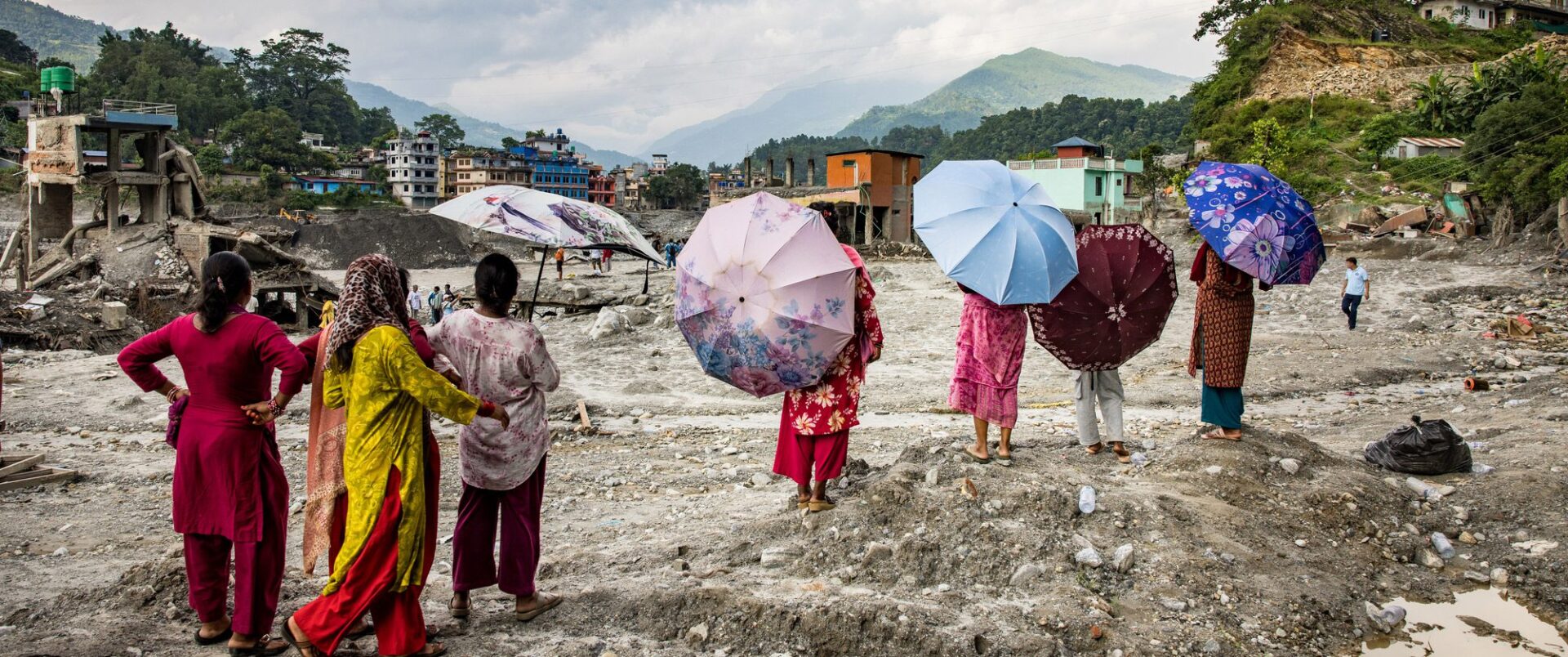
A very recent example is the cascading disaster that occurred on August 26, 2026, in Nepal’s Rasuwa district. After a bedrock failure resulted in a glacial collapse on the Tibet-Nepal border, a huge volume of ice, rock and mud entered a tributary of the Bhote Koshi river, generating a massive river surge and flash floods. So unprecedented is the scale of this disaster that it has been referred to as a mountain tsunami – the wave heights reached up to 30 metres and speeds at 180 kilometers per hour. The footage that captures the sheer scale of devastation is harrowing.
At the time of writing, more than 1,400 people in Nepal and Tibet have lost their lives, and more than 5,500 people are still missing. Beyond loss of life and property, at least 12 hydropower projects in Nepal were affected, impacting the country’s main source of electricity generation. The government estimates that Nepal will need NRs723.31 billion (approx. $4.7 billion) to rebuild the infrastructure damaged by the floods – an astounding 11.84% of the country’s GDP for the fiscal year 2024/25. Several countries have supported Nepal by pledging humanitarian aid. The UK government announced £5 million of humanitarian support for Nepal’s relief and recovery efforts.
This announcement comes at a time when the UK’s Foreign Secretary has indicated that UK foreign policy would put the climate crisis at the heart of the country’s international relations. However, this is in stark contrast to what is happening within national borders, where the UK government is adopting climate pragmatism: that is, politicians are generally supportive of the UK Net Zero targets, but frame urgent climate action as extreme.
This is particularly evident in the ‘pragmatic’ approach to new drilling in the North Sea, framed as addressing growing concerns around energy security and affordability. It is also evident in the approval of the controversial Jackdaw gas field in October 2026, with gas set to flow from the end of the month, while a decision on the Rosebank oil field is still pending. Politicians are increasingly adopting the language of climate pragmatism to invoke ‘common sense’ and appeal to the populace, but what it really does is delay climate action by continuing to protect the fossil fuel status quo.
As individuals who grew up in the HKH region but now reside in the UK, researching climate justice, it is massively infuriating to see such catastrophic disasters unfold in the HKH alongside the now-normalised rhetoric of climate pragmatism here. But anger and grief are not distractions from the material politics of climate change. They tell us something about how climate injustice is lived, felt and acted upon, from individual to collective level.
Simultaneously, studies are beginning to reveal that climate change likely contributed to the preconditioning of the disaster. Thus, while it is important to highlight the huge economic costs of recovery and demand support from the richer countries who have contributed most to the climate crisis, it is also important to keep in mind that no amount of climate finance – for adaptation or loss and damage – will sufficiently limit the impacts of climate change without mitigation. This is not simply an appeal by two frustrated individuals. The scientific case for mitigation is overwhelming.
Moreover, numbers alone cannot tell us what is being lost. The stories of loss become an appendix to the disaster itself, buried beneath numbers of deaths, damaged infrastructure and estimates of recovery. But every life lost is not just a number – they are someone’s family. Every house lost is not simply a building – it is someone’s home. Communities displaced lose not only property, but relationships to place, collective memories, cultural worlds and forms of belonging.
These losses are not secondary or ‘intangible’, appended to the work of recovery. They are at the heart of how climate loss is lived and felt. Grief is not a one-off feeling that ends once the disaster ‘episode’ subsides; it lingers, folded into everyday lives, memories and landscapes marked by loss. What is the monetary value of grief and collective loss?
More worryingly still, there is now growing support for anti-immigration policies in the UK and across Europe. As an increasing number of communities face the risk of climate displacement, will international border security ask them to ‘go back where you came from’? Are we really normalising that some lives are expendable in the name of climate pragmatism?
To state that the impacts of climate change are unevenly felt is an understatement. For reference, Nepal produces approximately 0.1% of total global greenhouse gas emissions. All of the electricity generated in the country comes from renewables, predominantly hydropower – ironically, some of the very projects affected by the floods. Nearly 80% of all new personal cars sold in the country are electric, compared to 24.9% in the UK. In terms of transitioning to net-zero, Nepal is doing many things right. Yet it is still immensely vulnerable to the impacts of climate change.
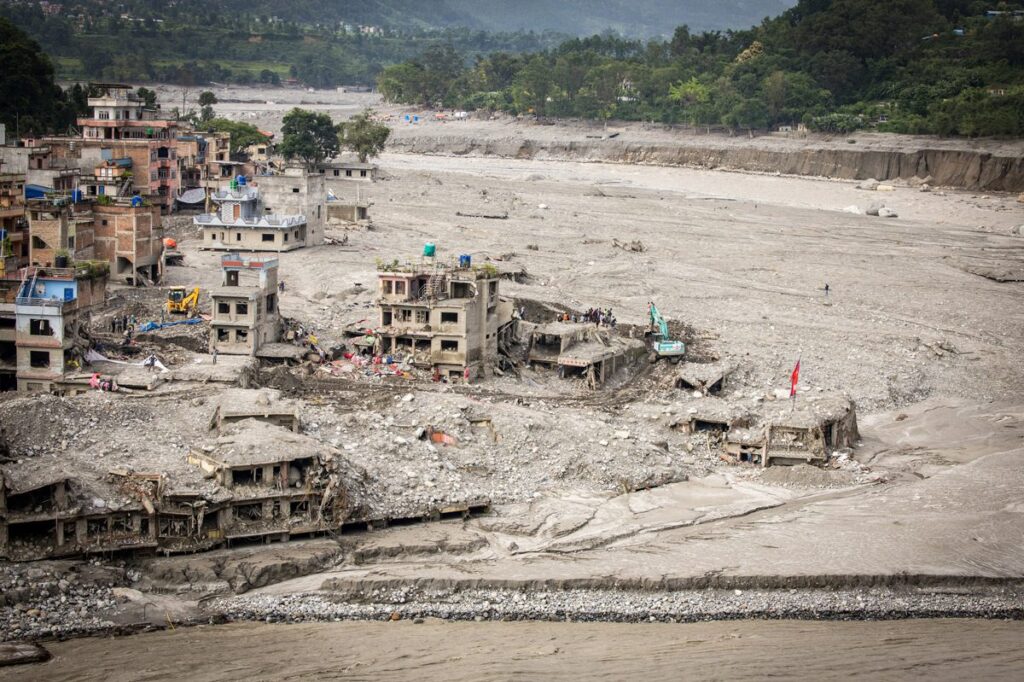
Bhote Koshi Flood, Nepal, August 2026. Photo by Jitendra Bajracharya/ICIMOD.
If the disasters happening in the HKH seem distant and dissonant, an average UK resident need only remember the summer of 2026 – the summer of record-breaking heatwaves. An estimated 2,877 people died in the May and June heatwaves alone. Adapting to the impacts of climate change – in the UK or elsewhere – is necessary, but there are limits to adaptation. To adopt climate pragmatism as a tactic is to embrace climate delay. Putting the climate crisis at the heart of UK foreign policy is an empty promise if its domestic policy is to approve oil and gas exploration – the very activities contributing to the crisis.
As scholars within the broader field of ‘just transitions’, our work has focused on ensuring that climate action and justice go hand in hand. But justice is also about whose losses are recognised, whose grief is witnessed, and whose lives are rendered expendable. A just transition that works for everyone cannot happen amid the current rhetoric of climate pragmatism amid cascading disasters. Nor can it be achieved solely through monetary mechanisms of compensation or climate finance.
A just recovery, then, requires prioritising the well-being, power, and self-determination of frontline communities. This, in turn, forces us to reckon with the historical legacies that perpetuate climate injustice, and to recognise that cascading disasters are not merely an episode – they are a process long in the making, whose aftermath is etched into collective memory, loss and grief. A just recovery must begin with adopting transformative climate justice within both domestic and foreign policies, and envisioning futures where everyone, irrespective of class, gender, race or citizenship, can flourish.
Header image by Jitendra Bajracharya/ICIMOD.