
By Emilia Lewartowska
Can we envision a research method that originates from the practices and concepts of grassroots communities, disrupts power dynamics, and is adopted in dialogue between community members, activists, and scholars? From India to Denmark, the Flower of Transformation prompts reflections on alternative transformations and illuminates new ways of doing research, towards more decolonial and emancipatory knowledge production.
Grounded definition of “Alternatives”
The pursuit of alternatives to the dominant capitalist, patriarchal, statist, ecocidal, and imperialist system is happening all around us. Across the world, communities, collectives, and individuals are responding to the interconnected and multiple crises we face, enacting more socio-ecologically just ways of being in the world. Since 2014, the Vikalp Sangam (VS) process has been a platform for confluence of such alternative organizing in India.
In addition to documentation, advocacy, and other activities focused on radical alternatives, VS has been working on a collective vision document entitled “The Search for Alternatives: Key Aspects and Principles” which includes the basic values and dimensions of alternative transformation, as well as strategies and challenges of implementing them, all based on the grassroots experimentation on the ground.
The Flower of Transformation is a visual summary of such a framework, and it illustrates the intersectional spheres for radical change through five interconnected petals.
At the centre, one can find values shared by a self-defined community of people. The Flower aims at enabling collective visioning and self-assessment on the holistic character of an initiative, respecting local contexts and used with the central involvement of the community in question, and never for an external evaluation.
In 2017 came the Alternative Transformation Format (ATF), a more detailed and expanded version of the Flower, which has the following aims: (a) distinguish between the transformative initiatives and reformist initiatives as well as false solutions, i.e., those that claim to be transformative but are only strengthening the status quo by being predominantly market-based or technology-based; (b) gain in-depth understanding of the process of transformation; (c) help understand if there are internally contradictory trends in transformation; and (d) through all this, enable the actors in the initiative to take steps towards a more comprehensive transformation.
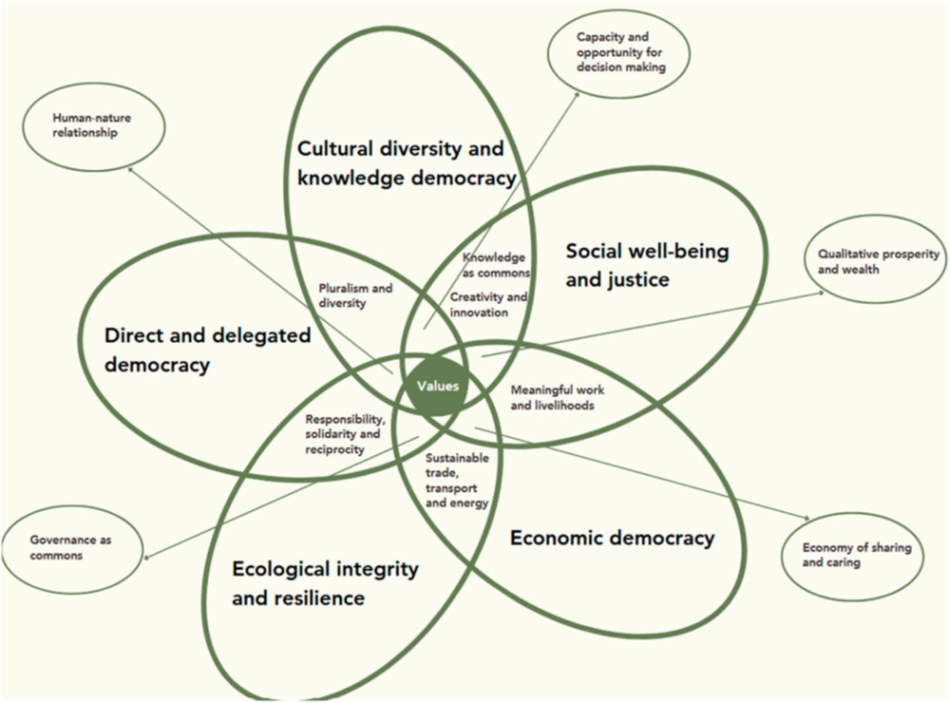
Visual representation of the Flower of Transformation: Spheres of radical alternatives. Credit: Vikalp Sangam (2024)
While the Flower and its broader framework has been used in a few research projects and studies of alternative transformations, it is now also proposed as a research method with participatory, co-creative, and decolonial potential.
Below, some preliminary takeaways and lessons on such application of the Flower are presented, initiating a methodological conversation and encouraging further applications and experimentations with the tool. These should be always carried out in the spirit and intent with which it was originally created.
The ”Flower Exercise”
The Flower of Transformation was used as a co-creative research method during fieldwork in two alternative organizations in India and one alternative community in Denmark. Its use was planned in dialogue with the VS representatives as well as based on the availability and interest of the participants.
In each community across different locations, a participatory workshop (otherwise called “Flower Exercise”) was organized in which community members discussed the different spheres of transformation, including synergies and trade-offs, as well as future goals, in relation to the transformative work taking place in their initiative. The moderation from the researcher[1] varied from minimal to full engagement with different results.
The discussions revolved in some cases around concrete examples of everyday practices, to a more ideological and value-based reflections, focusing on broader principles guiding the organizations. Notes were taken on big placards which turned into Flower charts documenting transformation achieved over the years, internal contradictions, and future ambitions. In one case, the researcher later produced a few additional charts which included her own reflections on the processes of transformation in the initiative.
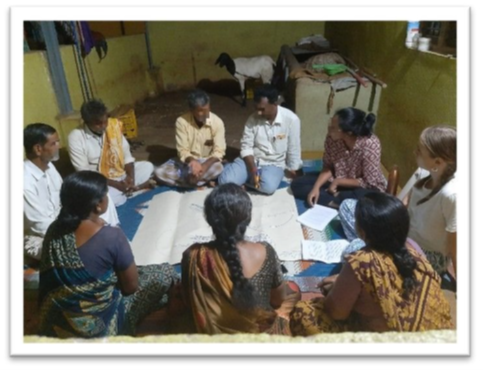
During the “Flower Exercise” in India. Credit: the author.
Asking the right questions
After conducting the workshops, the two researchers and a VS representative reflected on the original goals of the format [a), b), c), and d) outlined above] to see if they were helpful in fulfilling them for the participating community members: to what extent was the participation of the communities perceived as meaningful? Does it further the ability of participants to initiate the changes they would like to address based on their own learning, including any contradictory or complementary trends in their own work? To what extent were the internal power dynamics between members of the initiative challenged or upheld?
At the same time, these objectives were also applied towards the researchers organizing the workshop in each location, to reflect on the transformational potential of the exercise for a more participatory and decolonial knowledge production.
Hence, the following questions were asked: to what degree were local ways of knowing respected and encouraged, while facilitating a non-hierarchical research process? What kind of structural and systemic power dynamics were at play? How did the exercise allow us to challenge some of the issues inherent to conventional research methods, such as power inequalities, epistemological violence, or uni-directional learning? Which, in turn, did we fail to address and why?
These reflections were enriched by discussions held with other members of the VS process as well as based on the feedback from participating communities across the three field sites.
Emancipatory potential on the ground and reflexive potential for researchers
The exercise enabled new learnings among the participants: a more holistic visualization of change, internal validation, positive conceptualization of new goals, and a collective reflection on foundational principles and values that brought them together in the first place. The workshop has the potential of nourishing common visions for the desired transformation, developing practical knowledge and solutions based on internal learning, and enabling future visioning.
However, if not enough time is dedicated, there is a risk that these intended outcomes may not be fully realized, limiting tackling contradictory aspects between the different spheres, internal power dynamics, and analysing more systematically the inter-linkages between the spheres.
Participants also noted that the written character of the exercise can be exclusionary, suggesting that more visual tools could be applied depending on the context. Further points of critique included the rationale behind the placement of particular petals in the Flower as possibly constraining (i.e.: why is the “society” petal placed between “culture” and “economy”?), and the difficulty in summarizing complex transformational processes in the charts in just a few words.
With varying degrees of the researcher’s involvement in the workshop (from active moderator and co-participant to observer), the exercise challenged uni-directional learning and enabled a more relational process of collective reflection. In certain ways, it offered an opportunity for community-based and academic knowledge to come together, fostering mutual learning rather than extraction.
As the Flower originates from grassroots organizing in India, the use of such Southern framework in the Danish context offered interesting learnings which might not have otherwise surfaced, for instance inspiring conversation on issues of justice and different ways of knowing and being in the world. This further helped to reverse the often-un-recognized assumptions around the authority of the mainstream Northern sustainability frameworks.
In India, the exercise enabled a more participatory and engaging approach to the participants, illuminating more explicitly subtle power dynamics, privilege, and other inequalities, in particular related to researcher’s positionality. While the exercise helped shifting power to a certain extent, other structural inequalities, such as funding mechanisms or the broader research design, remained unchallenged, and a more systemic transformation of academia remains an ongoing commitment.
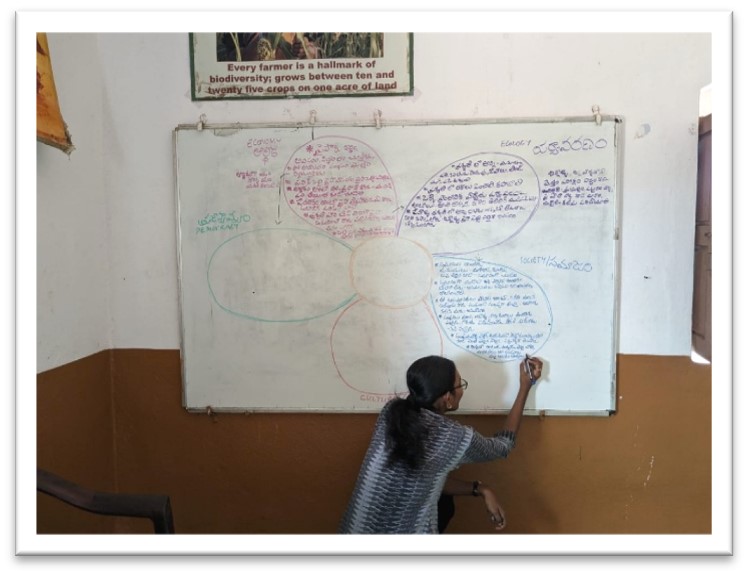
During the “Flower Exercise” in India. Credit: the author.
New directions for the Flower in co-creative research
The Flower of Transformation offers a useful analytical lens to look at alternative transformations on the ground, one that is self-defined by the concerned community. While this specific engagement with the Flower was limited to a one-time workshop in each participating community, it is possible to employ it in a long-term engagement and throughout different stages of the research process, as done in other studies. This would enable a more in-depth exploration, new insights, and potential usages to emerge.
The dialogue with both the creators of the format and alternative initiatives on the ground must accompany such efforts. The Flower is a flexible and malleable tool meant to serve radical transformations, and those can be supported in a mutual engagement between community members, activists, and scholars in different constellations and contexts. In doing so, it may also enable another transformational journey: one that challenges hegemonic ways of doing academia and science, while embracing the contradictions and challenges inherent to such processes.
[1] A Danish researcher was engaged in the Danish community, while an Italian researcher was engaged in the two Indian organizations.
This is a popular piece summarizing a research paper co-authored with Lone Riisgaard (Roskilde University, Denmark) and Ashish Kothari (Kalpavriksh, Vikalp Sangam and Global Tapestry of Alternatives, India).