By Lava Mustafa
What happens to a place when the trees that carried its memories are burned, uprooted, or turned into commodities?
Afrin is my hometown, a predominantly Kurdish region in northwestern Syria, within the broader region of Rojava.
I recall an autumn morning in October 2016. I was fifteen when my family and I woke up early and went to my grandfather’s orchard on the Mabata Plateau near Afrin. The orchard had around 200 olive trees, some of them more than 80 years old.
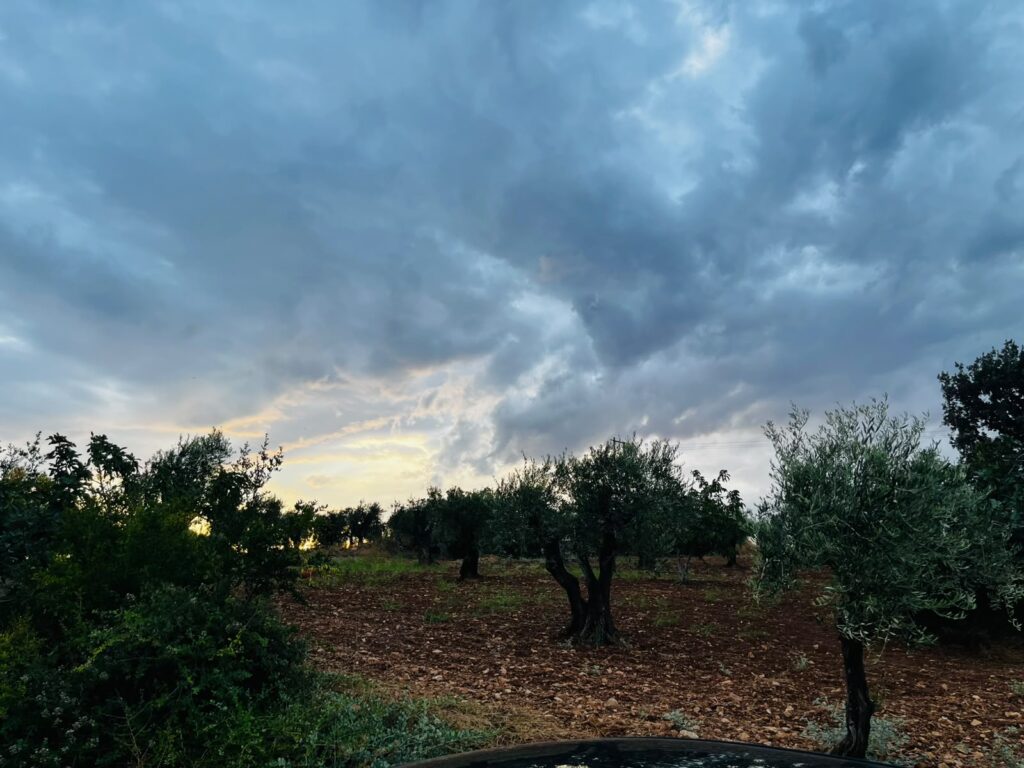
My grandfather’s-olive orchard in Mabata. Source: Author.
It was harvest season, but it felt like a family holiday. Relatives who were usually away for college or work came back to help. My grandmother sang traditional songs while we worked. People talked, children ran between the trees, and tractors carried the harvested olives. The orchard was not simply a place where we produced something. It was a place where family members gathered and where memories were made.
I also remember a small moment that has stayed with me. A relative tried to break a branch to make harvesting easier. My grandfather became angry and called this barbaric. He insisted that we use a wooden ladder instead. For him, the tree had to be protected during the harvest so that it could continue producing in the following years.
This care was part of a wider relationship with the land. In Afrin, olive cultivation was connected to everyday life and to a local economy. Families cultivated and harvested their own trees, sold olives, or took them to local olive presses to produce oil for household use and trade. The work also depended heavily on family and community labour.
Traditional harvesting practices generally tried to avoid breaking branches or damaging the trees. People cleaned the orchards from weeds and often dealt with insects and pests through manual methods. These practices were not necessarily perfect or completely free from chemical inputs, but they reflected an understanding that the trees had to survive beyond a single harvest.
This is why the olive tree matters to me as more than an agricultural crop. It connects land, labour, memory, and belonging. A tree can produce an income, but it can also mark a place where generations worked, met, celebrated, and built their lives.
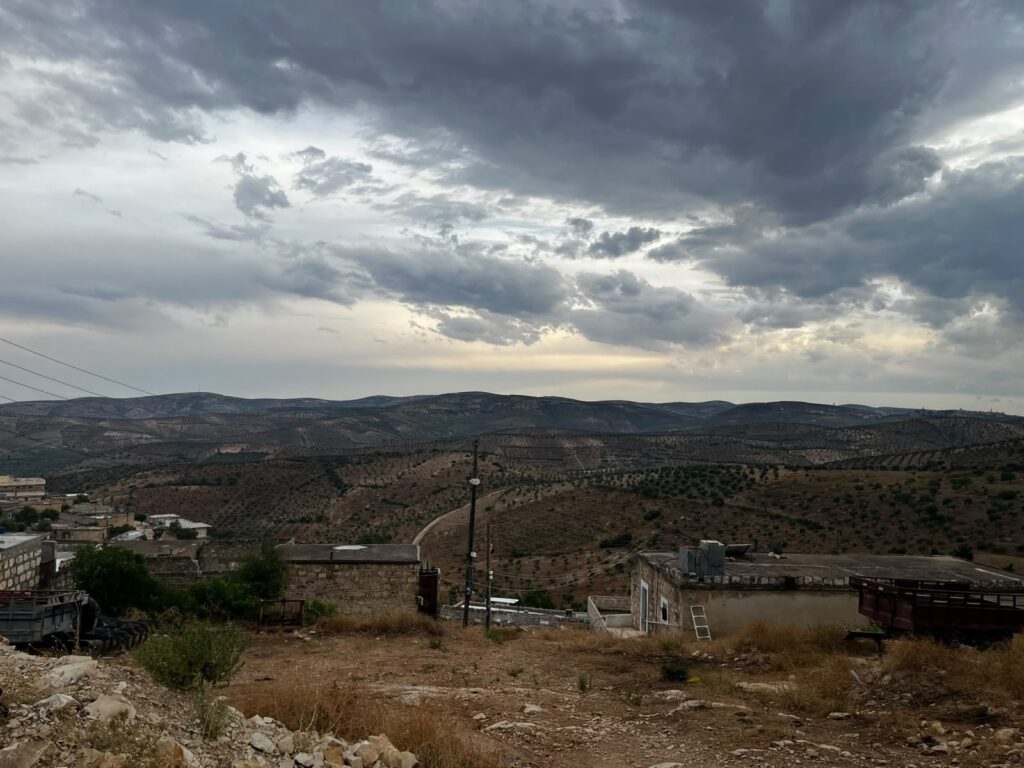
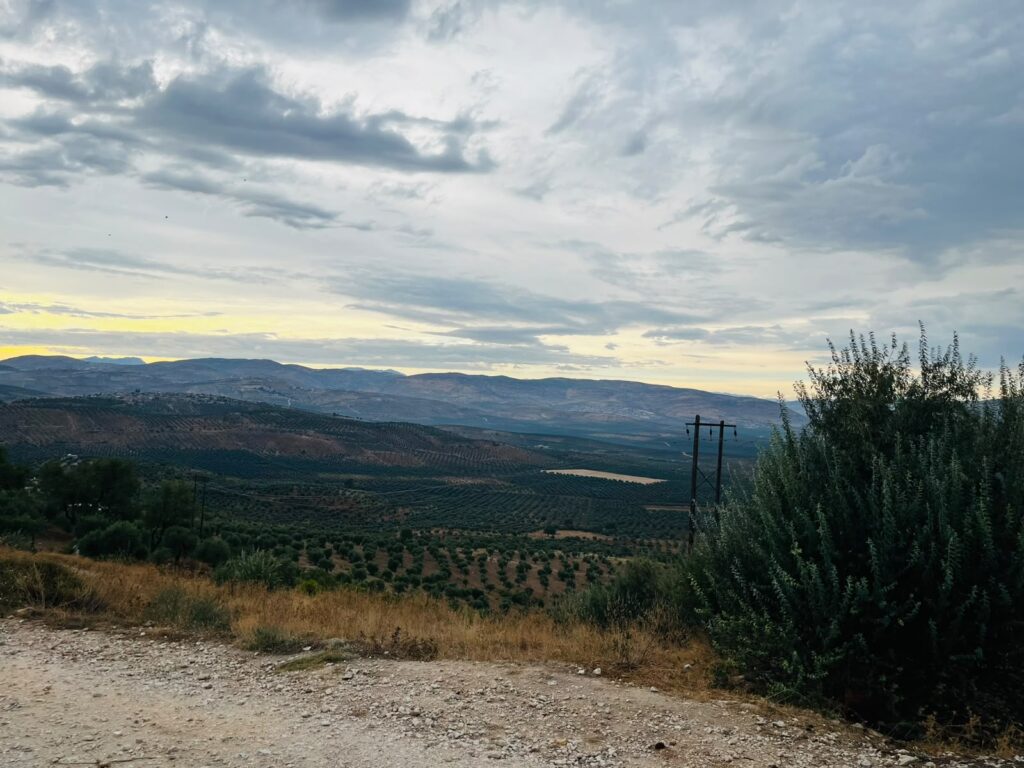
Views from my grandfather’s house balcony in the village. Source: Author
2018: Displacement and loss of land
That relationship changed violently in 2018.
On 20 January 2018, Turkey launched Operation Olive Branch in Afrin. During the final phase of the offensive, on 16 March, my family and I left. We walked for nearly fifteen hours while fighting and shelling continued. On 18 March, Turkish forces and allied armed groups took control of Afrin city. Amnesty International documented the risks faced by civilians during the offensive, while subsequent investigations documented violations including displacement, killings, arbitrary detention, torture, looting, destruction of homes and property, and restrictions on access to agricultural land after the takeover
Leaving Afrin was not only leaving a town. It meant leaving the landscape in which our family had lived and worked. My grandfather’s orchard, like many other orchards, was no longer a place that we could freely reach.
The environmental destruction did not happen separately from displacement and changes in land control. Estimates of the number of people displaced from Afrin in 2018 vary, but the displacement of much of the local population fundamentally changed who could access and use the land. Reports since have documented this destruction, and how it has deprived people of their livelihoods.
Reports since then have documented the cutting of forest trees and the destruction, uprooting, and unlawful seizure of olive trees and agricultural land, often through armed force and without regard for the rights of original landowners.
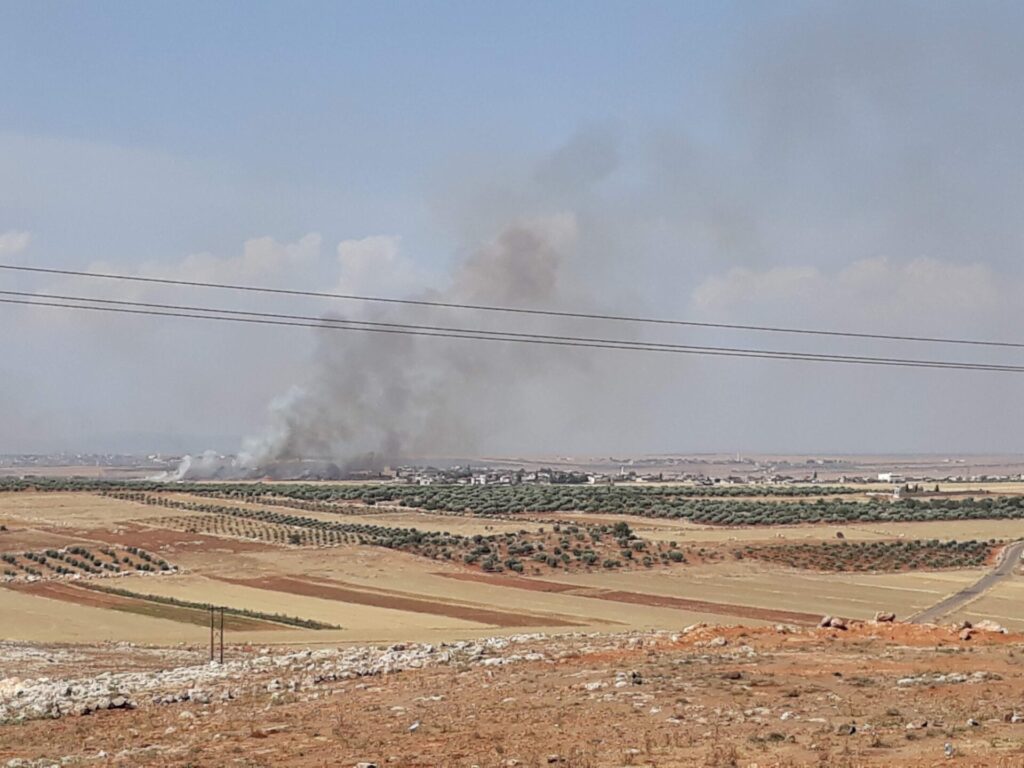
Smoke rising over agricultural land in Afrin during the 2018 violence. Source: Author
A United Nations Commission of Inquiry report documented the pillaging of olive harvests, which was a major source of income for thousands of people in Afrin. Satellite analysis and field investigations by Syrians for Truth and Justice have also documented extensive logging in forest areas and continuing violations involving housing, agricultural land, and property in Afrin.
The reasons for cutting trees have not been the same everywhere. Based on accounts I have heard from relatives and neighbours, trees were cut for several purposes: to clear land for settlements or camps, to establish military positions, to obtain firewood, and to sell wood in different markets. In some cases, people described the cutting as deliberate destruction of orchards rather than as an attempt to use the land productively.
The transformation of the olive economy was also significant. Before 2018, a family could cultivate its trees, harvest the olives, take them to a local olive press, produce oil, and benefit from the income. After the displacement, many original landowners could no longer reach their orchards. In some cases, families who entered the area after the offensive took unlawful control of agricultural land and harvested olives that were already growing there, while original landowners were denied meaningful access to their property. In other cases, agricultural land was seized and brought under the control of armed groups, while some original owners were prevented entirely from accessing their property.
Some landowners I spoke with also described being subjected to annual taxes and levies during the olive season. One account described these payments as reaching more than 35 percent of the value of the production. Such accounts should be understood as testimonies from landowners rather than as a figure that necessarily applies to every orchard in Afrin. Nevertheless, they illustrate how access to agricultural production became subject to new forms of control.
The result was not simply that some trees were cut down. The relationship between ownership, labour, cultivation, and the benefits produced by the land was also disrupted.
From trees to political ecology
This is where the story of the olive tree becomes a political ecology story.
Trees can be treated as economic resources, but this description alone does not explain what happened in Afrin. An olive tree also exists within relationships of land ownership, labour, care, memory, and political power. Who can access the tree? Who can cultivate it? Who can harvest its olives? Who receives the income from the harvest?
These questions matter because environmental destruction in Afrin cannot be separated from displacement and changes in control over land. Cutting or uprooting an olive tree can destroy part of an agricultural landscape, while preventing its original cultivator from accessing the land can change who benefits from what remains.
The accounts I have heard suggest that these processes occurred in different ways. Some trees were cut for wood or to clear land. Some orchards were damaged or uprooted. Some agricultural land was taken over and its existing olive harvests were collected by others. Other landowners were prevented from reaching their properties at all. Together, these practices weakened the relationship between local people and the land they had cultivated.
This is why the destruction of olive trees should not be discussed only as deforestation. Olive orchards are agricultural landscapes, not forests. Their destruction involves not only ecological loss but also changes in agricultural production, property, labour, and access.
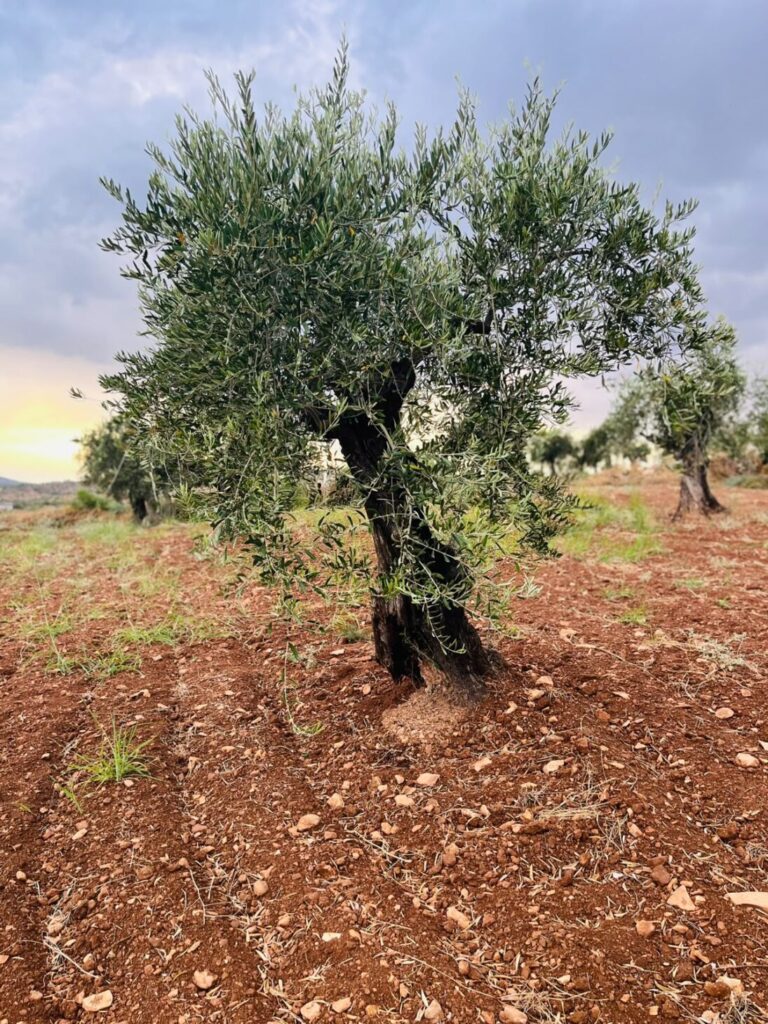
One of the old olive trees in the village. Source: Author.
What is lost when a tree is lost?
When an old olive tree is cut, the loss is not only ecological. It can mean the loss of income, food, agricultural knowledge, and a familiar landscape. For families whose lives were connected to their orchards, the tree could also carry memories of parents and grandparents and mark a physical connection to a particular village or piece of land.
I often think about my grandfather’s anger when that branch was broken. At the time, I saw it as a small family moment. Today, I understand it differently. His reaction expressed a way of living with trees in which care mattered. The tree was expected to survive the harvest and remain there for the next season, and for the next generation.
War can break that relationship. It can turn trees from living parts of a landscape into firewood, commodities, property, or objects of control. It can also make return more difficult by changing the land itself and the ways people can use it.
For my family, this loss is not abstract. Many of the trees in my grandfather’s orchard were cut. Some of the remaining land was unlawfully seized and came under the control of a family associated with a field commander of an armed group. We can no longer freely reach my grandfather’s house or orchard. We cannot even visit his grave.
The orchard is still physically there in some form, but our relationship with it has been interrupted. A place that once meant family gatherings, work, and memory has become a place that we can remember but cannot freely enter.
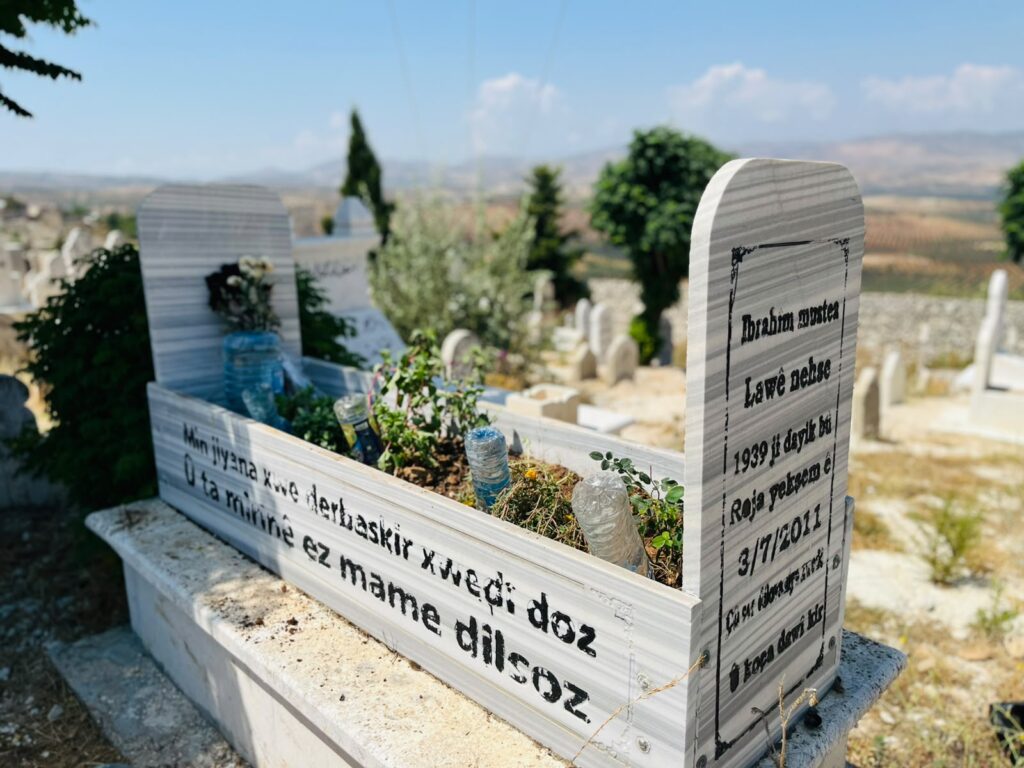
My grandfather’s grave in Mabata. Source: Author.
Remembering Afrin through its olive trees
This way of looking at Afrin also connects with earlier Undisciplined Environments writing on Afrin, which situated the violence within wider struggles over power, autonomy, and resources.
But the olive tree adds another dimension to this story. It allows us to see how large political processes become part of everyday life. Displacement, military control, property violations, agricultural exploitation, and environmental destruction are not separate experiences for people whose lives were built around the land. They can all appear in the same orchard.
Afrin’s story is therefore not only about destroyed forests or damaged orchards, or displaced peoples. It is about the transformation of relationships between people, land, and power. The olive trees show this transformation because they are at once ecological, economic, social, and deeply personal.
When I remember that autumn morning in 2016, I remember more than an olive harvest. I remember a way of living with the land. I remember people gathering around trees that had survived for decades, and I remember believing that they would still be there when we returned.
Today, when I think of Afrin, I still see those trees. But I also see what happened when people were separated from them. Understanding the destruction of the landscape is one way of understanding what was lost: not only trees, but livelihoods, agricultural knowledge, memories, access to land, and the possibility of continuing a relationship with a place.
The trees remain part of my memory. And perhaps that is why telling their story matters.
This article is adapted from an earlier version previously published on Medium.