
by Areti Angeli and Ombretta Giancaspro
From the “Virgin Land” myth to weaponized pine forests, this essay exposes how greenwashing masks the systematic erasure of Palestinian life. It reminds us that the struggle for decolonization and indigenous food sovereignty is the front line of a global movement to reclaim our collective ecological future.
“Eia pour ceux qui n’ont jamais rien inventé
pour ceux qui n’ont jamais rien exploré
pour ceux qui n’ont jamais rien dompté
mais ils s’abandonnent, saisis, à l’essence de toute chose
ignorants des surfaces mais saisis par le mouvement de toute chose
insoucieux de dompter, mais jouant le jeu du monde”
Aimé Césaire, Cahier d’un retour au pays natal
(“Eia for those who never invented anything
for those who never explored anything
for those who never tamed anything
but they give themselves up, captivated, to the essence of all things
ignorant of surfaces but captivated by the motion of all things
heedless of taming, but playing the game of the world”)
The zionist slogan “A land without a people for a people without a land” is not merely a historical fallacy; it is a fantasy of ecological dominance. It constructs a “Virgin Land” myth that positions the colonizer as a “saviour”, the sole creator of a green oasis, a bastion of western rights and environmental protection against a neglected, “barbarian” desert attributed to Palestinian mismanagement.
This narrative serves to greenwash occupation. Drawing on Malcom Ferdinand’s concept of the “double colonial/environmental fracture”, we argue that the zionist separation of Nature/Culture is instrumental to land theft.
Yet, colonial domination extends beyond the land to the body itself. Adopting an eco-transfeminist perspective, it is evident that the occupation operates a “war on reproduction,” enforcing a capitalist sterility on both the Palestinian indigenous landscape and body.
In this essay, we examine how ecology is weaponized as an instrument of erasure through the JNF’s afforestation projects that replace native biodiversity with European monocultures. Then, we analyze the biopolitics of the “Chosen Body,” exposing how Israel’s self-branding as an “eco-friendly” and “gay-friendly” country relies on casting the Palestinian as “savage” to justify elimination. Finally, we explore colonial control over agriculture and seeds, framing the recovery of heirloom seeds and food sovereignty by the Palestinians as acts of resistance against ecological and social erasure.
The syntax of “entangled history” proposed by Bashir and Goldberg is essential to dismantle the colonial apparatus. To fully comprehend the ecological devastation in Palestine, we must address how the historical trauma of the Holocaust is employed to justify and ethically mask the continuous Nakba.
In this framework, settler’s anxiety is projected onto the landscape: the security demanded to allegedly prevent another Shoah is translated into a need for total domination over the land and the erasure of the indigenous population. This turns Jewish trauma into a shield for settler-colonialism, where the “status of absolute victim” allows the state to reframe any Palestinian resistance as an existential and antisemitic threat.
Recognizing this connection does not mean to compare the two events but it means to refuse to allow historical Jewish suffering to be instrumentalized to justify zionist colonialism, and to render the Palestinian catastrophe invisible beneath the roots of the JNF’s pine forests.
ECOLOGY AS AN INSTRUMENT OF ERASURE
The Colonial Roots of “Ecology”
Coined in 1866 by Ernst Haeckel, “ecology” emerged from a framework of white supremacy and eugenics. Haeckel’s assertion that “politics is nothing but applied biology” was used to justify racism and Social Darwinism, turning European ecology into a tool for the colonial exploitation of Africa.
Indigenous knowledge and land stewardship were deliberately erased to make way for Eurocentric management and industrial capitalism, driving the continent’s ecological and social disaster.
To reclaim ecology for liberation, we must acknowledge its colonial roots and commit to dismantling the West’s racist storytelling. This acknowledgment is essential for moving toward a decolonial environmental justice.
The double colonial and environmental fracture
Malcolm Ferdinand argues that modernity’s “double fracture” – colonial and environmental – separates colonial history from environmental history, isolating environmental/ecologist movements from postcolonial/anti-racist ones.
The environmental fracture originates from modernity’s “great division” – a dualist opposition separating nature and culture, environment and society. This establishes a hierarchy that privileges humanity over nature justifying the “domestication” of the environment and non-human species through technical, scientific, and economic advances.
The colonial fracture divides humans and geographic spaces by separating European colonizers and non-European colonized people, whites and non-whites, masters and slaves, countries of the North and countries of the South. This fracture elevates the settler’s history and desires, subordinating the lives and lands of the colonized.
Current mainstream environmentalism, by overlooking black and racialized people from the debate and prioritizing “protection” over liberation, maintains and reinforces, rather than dismantles, the existing racist, speciesist and misogynous western social order. This leads to what scholars Malcom Ferdinand and Ghada Sasa identify as a “white elite environmentalism “.
This critique is reinforced by Andreas Malm’s exposition of the hypocrisy of western climate movements that mourn the loss of biodiversity while remaining silent on the genocide. He argues that an environmentalism that separates the protection of nature from the protection of the indigenous people living within it, is merely a “guardian of the colonial garden”: one cannot claim to defend the biosphere while ignoring the imperial war machine that is its primary destroyer.
Ferdinand proposes to make this double fracture a central problem of the ecological crisis, going beyond the lie of a universal “ecological crisis”. We are not all in the same boat, some are on the bridge of the ship, while others are in the hold, absorbing the engine’s fumes.
The Production of race and territory, despicable living beings and dumps
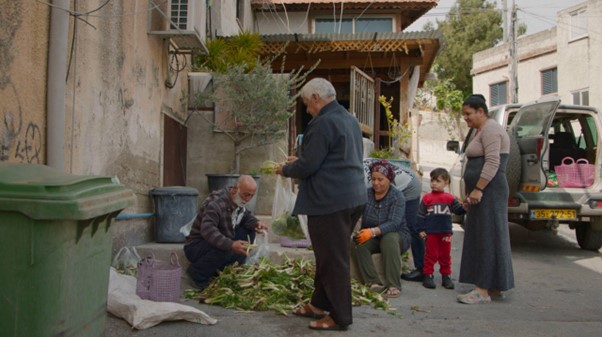
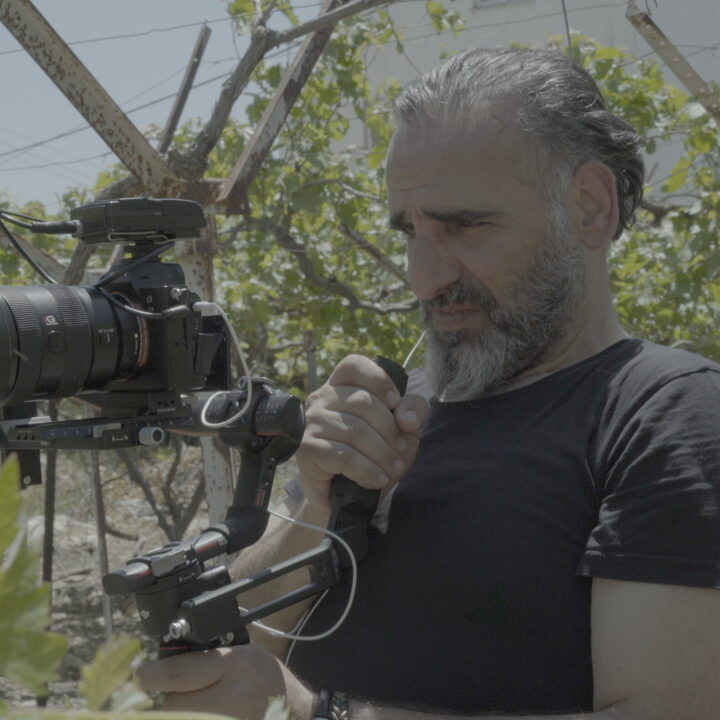
Still from the documentary Foragers (2022) by Jumana Manna.
Based on Malcom Ferdinand’s seminal book, “A Decolonial Ecology: Voices from the Caribbean World” (originally published in French in 2019 as Une écologie décoloniale), we argue that colonization exploits modernity’s “double fracture” by transforming these separations into instruments of domination: “to produce race and territory, to hierarchize individuals and lands, to produce respectable living beings and despicable ones, lands to be protected and dumps.”
Environmental toxicity is a physical continuation of social oppression, targeting already marginalized bodies -weakened by economic or racial discrimination- and forcing them to inhabit the spaces that the privileged abandon: the fence-lines of factories, landfills and the banks of polluted rivers.
This dynamic is deepened by Marco Armiero’s theory of the Wasteocene, an era defined by “waste relationships.” Since the colonial and capitalist state cannot function on equality, it creates a violent hierarchy in which waste is not just the physical trash we discard but a tool for organizing society. To produce value, hygiene, and purity for a select few (usually in the Global North or wealthy enclaves), it must produce contamination and waste for the many whose lives are treated as “wasted lives.”
This aligns with the colonial habitation: the “othering” of people – classifying them as poor, racialized, or “backward”- is the prerequisite for the “wasting” of their environment. The zionist project relies on these principles: by categorizing indigenous lands as wild and empty “nature”, settlers disguise land theft as “conservation” or “protection” while viewing the palestinian indigenous population as “deviant/waste”and a threat to that land.
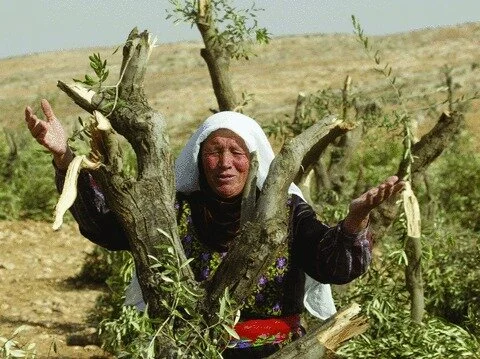
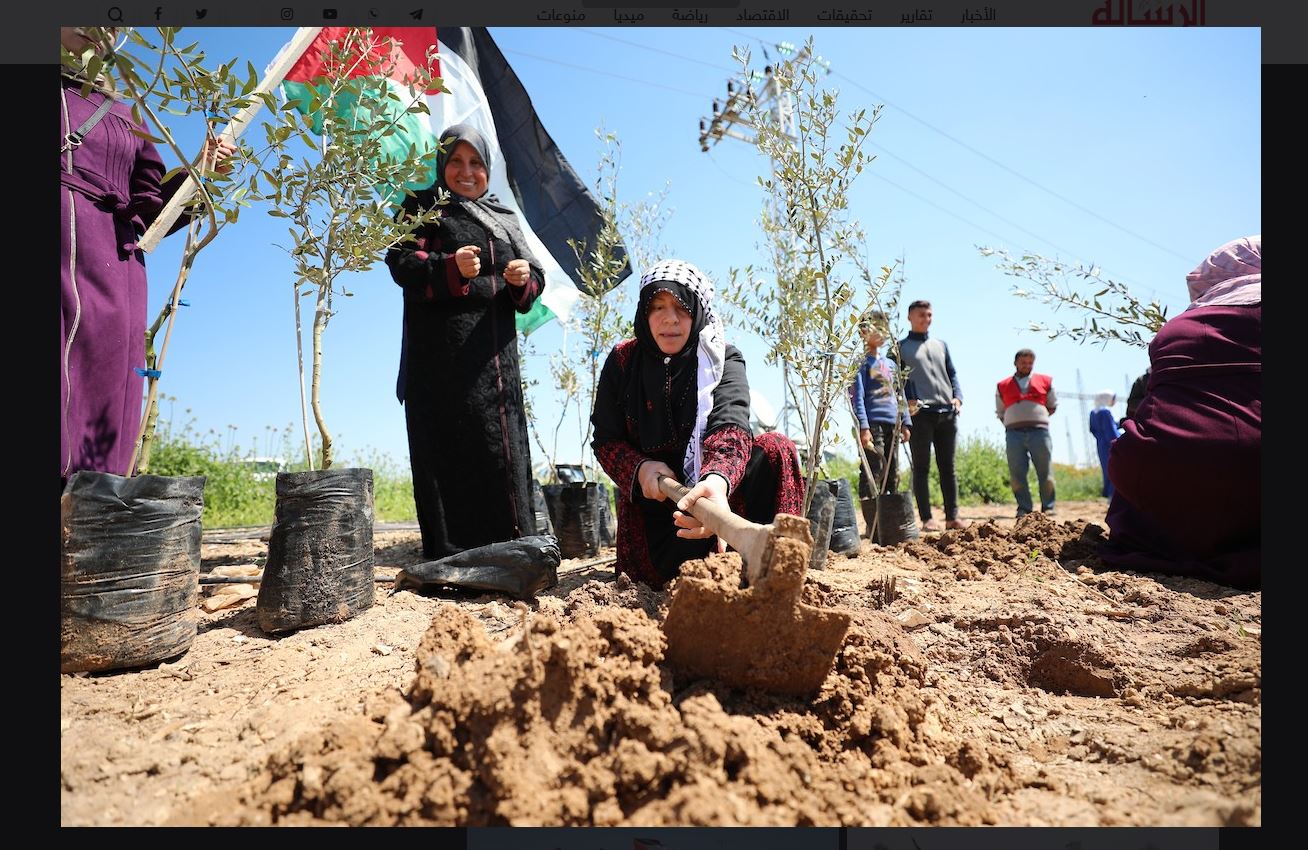
Palestinian woman lamenting the vandalization of her olive trees in Litwane, January 6, 2006, near the Jewish settlement of Ma’on – [REUTERS/Nayef Hashlamoun, 2006].
Trees as a Weapon in Palestine
“They cut down the tree, smash the stone, destroy the land: they fight everything that is a testimony to Palestinian history. They want to change the face of our land because they fear the truth it holds. But we have a weapon they cannot have, with which we resist all their attempts to drive us out: the ancestral love and duty to protect everything that grows on Palestinian soil. Palestine is our mother and we will never abandon her. This commitment to resistance is exactly what Israel is trying to eradicate.” — Omar, Palestinian farmer.
To understand the weaponization of ecology, we must situate it within the broader framework identified by Hanieh, Knox, and Ziadah: Palestine is not a mere conflict, but a structural and ongoing project of settler-colonialism intertwined with racial capitalism. In this context, the erasure of indigenous vegetation is the ecological parallel to the elimination of indigenous people.
Ecology is weaponized by the zionist entity in its expansionist and genocidal project to transform land from a communal means of production – supporting indigenous life and subsistence – into a controlled, militarized state asset. By systematically destroying the territories and their history, the land stewardship practices, the indigenous knowledge systems and the existing ecological relationships binding Palestinians to their land, it prevents their return.
Israel manipulates the natural environment to support an oasis of luxurious settler compounds in the West Bank, with palestinian resources rerouted away, and uses the occupied Palestinian territory as a dumping ground for its waste – causing damage to the groundwater resources and the environment.
Primarily through the Jewish National Fund (JNF), the zionist entity has long utilized the planting of exotic pines – reminiscent of European landscapes – on Palestinian village lands to annex territory and violently displace Palestinians under the guise of environmental protection.
This is an effort to conceal Palestinian existence and remake not only the environment but also cultural memory. This process involves eradicating native, centuries-old crops like carobs and olive trees to establish monocultures of European pines. These trees have a destructive impact on biodiversity by consuming excessive groundwater, acidifying the soil and raising the risk of fires, a danger made worse by climate change.
The zionist ecological model uses non-native homogeneity as a weapon severing the connection with both the inhabitants and the environment, securing land for the colonial system.
The erasure of the Palestinian landscape is not merely a byproduct of war, but according to Amos Goldberg and Bashir Bashir, a deliberate act of “spatial purification”. They argue that the zionist project requires the physical destruction of indigenous signs: villages, ruins and native vegetation.
The planted forests of the JNF thus function as a mechanism of denial: they cover the trauma of the Nakba with a greenery that mimics the European landscape, allowing the settler to feel “at home” while physically burying the evidence of the crime beneath the roots of the pine.
BIOPOLITICS OF THE CHOSEN
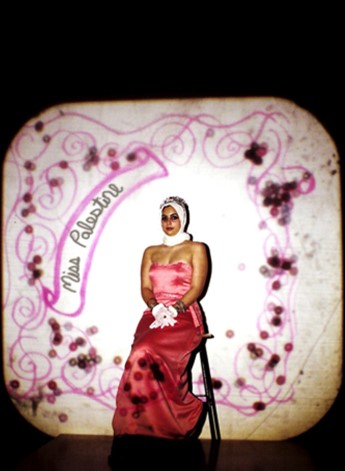
Jana Boulus, Self-Portraits: ‘Miss Palestine’, a visual stab at western culture and its many trivial obsessions.
The “Chosen Body” vs. The “Primitive Body”
Meira Weiss argues that the zionist revolution sought to create a new Jewish people in a new land – “masculine, healthy, powerful and perfect” – to replace the image of the emasculated diasporic Jew. This supposed “chosen body” achieved superiority through the manipulation of nature and the conquest of both the land and the Palestinian people.
This new identity, which aimed to transform the landscape of Palestine, justified Israel’s supposed divine right to the land. As Irus Braverman notes, “labor and the transformation of nature through labor in particular was central to the development of the new halutz ivri (Hebrew Pioneer): a Jewish farmer who cultivates the land and lives off the fruits of his labor”.
Early zionist s believed that planting would transform the “rootless cosmopolitan” Jew into a physical laborer with an “intimate connection to the Land”.
While the Israeli body aligns itself with “culture” and rational management of nature and of the land, the Israeli/American/western projection of the Palestinian/Arab body is more closely aligned with nature, thought of as primitive and unable to properly master resources.
In “Terrorist Assemblages: Homonationalism in Queer Times”, Jasbir K. Puar argues: “Muslim masculinity is simultaneously pathologically excessive yet repressive, perverse yet homophobic, virile yet emasculated” defining the racialized queer paradigm.
Through a selective acceptance of queer representation, in what Puar calls “homonationalism,” other queer identities become understood as homophobic, death driven and perverse to justify xenophobic, Islamophobic, or racist policies.
Israel’s self-marketing narrative as “Eco-Friendly” and “Gay-Friendly” operates as a biopolitical tool to “naturalize” the exclusion of Palestinians, designed to justify and preserve hegemonic control.
By framing itself as the only keeper of “progressive/western” values in the region, the state weaponizes liberal rights -both environmental and sexual- against the colonized, and Palestinians become depicted as “ecological savages” and “homophobic barbarians”. The apartheid is strategically justified by elevating the settler state as a heaven of rights and framing colonial violence as a defense of modernity.
THE COLONIAL CONTROL OVER REPRODUCTIVE LIFE AND SEEDS OF RESISTANCE
Colonial power operates also through a “war on reproduction,” enforcing a capitalist sterility on both the land and the body to ensure dependency. The system demands monoculture (uniformity in crops, binary in gender) because it fears the complexity, diversity, and self-reproduction of the indigenous /queer ecosystem.
This control disrupts the connection between the people and the soil, replacing “food sovereignty” with a biopolitical “food security” – or quoting Achille Mbembe a necropolitics. Colonial systems weaponize food to enforce control, as seen on Turtle Island where replacing traditional diets with “government cheese” and “mystery meat” disconnected indigenous people from their healthy relationship with the land and caused chronic diseases.
This strategy is mirrored in Palestine through the criminalization of wild “za’atar” foraging, which uses the guise of “conservation” to dismantle self-sufficient economies and force dependency on capitalist markets. Both tactics serve to police indigenous bodies and sovereignty by systematically severing their physical and spiritual ties to the environment.
The destruction of agricultural traditions by colonialism has historically targeted women, stripping them of economic independence and social status, and increasing their vulnerability to gender-based violence.
Against this enforced sterility, the recovery of seeds and land, as well as the claim of food sovereignty, become radical collective acts of anti-capitalist, decolonial, eco-transfeminist resistance against occupation and corporate dominance.
Vivien Sansour, founder of the Palestine Heirloom Seed Library, champions this by preserving threatened heirloom seeds. These are seeds that adapt to weather conditions, resist drought, water scarcity and do not require pesticides. It is an act that reclaims cultural heritage allowing farmers to recover control over their food systems and reject dependency on industrial imports.
This praxis aligns with the global movement La Via Campesina, which advocates for “peasant and popular feminism,” asserting that liberation requires access to land and the eradication of gender violence. The path towards global justice, today must be led by those resisting the intersecting oppressions of “heteropatriarchy, capitalism, racism, and colonialism”. Communities must reject the colonizer’s binary logic through mutual support, diversity and self-reproducing ecosystem.
As Laila El-Haddad’s “The Gaza Kitchen” shows, preserving indigenous cuisine and cooking native herbs (like those gathered by Palestinian women) is “Sumud” as well as protecting olives trees and heirloom seeds: steadfastness and resilience on the land, an assertion of culture, identity, and persistence against an attempted ecological and social erasure.
GLOBAL INTIFADA TOWARD HOLISTIC DECOLONIZATION
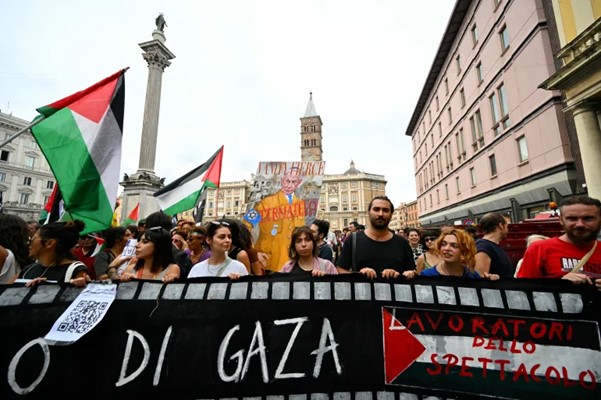
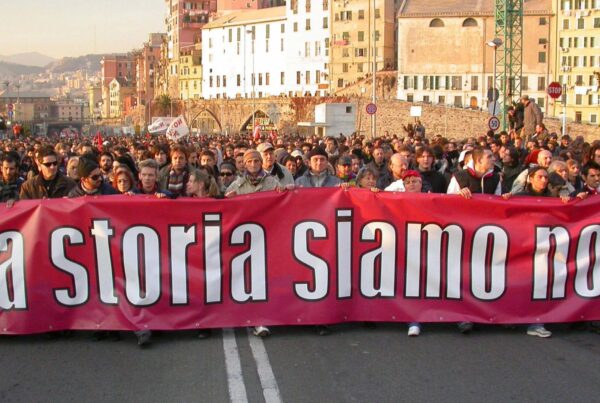
People march during the nationwide strike “Let’s Block Everything” in solidarity with Palestinians in Gaza and calling for a halt to arms shipments to Israel, in Rome on September 22, 2025 [AFP]
Horizontal Solidarity
The rise in global solidarity with Palestine is not a reaction to an isolated crisis: it maps the contours of a planetary colonial order.
Reading Palestine alongside Turtle Island, as Tabar and Desai suggest, reveals a shared logic of erasure: just as U.S. and Canadian “wilderness” parks were carved out of indigenous expulsion, the Jewish National Fund’s forests serve as green camouflage for displacement.
This is the essence of green colonialism. As Hamza Hamouchene defines it “is the extension of colonial relations of plunder and dispossession to the green transition era, as well as the displacement of the socio-environmental costs of this transition to the Global South.”
It replaces communal, multispecies ecologies with landscapes engineered for accumulation of capital – tourism, real estate, and extractive monocultures. When western environmentalism ignores this dynamic, it stops being a movement for protection and becomes an accomplice to dispossession.
Andreas Malm provides the historical anchor for this horizontal solidarity, arguing that the colonization of Palestine and the destruction of the planetary climate are fuelled by the same source. Malm identifies Israel not just as a settler-state, but as a strategic outpost of the US-led “Fossil Empire”.
Inevitably, the Palestinian resistance intersects directly with the global climate struggle. If the zionist entity serves to secure the flow of fossil capital in the region, then a Global Intifada is not merely a political necessity for human rights, but a planetary imperative: dismantling the colonial machine in Palestine is a prerequisite for halting the engine of ecological collapse.
Beyond Statism Toward Holistic Decolonization
Environmental justice cannot be achieved within the confines of capitalist nation-states. A post-statist framework, as the one proposed by Smessaert and Feola, rethinks democracy as the collective generation of autonomy rather than a fixed institutional design.
This requires acknowledging that non-deliberative political forms -insurrection, refusal, ritual practices, and multispecies modes of care- are not irrational disruptions but democratic expressions. Further research should explore how autonomous human and multispecies communities form, persist, and resist within capitalist and colonial infrastructures, and how they destabilize state-centered ideas of agency and governance.
Indigenous Palestinian principles such as “a’wna” (collaboration) and “tawhid” (unity) offer potential alternatives to the domination-ecology of capitalism, gesturing toward non-binary, non-extractive relationships with the earth that honors interdependence.
Daniel Boyarin offers a radical Jewish manifesto that argues for a decoupling of “nation” from “state”, proposing that the true essence of Jewish existence is diasporic, defined by coexistence and study rather than sovereignty and borders.
By rejecting the “chosen zionist body” that necessitates fences and monocultures, Boyarin envisions a future where Jewish safety is not built on domination but on a “diasporic solidarity” with all oppressed people. This challenges the very logic of the ethno-state, suggesting that the dismantling of the colonial apparatus is not an erasure of Jewish life, but a return to a more ethical, non-hegemonic mode of existence.
In this framework, the healing of the double colonial/environmental fracture reveals that true collective liberation of the oppressed requires a global Intifada -understood as a collective refusal of the borders and walls that facilitate extraction.
To achieve holistic decolonization demands the total dismantling of the “Virgin Land” myth, exposing colonial “green” narratives as necropolitical weapons of erasure and apartheid. By recognizing that the forced sterility of the landscape mirrors the systemic control over Palestinian bodies, we see that the struggle for the land is inseparable from the struggle for the flesh.
Considering a Global Intifada that targets the core of the “fossil empire” – a system that treats indigenous lands and lives as throwaway fuel for accumulation – we must reject the empty promises of liberal environmentalism.
True ecological restoration is not a mere conservation project; it is an act of radical return, where the healing of the planet is contingent upon the liberation of Palestine and the unconditional restoration of its indigenous human and non-human kin to their rightful home.
Authors’ Note
This article arises from a personal need of the authors to explain how western conceptions of ecology have been used as a “green” weapon for indigenous erasure around the globe, serving capitalist and colonial interests. Concerning the ongoing genocide of Palestinians, for 77 years now, it is inevitable to confront the ways in which the state of Israel leverages European ideas about ecology to justify its genocidal and ecocidal crimes in Palestine.
It is important for us to develop a political analysis that fully recognizes the patriarchally structured ideology supporting the creation of colonial systems. For this reason, we attempted an eco-transfeminist analysis from below, to explain the environmental and colonial crisis as deeply connected with the marginalization of the bodies, and extend it to all humans and non-human bodies that are not-white-middle/upper class-males. It is a choice of terminology that has a long history and therefore we took great care in writing the article.
As writers, we would like to express our undivided respect to all people who have been actively fighting for so many years for the creation of a society that is just, horizontal, and respectful of all the beings and ecosystems. We thus send our unwavering support to the struggle of the transfem movement and of all oppressed people of this world. From Palestine to Yemen, Sudan, Congo, Myanmar and every oppressed population of this world, till the complete decolonization and freedom of all.