
By Juan Alberto Gran
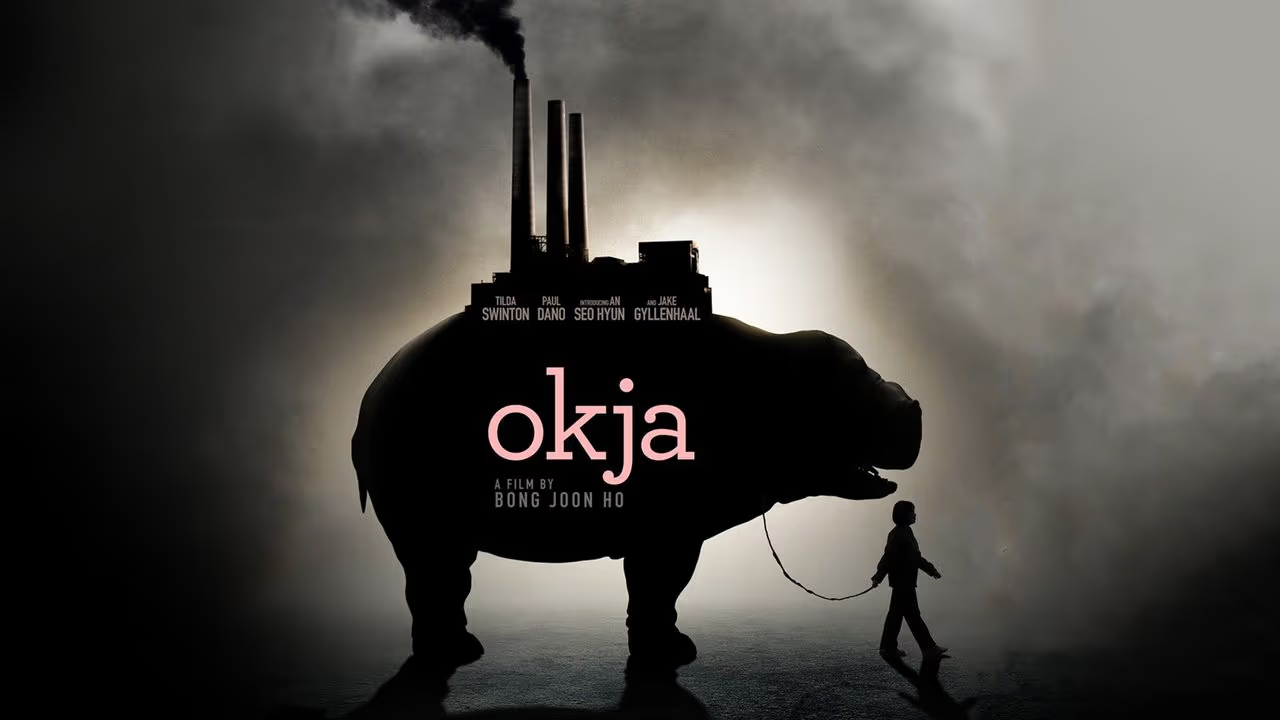
Through its diverse works and artistic expressions—particularly cinema—science fiction creates stories that serve as a window through which we can observe and reflect on our own existence. This article discusses and examines some of the causes and implications of the contemporary environmental crisis through such expressions, based on the film Okja.
Science fiction presents narratives that invite us to reflect on vital issues in our world, on how societies are organized, and, above all, on the consequences tied to the production and use of science and technology. At the same time, by presenting cultures and civilizations beyond our everyday environment, science fiction offers the possibility to imagine new worlds and the beings that inhabit them, as well as different cultures and civilizations that employ science in distinct ways. This is something that Undisciplined Environments has previously explored through other authors, from stories such as Game of Thrones or The Walking Dead.
Based on the above, my objective is to present a critical reflection on the environmental crisis using the film Okja (2017), part of the cinematic work of Bong Joon-ho, as a point of reference. With the purpose of extending the reach of political ecology into the discussion and analysis of case studies whose geographical and temporal location is defined by the worlds depicted in science-fiction works. Before addressing Okja in detail and its relevance for better understanding the causes and implications of the environmental crisis we face today, I would like to lay out some foundations from political ecology.
For Robbins, political ecology is articulated through five central theses:
- Degradation and Marginalization. The integration of productive systems into regional and global markets, together with state-led development interventions, promotes practices of overexploitation that deepen inequality and poverty.
- Conservation and Control. Many institutional conservation initiatives displace local communities and reconfigure their subsistence systems, generating new forms of dispossession.
- Environmental Conflict and Exclusion. The appropriation and enclosure of resources by powerful actors produce scarcity and exacerbate conflicts among social groups differentiated by class, gender, or ethnicity.
- Environmental Subjects and Identities. Contemporary regimes of environmental governance generate political identities linked to ecological concerns, capable of articulating diverse actors around shared struggles.
- Objects and Political Actors. Non-human elements actively participate in environmental disputes, influencing power relations and transforming in the process.
Now then, why not imagine a political ecology of science fiction?
Exploring science fiction from this perspective makes it possible to examine the links between narratives and the ways they shape our sensitivity and understanding of the environment, as well as to understand how societies produce and transform their relationships with the non-human world. With this in mind, let us move to the analysis and apply some of what has been discussed above.
Okja by Bong Joon-ho as a Lens for Discussing a Political Ecology of Science Fiction
Okja tells the story of Mija, a young girl who lives with her grandfather in a rural region of South Korea and who has cared for Okja, a “super pig” created by the multinational corporation Mirando, for years. The company presents Okja as a “sustainable” production strategy designed to address global food problems through genetic engineering, a reduced environmental footprint, and productive efficiency.
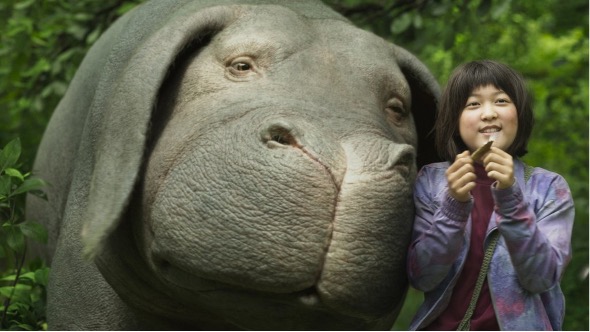
Mija and Okja in the mountains of South Korea. Source: Okja [Film], by J. Bong (Director), 2017, Plan B Entertainment.
Mija’s quiet life is disrupted when Mirando executives decide to take Okja to New York to showcase her as proof of the biotechnological program’s success and subsequently slaughter her in the corporate abattoir. In response, Mija embarks on a rescue journey that brings her into conflict with various actors: corporate executives, scientists, activists from the Animal Liberation Front (ALF), global consumers, and the industrial machinery that sustains contemporary agro-food production. As we will see, the story offers ample material for reflecting on the five theses of political ecology.
Regarding the thesis of degradation and marginalization, the experiences of Mija and her grandfather illustrate the unequal incorporation of rural communities into global value chains. Although they participate in Mirando’s project, they hold no control over the terms of exchange nor over the life of the animal they have cared for over the years. The supposed “opportunity” the company presents—caring for a super pig—does not yield material benefits for the family; instead, it positions them as subordinated links within an intensive agro-industrial chain.
Though degradation does not appear as overt environmental destruction but rather as socioeconomic degradation, the film portrays how the family becomes dependent on corporate decisions made thousands of miles away. Simultaneously, the rural environment is instrumentalized as an experimental laboratory for a food-production project designed to serve interests oriented toward economic profit.
With respect to the thesis of conservation and control, the film reveals a process of corporate conservation of genetic resources; Mirando therefore treats Okja as a commodity subject to private property rights. Through a strict regime of biotechnological control, the corporation constructs an entire narrative of “care,” “animal welfare,” and “sustainability” that functions as a façade for exercising total control over the bodies of super pigs.
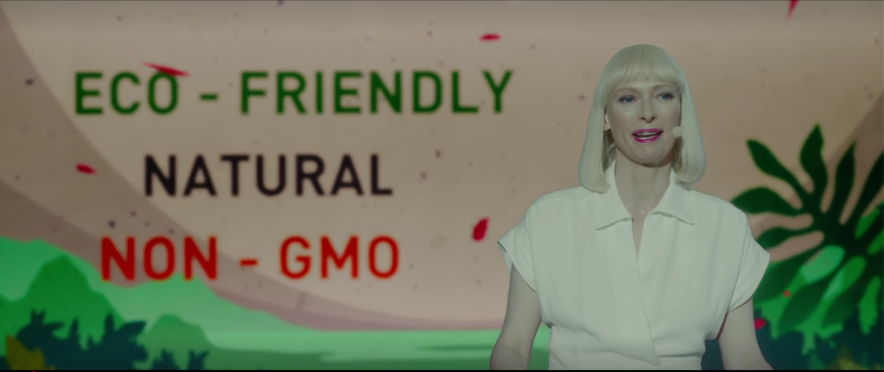
Lucy Mirando, CEO of the Mirando Corporation. Source: Okja [Film], by J. Bong (Director), 2017, Plan B Entertainment.
Mija’s attempt to recover Okja runs into various bureaucratic and regulatory mechanisms that establish that Okja’s life has been governed since birth by patents, protocols, and intellectual property. During Okja’s capture, the company invokes sustainability discourses that obscure a structural violence: genetic experimentation, confinement, and even mass slaughter of other super pigs. This form of animal control represents not only physical violence but also epistemic violence, as the corporation defines what counts as a “good,” “sustainable,” or “useful” life.
The thesis of environmental conflict and exclusion becomes evident as various actors dispute sovereignty over the life of the super pig. Mirando enclosed a resource—the biological value of super pigs—and transformed it into absolute private property. This enclosure triggers multiple forms of exclusion: rural caretakers cannot make decisions about their animals; activists lack legal standing because corporate property prevails over ecological morality; and consumers are excluded from transparent information about the origins of their food.
The confrontation among the corporation, the ALF, and Mija highlights that scarcity—and the exclusion and violence it generates—is a political construction that serves to secure control over power relations: the company creates the need for efficient meat, invents a “sustainable” solution, and then controls its distribution.
The relationship between Mija and Okja is a paradigmatic example of the thesis of environmental subjects and identities. This is evident in the way Mija builds and sustains an affective bond with the animal, a bond that transcends production logics. Her struggle to recover Okja, while initially grounded in personal necessity, evolves into a political act that links rural communities, international activists, and consumers of the meat industry.
Gradually, Mija’s quest ties her to the Animal Liberation Front (ALF), a group that embodies a transnational environmental identity based on defending living beings against agro-industrial capitalism. The ALF’s agency emerges through ethical and political opposition to the corporation and is sustained by alternative forms of knowledge and action.

Jay, leader of the Animal Liberation Front (ALF). Source: from Okja [Film], by J. Bong (Director), 2017, Plan B Entertainment.
Finally, regarding the thesis of non-human objects and political actors, the film foregrounds the agency of non-human entities within power networks. Okja, the super pig, is the most evident case: she is not a passive object, but an actor endowed with different social, economic, and affective meanings depending on who perceives her. She exhibits behaviors, decisions, and responses that directly influence human actions—from saving Mija on the mountain in the film’s early minutes to refusing to be transported to New York from the laboratory.
What Cinema Teaches Us —In This Case Okja— About the Contemporary Environmental Crisis
Okja clearly reveals how a corporate narrative that frames the solution to hunger as a business opportunity illustrates the extent to which the commodification of life—both human and non-human—can be concealed beneath discourses of sustainability and social responsibility. In this context, genetic manipulation appears as one of the most extreme expressions of such logic, transforming organisms into commodities optimized for industrial reproduction.
Thus, analyzing Okja through a potential political ecology of science fiction reveals at least two broad forms of relationship between society and the environment: on the one hand, through the Mirando corporation, whose logic responds to market interests and to the control of Okja as private property legitimized by sustainability discourse; on the other, through Mija, who sustains a clear sense of self and place grounded in an affective relationship of care toward Okja—a relationship that, when threatened, activates political actions aimed at recovering and preserving it. This difference is crucial if we wish to question and construct new ways of confronting the challenges posed by processes of environmental exploitation and degradation.