
By Calico
Drawing from on-the-ground direct action as a volunteer with the International Solidarity Movement (ISM), this essay details the violent realities of Israeli apartheid and occupation and the ways in which Zionist settler colonialism attempts to break Palestinian land relations. It also offers a window into Palestinian resistance and sumud (steadfastness) while illustrating how the Israeli state greenwashes land grabbing, ecocide, and ethnic cleansing.
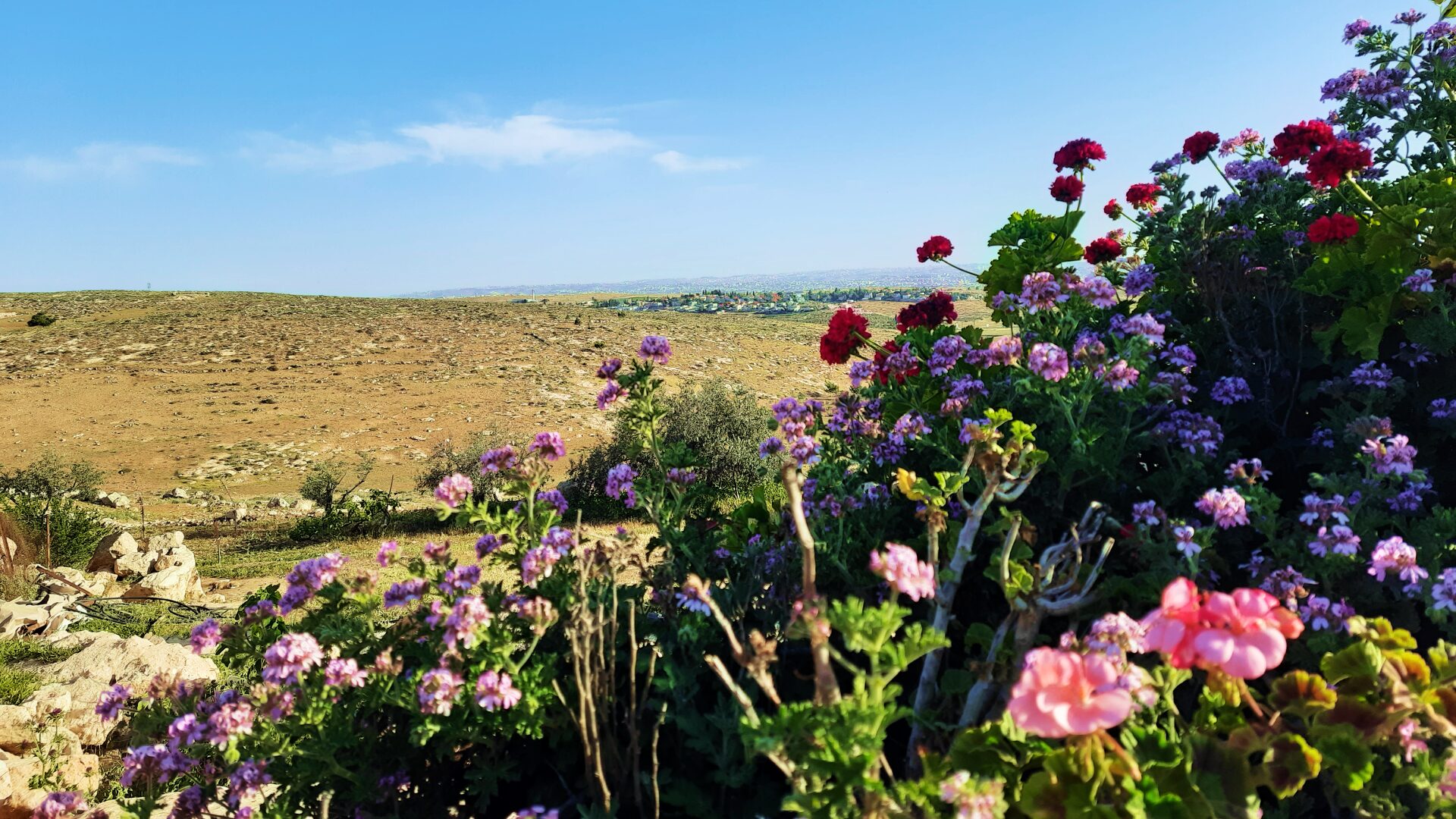
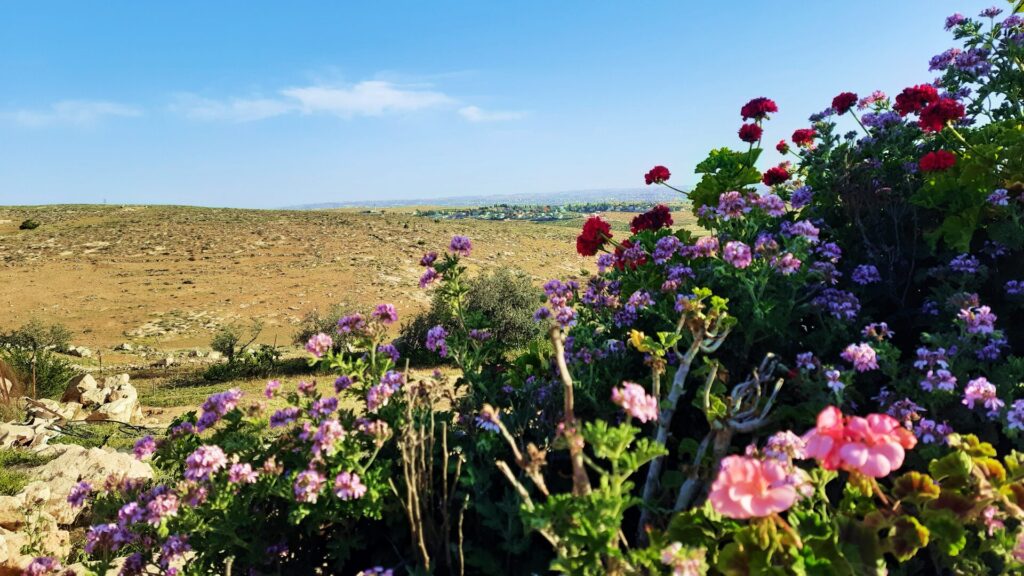 A Bedouin woman’s flowers in the Palestinian countryside. Credit: ISM
It starts with the grating sounds of occupation—clanging rusted iron gates and racial hatred that is as caustic as it is contemptuous. Checkpoints lock, bulldozers rattle, assault rifles are chambered, and “Death to Arabs” is shouted by scornful settlers. With shocking and surreal regularity, conscripts from the Israeli Occupation Forces (IOF) bully little Palestinian girls riding bikes, commanders place hoods on young Palestinian men detained at gunpoint, and soldiers watch with satisfaction as Palestinian lands and homes are stolen and razed.
Welcome to the occupied West Bank; where the dispossession, dehumanisation, and humiliation of Palestinians at the hands of the Israeli apartheid regime are a daily occurrence. Make no mistake, however, it is all part and parcel of the Zionist movement’s broader settler colonial project. For well over a century, Palestine continues to be placed in the crosshairs and carved apart by the destructive advance of colonisers, capital, and empire. Isolated families are enduring a militarised Zionist onslaught designed to eradicate Palestinian life.
I witnessed this reality firsthand during my time on-the-ground in the West Bank, from recording a home demolition in Masafer Yatta to being forced on my knees and brutalised by IOF soldiers while staring down the barrel of a gun. My team also responded to a settler-initiated shooting in Al-Rakeez that left a Palestinian shepherd with an amputated leg and his son jailed for verbally accosting the perpetrator. We later navigated the aftermath of a Jordan Valley night raid in which a settler lynch mob ambushed and pepper sprayed a Bedouin family before slashing the leg and wrapping a chain around the neck of a young Palestinian student.
 Israeli settlers attack Palestinians and set fire to olive trees. Credit: ISM
Amid attacks like these, settler “farming outposts” rise on hillsides while evictions are carried out through the establishment of military “firing zones” and ever-expanding illegal Jewish supremacist settlements. When driving through the remote Jordan Valley to drop comrades off for night watches with rural Bedouin families, I skirted by fortified Israeli settlements with paved roads, manicured lawns, and signs advertising “sustainable ecotourism.” The contrast was stark, unequivocable, and revelatory about the degree to which the comforts, luxuries, and curated landscapes of Zionist settlements are direct products of the theft of Palestinian lands and waters.
Israel’s attempted annexation of West Bank is as palpable as it is premediated. Palestinian communities are suffocating under separation barriers, surveillance drones, and the imminent threat of arbitrary imprisonment, which is sanitised rhetorically as “administrative detention.” Amidst the naked violence, neither recognition nor respect for Palestinian land relations cross the settler coloniser’s mind—only conquest.
Since the Nakba (“Catastrophe”) of 1948, when over 750,000 Palestinians were forcibly driven from their homes, sent on death marches, and massacred in cold blood, Israel’s twofold aim has remained the same: expulsion and elimination. Indeed, Zionism’s colonial project is defined by deracination and genocide. Space is weaponised, Palestinian land relations are severed, and mass graves proliferate.
At present, confiscated fields, seized waters, and internationally prohibited settlements serve the same trifold function: to uproot Palestinians, make life unbearable, and wipe Palestine off the map. I felt this viscerally as our team documented settler pogroms that left Palestinian homes with their doors ripped off, walls blackened by arson, and greenhouses set ablaze. Families reeled in shock while trying to pick up the pieces and recover their scattered, broken, and burnt belongings. It was all clear and undeniable evidence of a ruthless Nakba that has indeed never ended.
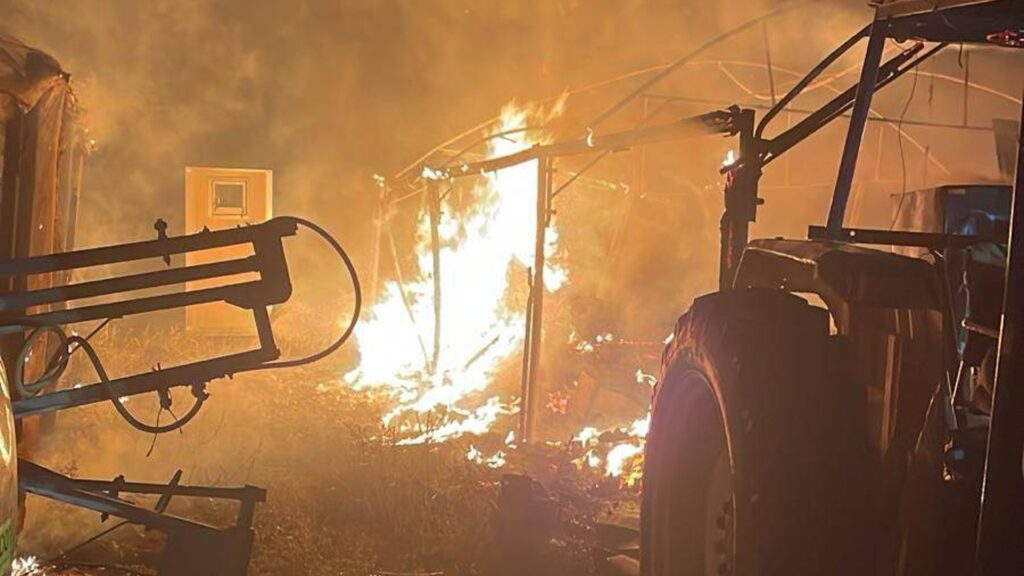 A Palestinian farm burns after a settler raid and arson attack. Credit: ISM
Palestinian Land Relations, Resistance, and Sumud
Politically and in practice, Palestinian land relations constitute a continuity of presence and enduring rootedness. Amongst the communities I visited, land is inextricably linked to memory, livelihood, and identity. It is also the foundation and lifeblood of liberation and survival. Terraces shaped across decades, wells dug by hand, and olive groves nurtured for generations are living records of territorial belonging and time-honoured environmental relationships.
During one post I had with a Bedouin community in the rural Jordan Valley, an elder shepherd walked me across the rocky hills where his family has grazed sheep and goats for generations after quietly praying. Pointing to fields cultivated by his ancestors, he solemnly reflected: “If we lose this land, we lose our history, our work, and the only future our children have.” For decades, Zionist colonial violence has targeted—yet failed to vanquish—these, deep connections, attachments to place, and longstanding memories.
Racist pogroms, legislative enclosure, forced displacements, and greenwashed land grabs persist as key pages in Israel’s ethnic cleansing playbook. Across the occupied West Bank, greenwashing occurs when Israeli authorities and illegal settlements peddle criminal annexation activities that include restricting water, levelling Palestinian villages, and destroying seed banks as “sustainable” and “eco-friendly.” Environmental branding is cunningly used by the Israeli state and ethnonationalist settlers to veil the violence of dispossession.
The significance of land became most visible to me during moments of terror and trauma. I watched families replant crops and rebuild homes—with steadfastness (sumud)—after arson attacks, night raids, and armed demolitions. On one blistering summer day, settlers arrived to harass a Bedouin family. They taunted and shoved both elders and children while an Israeli reservist soldier, previously filmed killing a Palestinian while undercover, stood and watched. When IOF patrols arrived, the settler accused the family of being aggressors, leading the army to detain the family at length under the sweltering sun as retribution.
Despite the abuse, the family, in this instance led by Palestinian women who refused to back down, stood their ground in open defiance. They were asserting their agency, right to remain, and, pointedly, land relations.
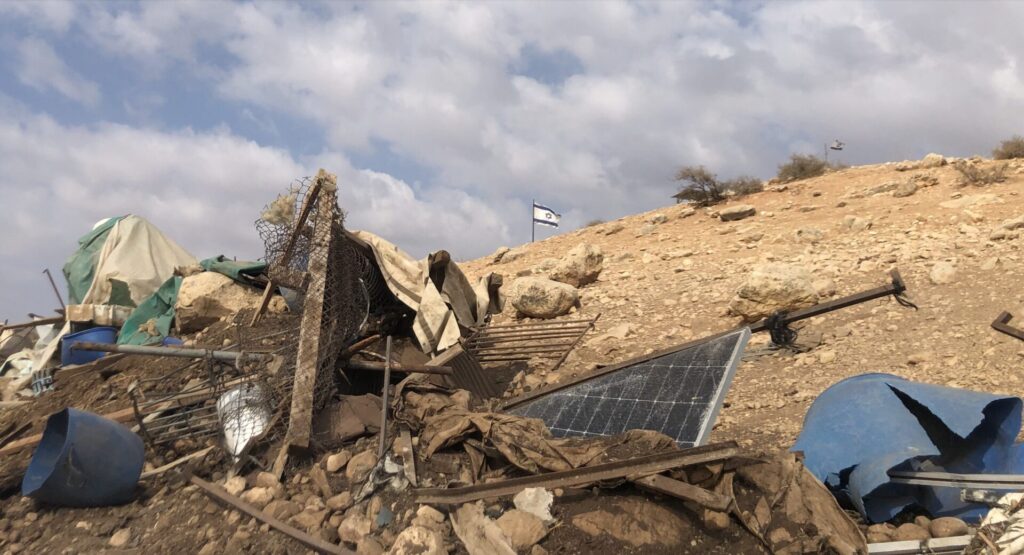 Demolition of a home, solar panels, water tanks, and trees. Credit: ISM
Each sapling planted in ground charred by fire and every wounded sheep offered aid after a settler-instigated mass slaughter exemplify resistance. Intergenerational acts like these also counter arguments that Palestinian territories were a terra nullius (“empty land”) that was predestined to be “a land without a people for a people without a land.” They also reveal how colonial-capitalist worldviews desecrate, desacralise, and distort land and nature into mere real estate assets, commodities, and merchandisable products that must be sacrificed at the altar of Israeli “national development.”
As Indigenous people have illustrated for centuries, they —and their land relations— refuse to go quietly into the night when subjected to the violent machinations of settler colonialism and exploitative logics of capital. Here, let us neither dismiss nor disavow the moral imperative and legal right occupied and oppressed people have to armed struggle. From Chiapas to Palestine, Indigenous land relations often come with a duty to defend territory because it is undeniable that human dignity and collective survival are worth fighting for.
What I saw across the West Bank were territorial relations anchored in care and responsibility. Palestinian farmers and shepherds affirmed their presence on the land because it carries their genealogies and a sense of who they are. What one bears witness to in Palestine are understandings of land that depart from private property, profit motives, and rent seeking. Rather, relationships are shaped by stewardship, service, and mutual bonds that bind Palestinian communities and cultural heritage to ancestors, seeds, and soil.
A case in point is during the olive harvest when our civil protection teams see and experience such relations up close and personal. We work alongside Palestinian families as they gather olives from trees planted generations ago. Each basket filled seems less like a chore to be done or task to be completed and more like expressions of resistance and acts of reaffirmation. Labouring in an olive grove together is only one manifestation of a multitude of shared memories and practices of collective work that make life meaningful and tie Palestinians to the land.
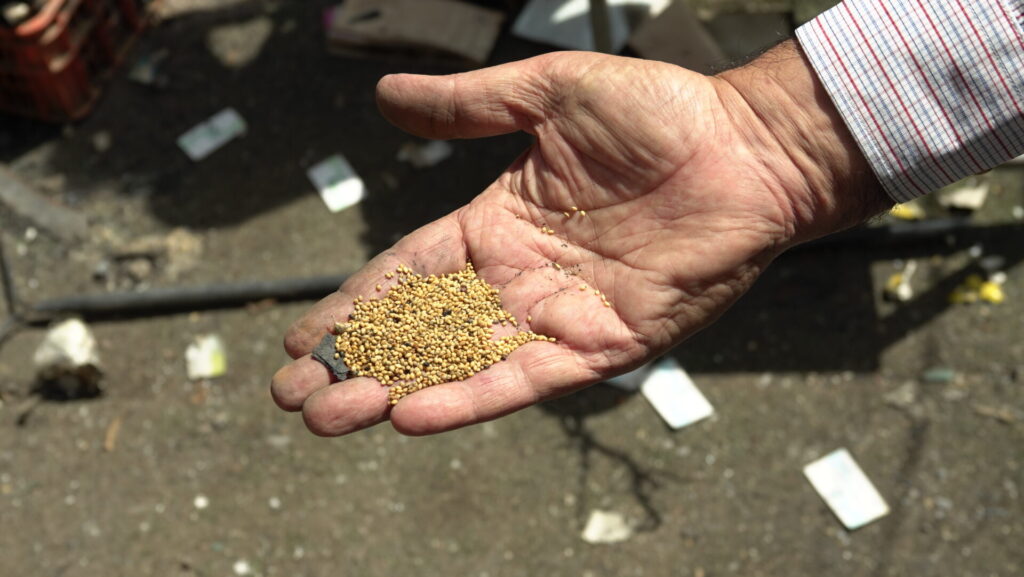 A Palestinian farmer saves seeds after a Zionist attack. Credit: ISM
Greenwashing Ecocide, Ethnic Cleansing, and Racism
Israeli policy and illegal settlements function as the prevailing instruments of environmental apartheid and ecocide in the West Bank. What are framed as matters of “national security” and “ecological restoration,” in practice, are schemes used to forcibly displace Palestinians and obscure the barbarity that makes expulsion possible. In short, conservation has become a bureaucratic weapon deployed by the Zionist movement to carry out green colonialism and ethnic cleansing.
The clearest example lies in European pine forests planted by the Jewish National Fund. The forests sit directly atop destroyed villages depopulated during the Nakba. Lands cultivated, irrigated, and lived in by generations of Palestinian farmers and pastoralists were deemed vacant. The imported pines suppress native vegetation, acidify soil, and are highly flammable. What now appears “natural” to the untrained eye is covering up crimes against humanity.
Similar dynamics underpin Israeli nature reserves and national parks. Entire hamlets have been dislocated and labelled as “protected areas.” Stolen fields are reallocated for settler agricultural entrepreneurship while grazing contracts are a prelude to land grabs. Once Palestinians are evicted, their smallholdings are rebranded as ecological sanctuaries. Land is weaponised twice —first through dispossession cast as “sustainable development,” then by Israeli claims that said theft is “saving” the environment.
Greenwashing also operates through infrastructure and architecture. Israel promotes itself globally as a pioneer in renewable energy and hydrological innovation while confiscating solar panels, sealing water cisterns, and diverting aquifers to illegal settlements. Palestinian farmlands are restricted under a pretext of environmental regulation while industrial settler agribusinesses expand through state subsidies. Such phenomena reveal a cynical strategy: Israel employs environmentalism to justify its systematic theft of resources and displacement of Palestinians.
In addition, racial tropes stereotype Palestinians as uncivilised invaders and terrorists who know neither how to care for, nor “modernise” the land. A cycle of enclosure and expropriation is reproduced through “concerns” related to national safety and environmental preservation. Zionist imaginaries and discourses related to “making the desert bloom” revive colonial fantasies that paint Palestinian lands as uninhabited and barren—a desolate frontier in need of being made “productive” and “protected” by the hands of the settler.
The Olive Harvest and Ravages of Zionist Occupation
 Palestinian women collectively harvesting in an olive grove. Credit: ISM
If there is a single season that captures the savagery of the occupation in full, it is the olive harvest. For Palestinians, the olive tree represents life. Some have stood for centuries, their resilient and weathered trunks rich with history. Each autumn, families return to the groves, spread nets beneath branches, and work from dawn until the light fades.
This year, the harvest was defined by both constant threat and harrowing death. Settler mobs, often masked, roamed the hills with weapons. IOF soldiers appeared alongside them to “maintain order”, e.g., arrest and deport activists. What ensued was fanatical settler brutality incarnate. In some groves, trees had been cut down with chainsaws or set on fire by Zionist intruders. In others, Palestinian landworkers laboured under duress for only a few hours before being ordered to leave at gunpoint by IOF commanders or be beaten by Israeli settlers.
Violence during the harvest is rarely spontaneous but always deliberate. It follows a recognisable pattern —harassment when the fruit ripens, intimidation and assault amidst the picking, and vandalism or theft after the harvest is collected. The cumulative effect is a debilitating combination of psychological trauma, physical injury, and lost income. Over time, Palestinian families abandon groves because they are too perilous to enter. The Israeli state then classifies the land as “uncultivated” and transfers it to settlement councils.
Yet, year after year, the harvest continues. For Palestinians, to pick olives under duress and in such dire circumstances is to resist —an act of both defiant self-determination and insurgent social reproduction. Farmers laugh as they carry sacks of fruit past checkpoints, unintimidated by IOF soldiers who do not understand that the arc of history bends towards justice. It is the concurrent practice of oppositional consciousness and insubordinate praxis, a quiet refusal to disappear and a way to (re)assert that Palestinians, their land relations—and Palestine itself—will remain.
I left the West Bank with the sense that one of the occupation’s gravest errors is its ignorance and gross misunderstandings of time, place, and presence. Colonisers, capitalists, and settlers think in terms of annihilation, accumulation, and individual property rights. Oppressed Indigenous people think in terms of ancestral memories, reciprocal land relations, and future generations. Olive trees have deep roots and grow slowly—they forget neither the hands that sow their seeds and care for them, nor those that sever their branches and scorch the earth.