
By Jan Selby
The UK’s new National Security Assessment on biodiversity has been lauded by environmentalists. But it is utterly incoherent, representing little more than a rehashing of tired Malthusian assumptions and ideas.
The UK government’s new National Security Assessment on Biodiversity Loss and Ecosystem Collapse has drawn much fanfare in recent weeks – and all the more so, it seems, because of a botched attempt to suppress it. Environmental activists and commentators have found vindication in the report’s findings. ‘I’d be lying if I wrote “I hate to say, ‘We told you so,’” observed George Monbiot in The Guardian. ‘After years of insults and abuse, I say it with pride’.
Unfortunately, there is one big problem with such responses – which is that the National Security Assessment is hugely flawed. Far from presenting a balanced or reasoned analysis, it is instead a mish-mash of non sequiturs, silences and Malthusian tropes and metaphors, which do little to help us understand the problems at hand, and still less to figure out how to tackle them.
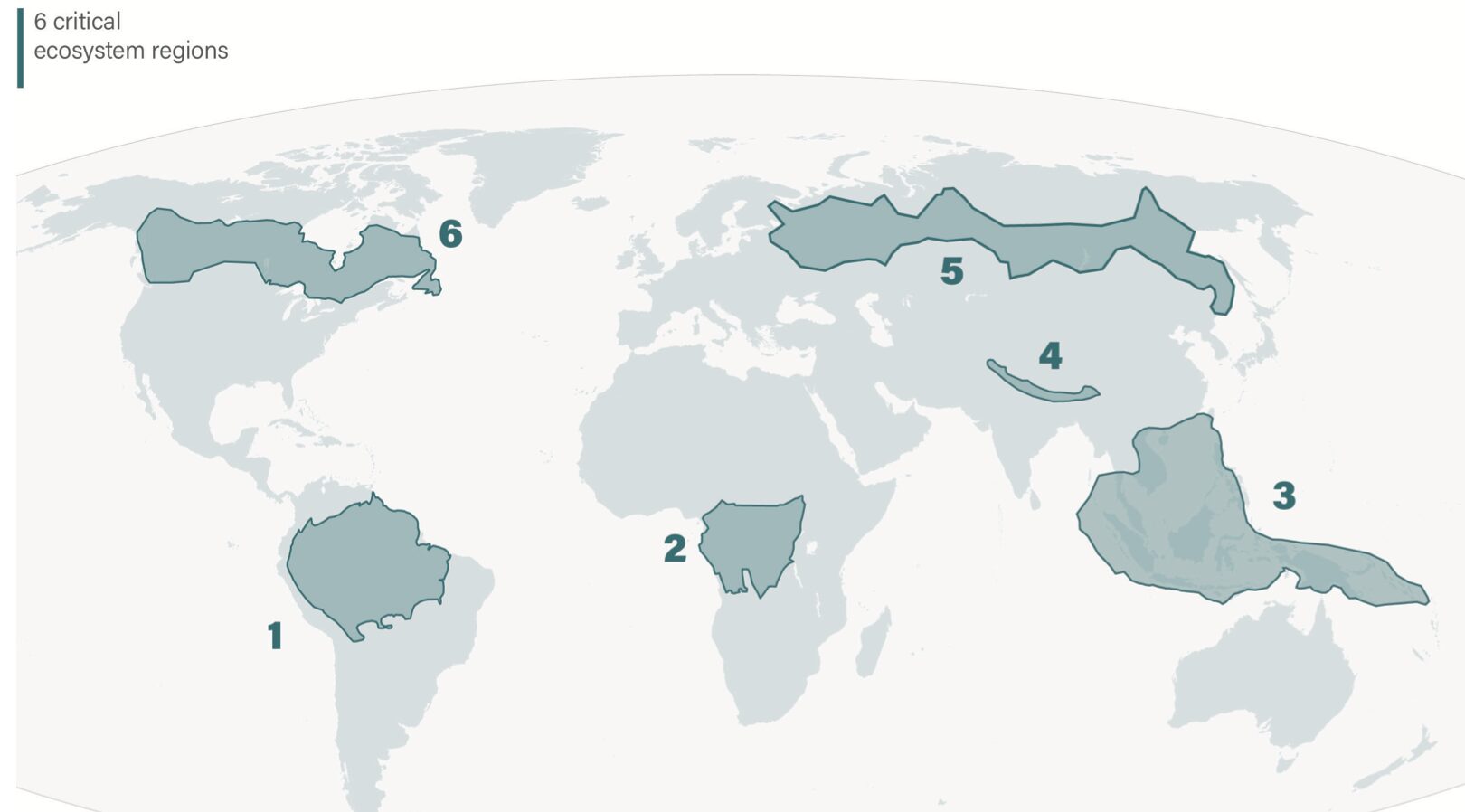
A summary, first: The Assessment’s central claim is that ‘biodiversity loss impacts national security’, heightening risks of mass migration, resource competition and geopolitical instability. More specifically, the Assessment argues that current rates of biodiversity loss mean that the world’s ‘critical ecosystems’ are all ‘on a pathway to collapse’. The report deems six ecosystems particularly critical for UK national security – the Amazon rainforest, the Congo basin, the coral reefs and mangroves of South East Asia, the Himalayas, and the boreal forests of Russia and China – and sees a ‘realistic possibility’ that some of these will collapse from 2030. The report identifies various ways in which the collapse of these ecosystems might impact UK national security, but is particularly concerned with risks to UK food imports, as well as from mass inward migration.
Cover of the report
The problem is that very little of this holds water. Consider first the question of migration. There is no evidence, so far as I am aware, that biodiversity loss increases human migration (and no such evidence is presented in the report). Moreover, five of the report’s six critical ecosystems are basically huge forested areas, three of which are populated only very sparsely – and one searches in vain in the Assessment for anything on how biodiversity loss within these sparsely populated and forested areas might drive mass human migration. Are we really to imagine that deforestation or wildlife loss within the boreal forests of northern Canada and Russia will result in mass human displacement from these regions to the UK?
The evidence on food is equally incoherent. The UK does of course depend heavily on food imports, and this may be considered an important national security vulnerability. But most of the UK’s food imports come from the EU and US, which lie outside the aforementioned critical ecosystems. And most of the imports from the latter – soya from Brazil and palm oil from Indonesia, for example – have actually been made possible by the destruction of natural ecosystems. Presenting biodiversity loss as a threat to UK food security is, in this sense, entirely the wrong way around. But on this and other such complexities, the report is completely silent.
As for biodiversity loss itself, while this is of course a hugely significant global problem, the six critical ecosystems on which the UK National Security Assessment focuses are not especially depleted; to the contrary, they all have unusually high ‘biodiversity intactness’. By contrast, the UK is, as the British government has repeatedly observed, amongst the most ‘nature depleted’ countries on earth. How come it is relatively intact ecosystems which are imagined as threats to UK national security, while the much reduced biodiversity of the UK and other developed countries are not imagined as threats at all?
Now, some of the above flaws may perhaps be explained by the UK government’s editing of the published version of the report. Indeed, the classified version of the Assessment apparently includes additional claims – about the impacts of climate change on Himalayan glaciers and thus water availability in the Indian subcontinent, about diseases which may be released by thawing permafrost, about climate-induced migration, and about UK food import dependencies. Plenty could no doubt be said on each of these themes. But crucially: none of them is about impacts resulting from biodiversity loss. They are separate issues entirely, which do nothing to substantiate the claim that ‘biodiversity loss impacts national security’.
**
How can a report like this include such glaring flaws? What explains all the non-sequiturs and silences? And how come environmentalists like Monbiot have been so easily sucked in? I think there are three main issues, all of which relate to an insufficiently politicised approach to ecology.
One is a misplaced environment-centrism, or environmental determinism. I tell my students in their very first lecture on these themes that, if they want to understand how environmental changes affect politics, migration or security, then they have to consider both environmental and social processes in tandem. But this Assessment does nothing of the sort. Instead, it presents bits of evidence on ecosystem pressures, and simply asks us to assume that these will translate into migration, food shortages and geopolitical crises. The Assessment includes not a single reference to social scientific research on these topics. If I was marking an essay with such conspicuous flaws, I would award it a fail.
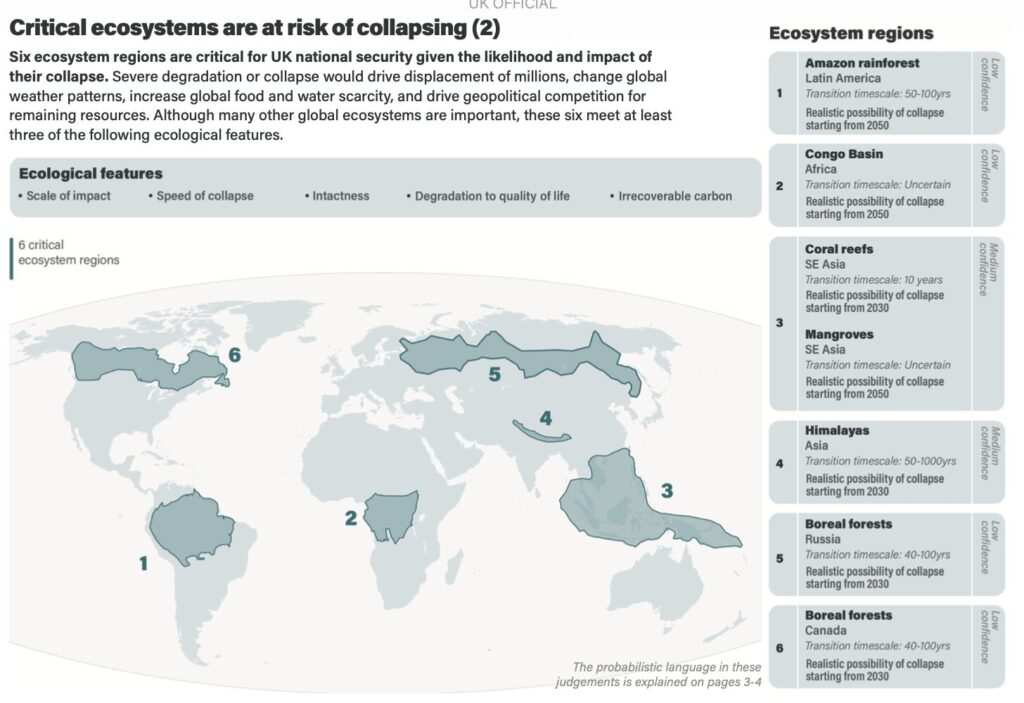
Map of the report’s focus regions
The issue of climate shocks and migration illustrates why this is so important. For, social scientific research on this issue shows that, while in some contexts floods, storms and droughts lead to increased migration, in other contexts (or at other times, or for other groups) they can lead to reduced migration, owing to reduced financial resources and migration capacities. This research thus shows that is fallacious to assume, as environment-centric work often does, that climate shocks simply or mainly increase migration. And this in turn suggests that predictions of mass climate-induced migration are similarly fallacious.
By the same token, even if biodiversity loss did have statistically significant migration consequences – and it’s a big if – there is absolutely no reason to suppose that this would translate into more rather than less migration, let alone more rather than less geopolitical conflict. Indeed, it seems reasonable to assume the exact opposite: that biodiversity loss, resulting as it does primarily from capitalist expansion and intensification, would be more closely correlated with local in-migration and population expansion than with the reverse.
But this Assessment simply assumes that out-migration and conflict will follow, which brings us to the second issue: that most tired trope of ecological thinking, Malthusianism. Malthusian thought presents crises, conflicts and above all ‘collapses’ as the inexorable consequences of demographic and environmental pressures. And this Security Assessment fits squarely in this tradition: the word ‘collapse’ appears nine times in its summary alone.
Of course, Malthusian thinking has repeatedly been debunked. Malthusianism has a terrible predictive record. It ignores the complexities of human-environment relations. It ignores and obscures the political causes of environmental destruction. It treats metaphors like ‘collapse’ and ‘tipping points’ as substitutes for analysis. And – by presenting famines and other socio-ecological crises as ‘resources of nature’, and local rural conflicts in the global South as simple responses to scarcity – it meshes all too comfortably with racist, sexist, imperial and authoritarian interests and worldviews.
I say all this having spent much of the past fifteen years interrogating Malthusian claims about the impacts of climate change, and of water scarcities, on security. There exist scores of national security studies on these topics, almost all of which envisage environmentally-induced ‘collapse’ just around the corner. But there is at least a degree of intuitive plausibility to studies of ‘water wars’ and ‘climate conflicts’ – unlike in the case of this new Assessment on biodiversity.
Which leads us to the third issue, which is that this report isn’t really a product of evidence or logic at all. For, Malthusianism is a zombie theory, which policymakers, media outlets and certain earth scientists and environmentalists keep raising from the dead despite overwhelming evidence to the contrary. Malthusian studies of the impacts of environmental change on security keep being rolled out and then lauded not because of their analytical coherence or value, but as attention-grabbing performances.
This is what happened in 2007, for example, when a raft of US national security and defence think tank assessments on the implications of climate change were released. Why then? Had new evidence suddenly emerged? No, nothing of the sort. Rather, what had happened was that various Democratic Party officials, who were understandably concerned about the Bush administration’s climate obstructionism, had decided to elicit the support of various retired military officials, and to push for increased climate action on the grounds that climate change was a security threat – a ‘threat multiplier’ – for the United States. There was no new evidence to this effect; and ‘security’ wasn’t even really their concern. Rather this was climate security as theatre – an attempt to ‘securitise’ and ‘dramatise’ the cause of climate change mitigation, by turning esteemed military figures into its advocates.
I do not know the inside story of the UK’s new National Security Assessment. But, paralleling the above example, the context to this Assessment’s appearance is a government which already has an awful record on nature and biodiversity, that has left commentators and informed experts up in arms. And clearly what has happened is that some amongst these critics have concluded that linking biodiversity with national security provides one way of fighting back, logic and evidence be dammed.

From battlefield to biosphere: a militaristic vision of climate security. Source: NATO
On one level this is all entirely understandable and valid. Politics is in large part theatre – and if ‘securitising’ biodiversity helps to embarrass the government, and perhaps even nudge them towards more progressive nature policies, then that would of course be positive. Yet other aspects of the politics of this Assessment are decidedly problematic. What is meant to distinguish experts and environmentalists from ring-wing populists is respect for facts and logic, and an unwillingness to simply reproduce and crow about those claims and narratives that fit with their own values and political agendas. If we depart from this, we are frankly little better than those right-wing anti-environmentalists spreading misinformation for their own political ends.
All of this could perhaps be forgiven if this Assessment changed anything, or had clear political or policy implications – but it does neither. That humanity is engaged in widespread biodiversity and ecosystem destruction is beyond doubt. But should we respond to this fact by turning to degrowth and anti-capitalist ideas? Or should we look to technologies and continuing economic growth for the answers? Should we promote population control? Or should governments be extolling the virtues of veganism?
And what should security and military establishments be doing? Should the UK be reviewing its defence strategies and military postures with biodiversity in mind? Should we further militarise, to protect ourselves against the imagined hordes fleeing wildlife destruction? Or should we demilitarise, given the devastating impacts that militaries and national security reasoning are having on the planet? These are all important, indeed crucial, questions. Yet this National Security Assessment provides no hint of an answer to any of them.
If we’re serious about reversing global ecological decline, let alone developing national security strategies appropriate to this challenge, then rehashed Malthusianism is not the place to begin.