
by Nicoletta Dosio
On December 8, 2025, the Italian movement against the high-speed rail (No TAV) celebrated the twentieth anniversary of the so-called Battle of Venaus, when 50,000 activists in Valsusa swarmed a worksite area for the New Lyon Turin Line. Nicoletta Dosio, a long-time activist and spokesperson for the movement, shares her recollection of those long winter nights.
This is the second contribution of a focus series on the No Tav movement and struggle coordinated by Gabriel Popham. Here is the opening post: Welcome to the valley: Landscapes of the No TAV struggle
Twenty years ago, the fields of Venaus in November were covered in snow. The snow fell hard and thick over the frozen grass, over the tents of our presidio di lotta (protest site), and over our lives, numbed yet determined to resist.
During those sub-zero days and nights, there was little we could do to keep warm, despite the fires burning in the barrels, the pots of warm drinks, the soups prepared over makeshift stoves.
And yet, the grassroots opposition to the project of the TAV (Treno ad Alta Velocità in Italian, High Speed Train) continued, growing by the minute, developing in steadfastness and awareness, becoming knowledge and collective action.
The belief in “no turning back” and that “the TAV can be stopped, it’s up to us to stop it” did not come about overnight, but instead grew out of decades of counter-information on the pointlessness of this great evil that hung over our heads, with its enormous costs, in economic terms but also in social and environmental terms.
The year 2005, which for us ended with the freezing cold of Val Cenischia (tributary valley of Valsusa, Turin Province, Piedmont region) had been an intense year of struggles across the whole valley, against the expropriation of lands and seeking to interrupt the first geognostic surveys.
It had seen the birth of the first presidio in the fields of Borgone and Bruzolo, the epic “battle of Seghino”, where, on the slopes of Rocciamelone we resisted against the first instance of armed, military occupation in Mompantero.
However, it was in Venaus, the site designated as the first victim of the worksite for the exploratory tunnel (the one that would later be drilled at Maddalena, in Chiomonte), that a ten-day-long resistance took place, which we called the “Free Republic of Venaus.”
The so-called “Battle of Venaus” was one of the high points of the thirty-year-long No TAV fight. Photo courtesy of the No TAV movement.
In that collective experience, we forged deep bonds of solidarity and inclusivity, allowing us to fight back against the repression that was becoming harsher by the day.
In Venaus, against the violence of the system and against the disinformation of mass media, we found ourselves amidst the world of ordinary people, with factory workers, farmers, university students from all over the country by our side.
The old partigiani came, the ones who had defended those very same places against everlasting fascism. Faced with the arrogance of the police state, even the mayors became movement.
The night of December 6th, the presidio was invaded by bulldozers, armored vans, batons: an army in riot gear beating people up, wreaking havoc among their tents and personal belongings, burning books and flags.
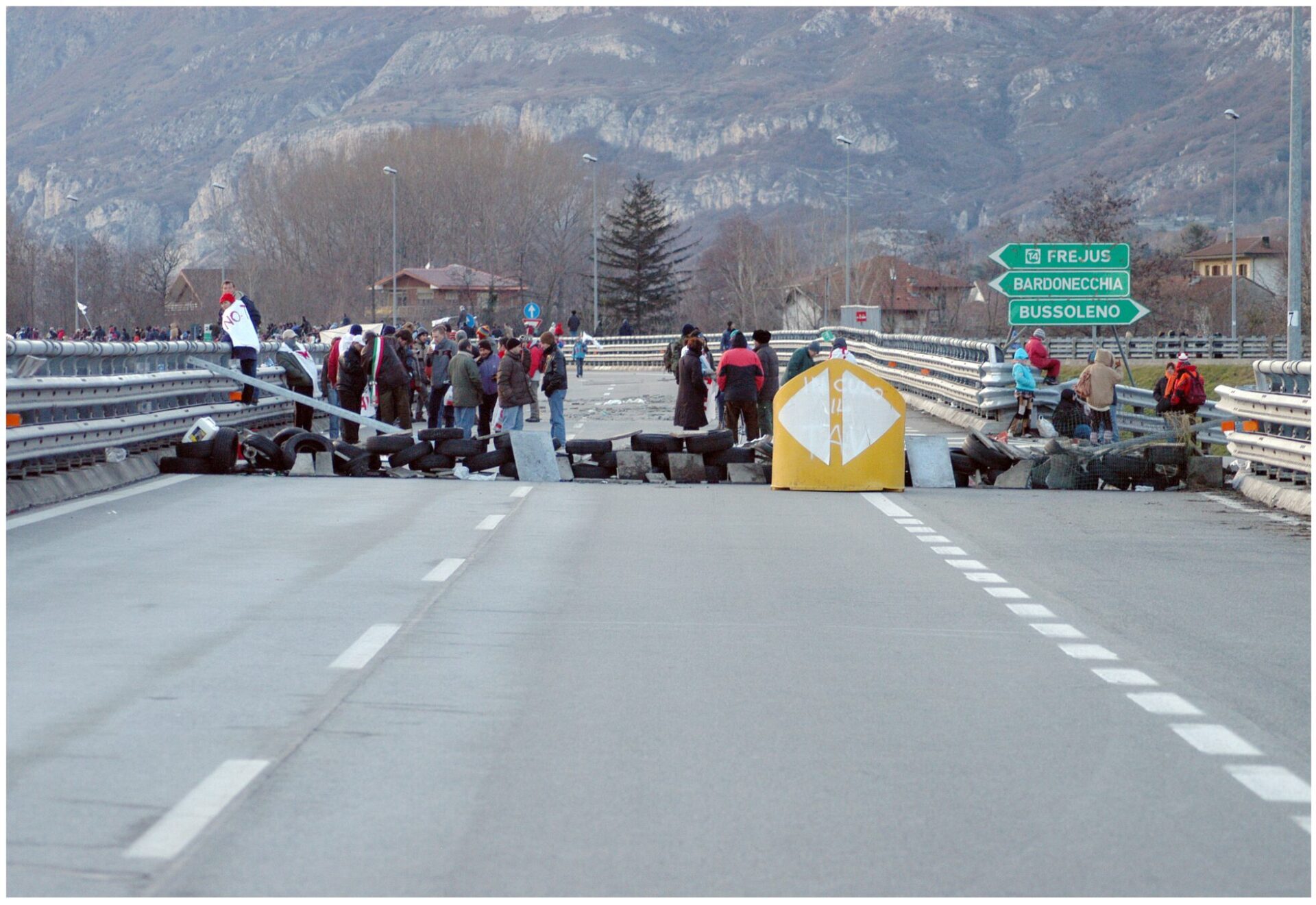
The Valley came together in a permanent assembly, and responded by raising barricades and occupying the freeways, the motorway and the railway, interrupting the circulation of the troops.
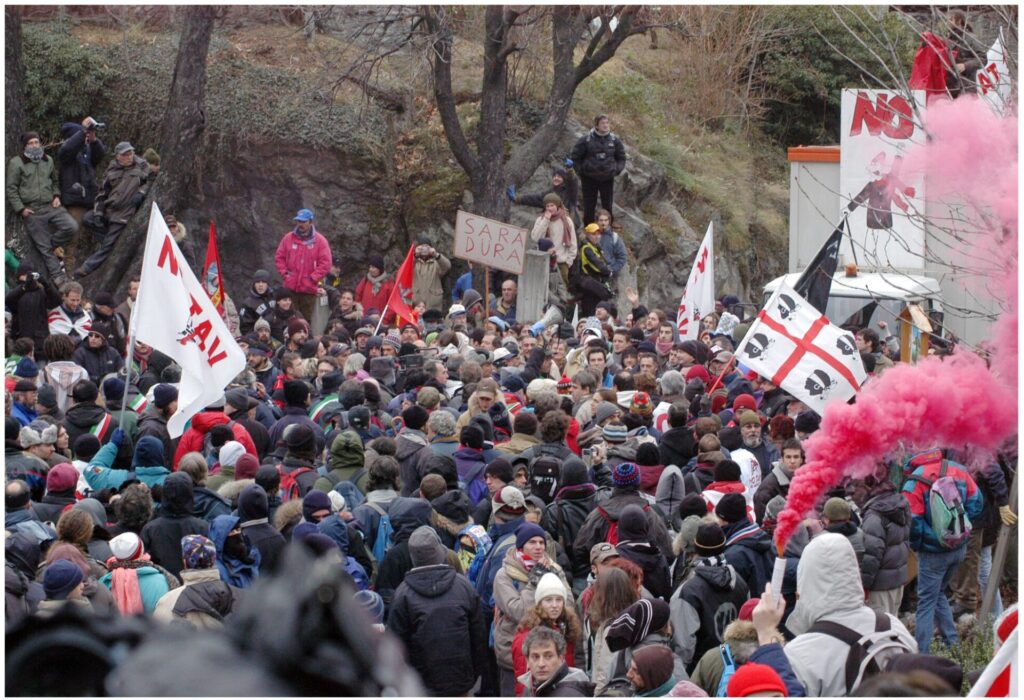
And then came the dawn of December 8th, the day that Venaus was liberated. A multitude of at least 30,000 people set off towards Val Cenischia: a silent march, with no music or slogans.
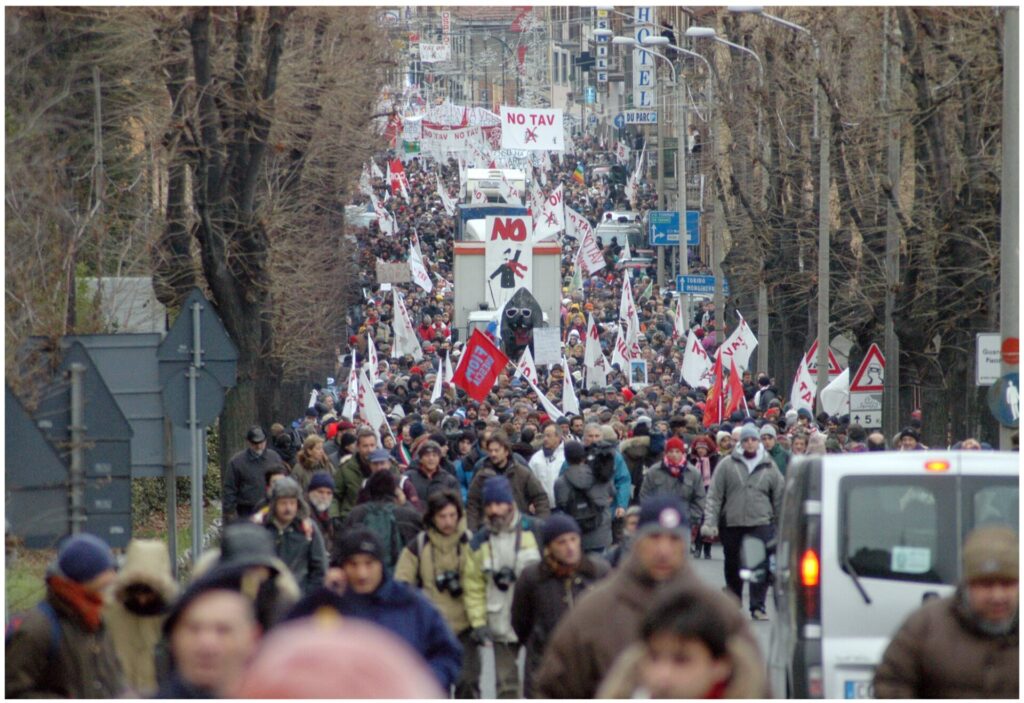
No TAV activists march to Venaus on December 8th, 2005. Photo courtesy of the No TAV movement.
At the entrance to the valley, we were met with a roadblock of police and carabinieri. The police garrison was swept aside by an avalanche of bodies, armed of nothing but their rage. And so, we took back the things that, with love and sacrifice, we had defended.
Twenty years have passed. Many who were there at the time are no longer with us. Some were taken away by the relentless passage of time, others by life’s twists and turns. But now our children and our grandchildren are here.
The struggle must go on because, even though nothing has been done to build the new train line proper, the devastation of the valley is advancing as a result of the preparatory worksites of the project.
The alliance between TELT (the company in charge of building the new train line) and Sitaf (the company that operates the Turin-Bardonecchia motorway that cuts across the valley) is an alliance of interests that is looting the valley.
And so it is that the former lorry park of Susa changes its purpose, becoming an open-cast deposit for debris filled with uranium and asbestos. Meanwhile, a new lorry pork has been built in San Didero, uprooting the woodlands that covered and neutralized the poisons left behind by the nearby steel mill.
Drills are at work in Bussoleno, between the fields and the wetlands, where a new railway bridge is in the works, part of the project to link up the new line with the existing railway line.
And the beech forest of La Maddalena is no more, wiped out by the worksite and by yet another exit on the motorway. In this way, our land loses its life, its beauty. Our memories burn.
This is war, too. The means and the intensity may be different, but the end is the same: the great interests of capital, the thirst of domination, the homicidal and ecocidal folly that denies the planet any chance of a future.
This awareness sets us in solidarity with Palestine and with all the peoples of the world who resists so that life, land, justice, equality and freedom may not be just words in vain.
In San Giuliano, the suburb of Susa where developers plan to drill the entrance to the tunnel and build a new international railway station, homes and lands have been taken away, and the demolition of the buildings is now just around the corner.
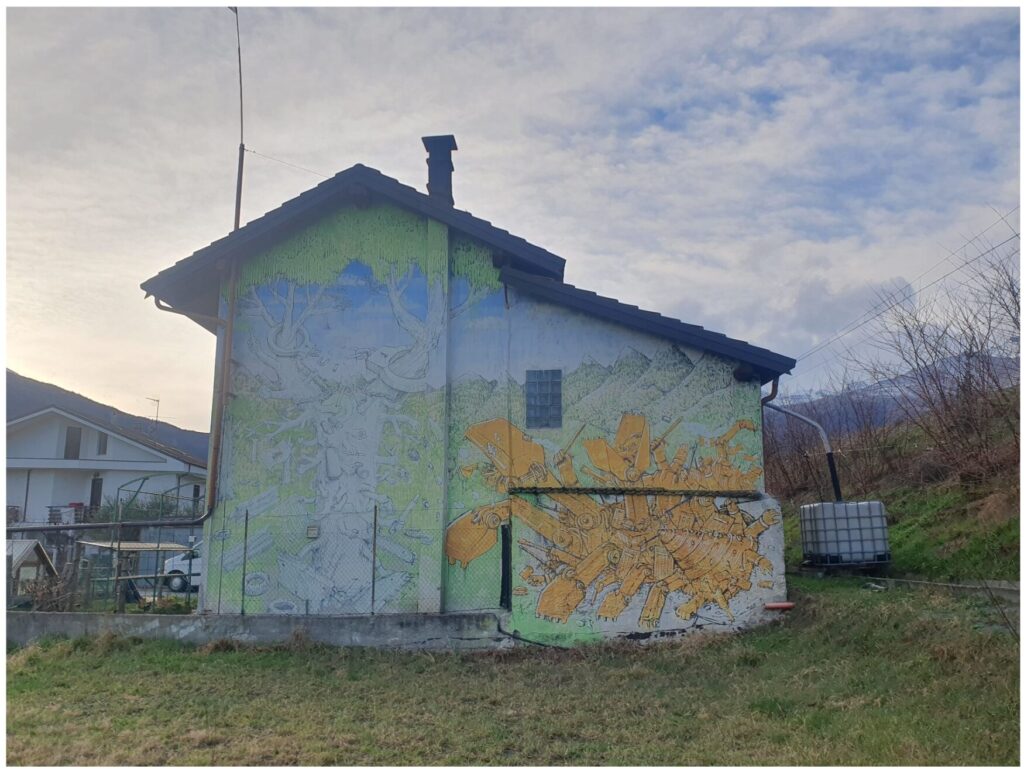
Mural piece by Blu on the wall of an expropriated house in San Giuliano, on the outskirts of Susa. Photo courtesy of the No TAV movement.
The first victim of this sacrifice will be a symbolic home: old walls built to last, an orchard, a few fruit trees, and on one side of the house, Blu’s mural piece: a great tree with branches that rip away security fences, handling wire cutters, brandishing gas masks, arms that break through shackles and set the crown free to embrace the sky.
The tree is locked in battle against a steel monster marching on caterpillar feet. A cry of revolt, our revolt. Nature defending itself. A warning against the internalization of defeat.
The image is dear to us, it represents us: this is why, at all costs, we must defend it.
Translated from Italian by Gabriel Popham. Originally published on the website of “L’Indipendente”.